This helps you quickly interpret patents by identifying the three key elements:
Problems solved by technology
Method used
Benefits of technology
Benefits of technology
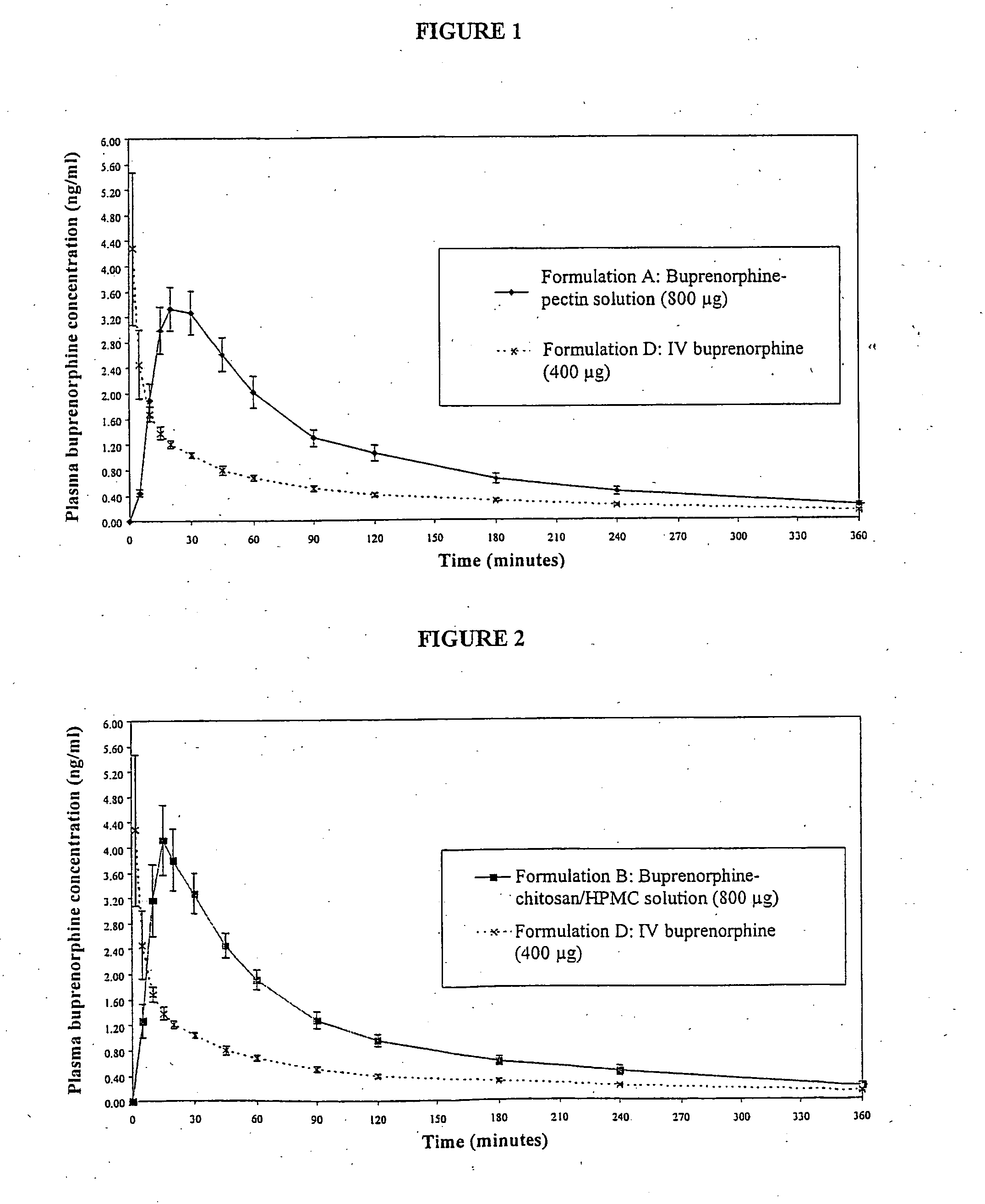
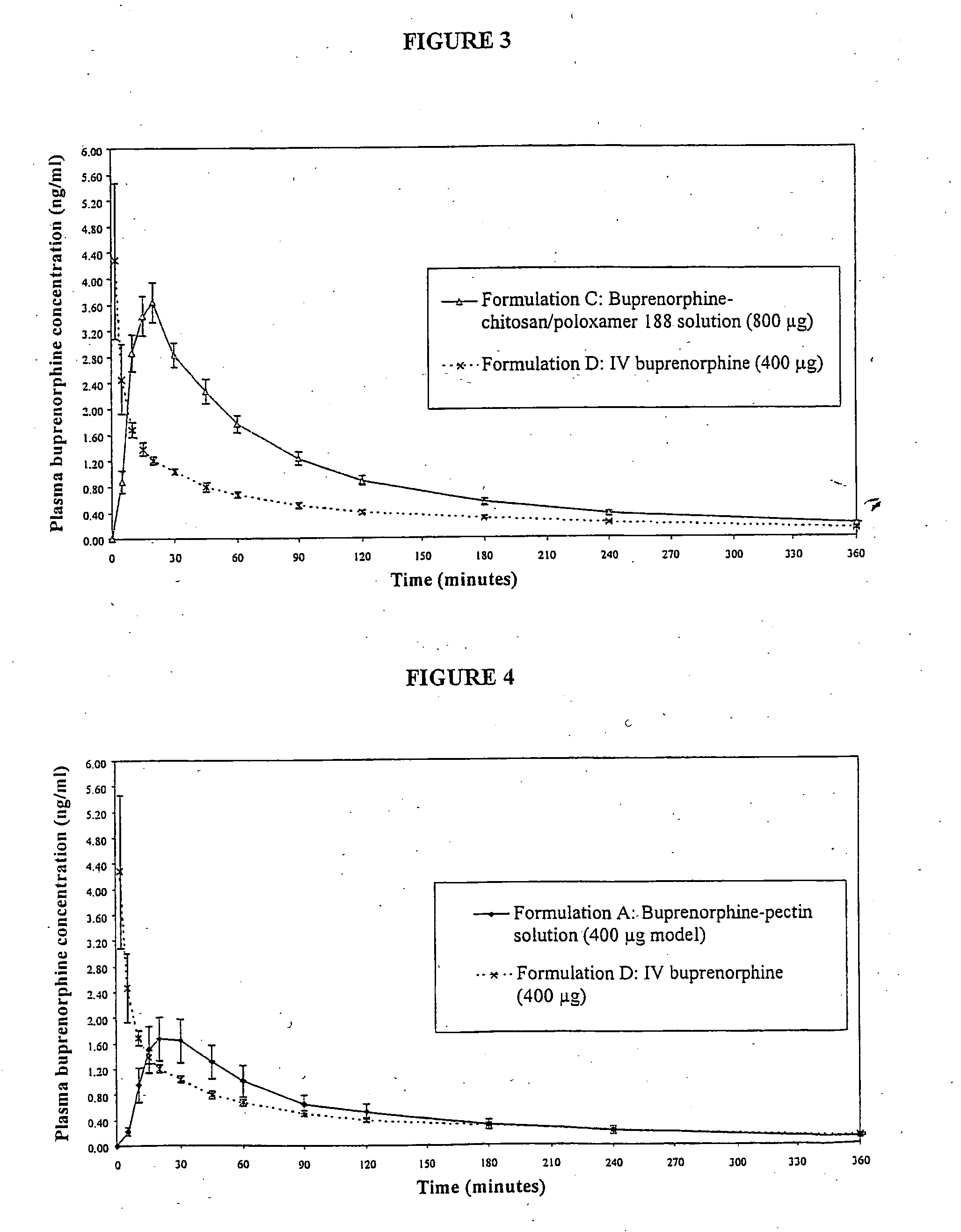
[0010] Improved buprenorphine formulations for nasal administration have now been devised. Rapid uptake of the buprenorphine across the nasal mucosa into the plasma can be achieved, which results in fast onset of analgesia. Further, the residence time of the buprenorphine in the nasal cavity can be increased, which results in prolonged analgesia. An improved profile of absorption of buprenorphine into the systemic circulation can thus be achieved by use of the formulation. Accordingly, the present invention provides:
Problems solved by technology
Rapid uptake of the buprenorphine across the nasal mucosa into the plasma can be achieved, which results in fast onset of analgesia.
Further, the residence time of the buprenorphine in the nasal cavity can be increased, which results in prolonged analgesia.
Method used
the structure of the environmentally friendly knitted fabric provided by the present invention; figure 2 Flow chart of the yarn wrapping machine for environmentally friendly knitted fabrics and storage devices; image 3 Is the parameter map of the yarn covering machine
View more
Image
Smart Image Click on the blue labels to locate them in the text.
Viewing Examples
Smart Image
Click on the blue label to locate the original text in one second.
Reading with bidirectional positioning of images and text.
[0138] 5 g of pectin (SLENDID (trade mark) 100, CP Kelco, Denmark) was dissolved by stirring into approximately 180 ml of water for injection (WFI) (Baxter, UK). 1075 mg of buprenorphine hydrochloride (MacFarlan Smith, UK) and 12.5 g of dextrose (Roquette) were dissolved into the pectin solution. 1.25 ml of phenylethyl alcohol (R. C. Treat, UK) and 50 mg of propyl hydroxybenzoate (Nipa, UK) were dissolved into the pectin / buprenorphine solution. The solution was adjusted to 250 ml using WFI. 1M hydrochloric acid (BDH, UK) was added to adjust the pH to 3.6.
[0139] The final product was a slightly turbid solution 4.3 mg / ml buprenorphine hydrochloride (corresponding to 4 mg / ml buprenorphine), 20 mg / ml pectin, 50 mg / ml dextrose, 5 μl / ml phenylethyl alcohol and 0.2 mg / ml propyl hydroxybenzoate. The pH of the solution was 3.6, as mentioned above. The osmolality of the solution was 0.46 osmol / kg.
[0141] 5 g of pectin is dissolved by stirring into approximately 180 ml of WFI. 538 mg of buprenorphine hydrochloride and 12.5 g of dextrose are dissolved into the pectin solution. 1.25 ml of phenylethyl alcohol and 50 mg of propyl hydroxybenzoate are dissolved into the pectin / buprenorphine solution. The solution is adjusted to 250 ml using WFI.
[0142] The final product is a slightly turbid solution containing 2.16 mg / ml buprenorphine hydrochloride (corresponding to 2 mg / ml buprenorphine), 20 mg / ml pectin, 50 mg / ml dextrose, 5 μl / ml phenylethyl alcohol and 0.2 mg / ml propyl hydroxybenzoate.
[0143] 123 μl of the above solution is filled into a Valois Monospray single dosenasal spray device (Pfeiffer, Germany). Actuation of the device will deliver a dose of 100 μl of liquid containing 200 μg of buprenorphine and 2 mg of pectin.
[0144] 0.75 g of HPMC (Methocel (trade mark) E4M, Colorcon, UK) was dispersed into approximately 125 ml of pre-heated (70-80° C.) water for injection (WFI) (Baxter, UK). The HPMC dispersion was stirred in an ice bath until a clear solution had formed. 1.25 g of chitosan glutamate (Protosan (trade mark) UPG213, Pronova, Norway) was dissolved in the HPMC solution. 75 mg of 50% w / w benzalkonium chloride solution (Albright and Wilson, UK) was dispersed in 10 ml of WFI and transferred with an additional 40 ml of WFI to a 250 ml volumetric flask. 1075 mg of buprenorphine hydrochloride (MacFarlan Smith, UK) and 12.5 g of dextrose (Roquette, UK) were transferred into the volumetric flask. The chitosan / HPMC solution and an additional 40 ml of WFI were added to the flask. The solution was adjusted to pH 3.4 using 1M hydrochloric acid solution (BDH, UK) and the flask contents adjusted to 250 ml using WFI.
[0145] The final pro...
the structure of the environmentally friendly knitted fabric provided by the present invention; figure 2 Flow chart of the yarn wrapping machine for environmentally friendly knitted fabrics and storage devices; image 3 Is the parameter map of the yarn covering machine
Login to View More
PUM
Property
Measurement
Unit
Fraction
aaaaa
aaaaa
Fraction
aaaaa
aaaaa
Time
aaaaa
aaaaa
Login to View More
Abstract
Aqueous formulations suitable for intranasal administration comprise buprenorphine or a physiologically acceptable salt or ester thereof and (a) a pectin having a degree of esterification of less than 50%, (b) chitosan and a polyoxyethylene-polyoxypropylene copolymer (poloxamer) or (c) chitosan and hydroxypropylmethylcellulose. Such formulations can induce rapid and prolonged analgesia when delivered intranasally to a patient. The buprenorphine or buprenorphine salt or ester may be delivered to the bloodstream to produce within 30 minutes a therapeutic plasma concentration of buprenorphine, Cther, of 0.2 ng / ml or greater which is maintained for a duration Tmaint of at least 2 hours.
Description
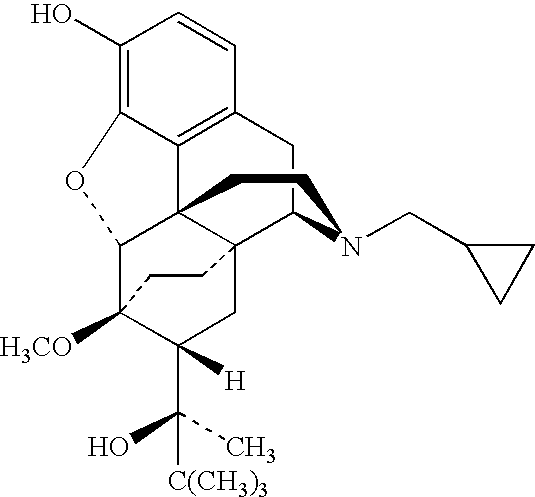
FIELD OF THE INVENTION [0001] The invention relates to pharmaceutical formulations of buprenorphine and physiologically acceptable salts and esters thereof. BACKGROUND OF THE INVENTION [0002] The term opioid (or opiate) defines drugs with morphine-like properties. Opioids can be sub-classified on the basis of their receptor specificity. Mu-agonist opioids provide intense analgesia. These opioids can be long-acting (e.g. methadone) or short-acting (e.g. remifentanil). [0003] Mixed agonist / antagonist opioids (e.g. butorphanol and buprenorphine) are partial agonists (the former at mu and kappa receptors and the latter at the mu receptor) and can produce good quality analgesia. They produce less respiratory depression and constipation than high efficacy mu agonists. [0004] Buprenorphine (CAS RN 52485-79-7; [5α,7α(S)-17-(Cyclopropylmethyl)-α-(1,1-dimethylethyl)-4,5-epoxy-18,19-dihydro-3-hydroxy-6-methoxy-α-methyl-6,14-ethenomorphinan-7-methanol) has the formula: [0005] The hydrochloride...
Claims
the structure of the environmentally friendly knitted fabric provided by the present invention; figure 2 Flow chart of the yarn wrapping machine for environmentally friendly knitted fabrics and storage devices; image 3 Is the parameter map of the yarn covering machine
Login to View More
Application Information
Patent Timeline
Application Date:The date an application was filed.
Publication Date:The date a patent or application was officially published.
First Publication Date:The earliest publication date of a patent with the same application number.
Issue Date:Publication date of the patent grant document.
PCT Entry Date:The Entry date of PCT National Phase.
Estimated Expiry Date:The statutory expiry date of a patent right according to the Patent Law, and it is the longest term of protection that the patent right can achieve without the termination of the patent right due to other reasons(Term extension factor has been taken into account ).
Invalid Date:Actual expiry date is based on effective date or publication date of legal transaction data of invalid patent.


 Login to View More