
Emulsion composite
a technology of emulsion and composite, which is applied in the direction of oil/fat/waxes non-active ingredients, other chemical processes, perfume formulations, etc., can solve the problems of fat embolism, thrombosis, and deep vein thrombosis, and achieves superior dispersibility of oil drop particles and stability
- Summary
- Abstract
- Description
- Claims
- Application Information
AI Technical Summary
Benefits of technology
Problems solved by technology
Method used
Image

Examples
example 1-1
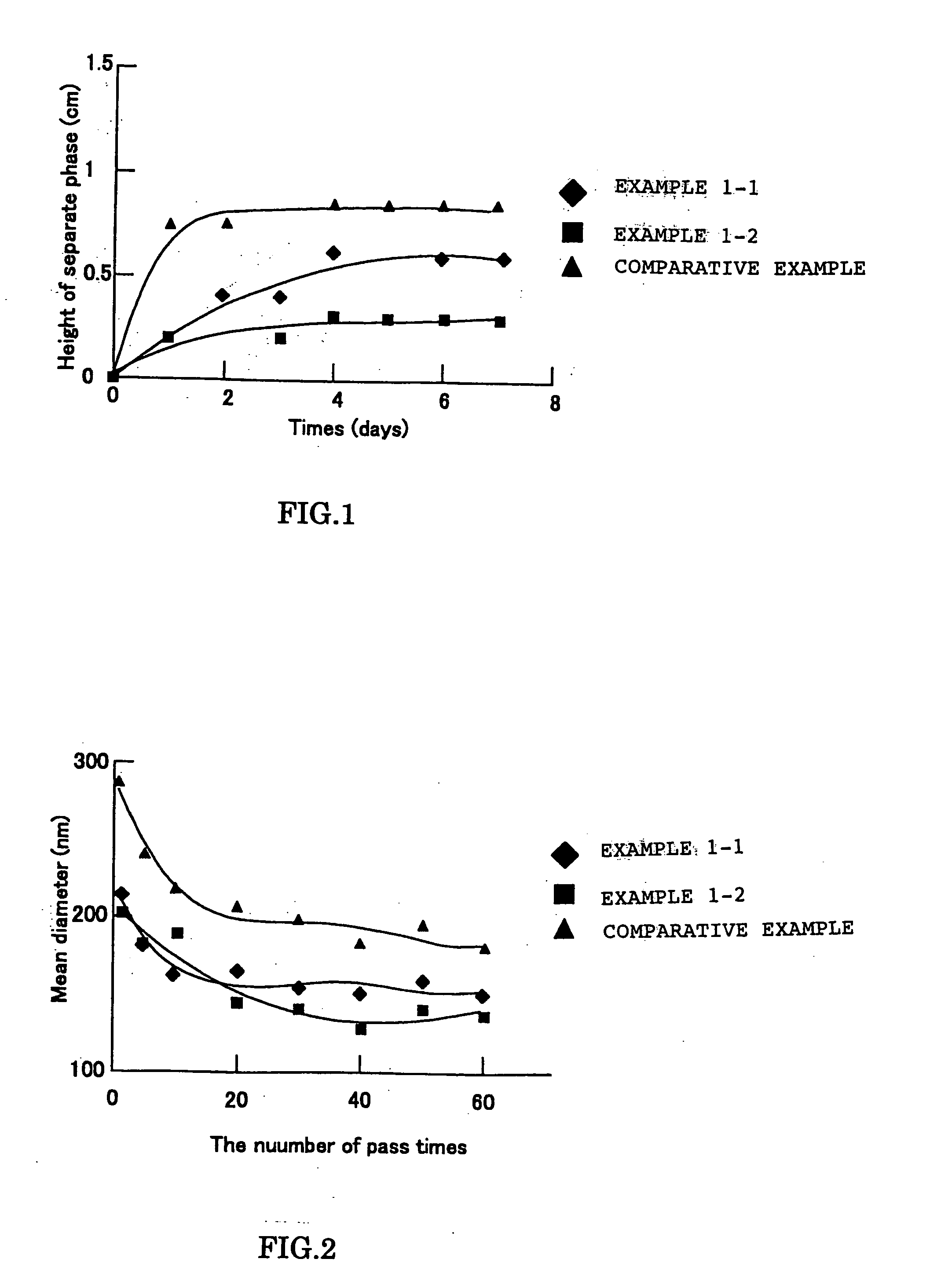
[0025] First, 20 g of soybean oil and 2.4 g of glycerin were mixed by being stirred with a magnetic stirrer (HS-4SP, manufactured by iuchi). The mixture was added to S-100 (trade name for a product manufactured by K.K. A. I. System Product) which is strong alkali ionic water and super-reductive water to adjust the total amount to 200 g. The solution was subjected to primary emulsification in a boiling water bath at 12,765 rpm for a stirring time of 30 minutes using T. K. Autohomomixer TYPE. M (trade name for a machine manufactured by Tokushu Kika Kogyo K.K.).
[0026] After the primary emulsification was completed, necessary amounts of strong alkali ionic water (S-100) and glycerin were added such that the volume became 200 ml and the osmotic pressure became 278 mOsm.
[0027] Further, the sample was subjected to secondary emulsification at a pressure of 1,000 bar with 40 pass times using a high-pressure homogenizer (GEO Niro Soavi S.p. A Via M. da Erva Edoari, 29A / A-43100 PARMA ITALY T...
example 1-2
[0028] First, 2.4 g of lecithin (surfactant) was completely dissolved in a small amount of ethanol, and 20 g of soybean oil and 2.4 g of glycerin were then added. The mixture was uniformly stirred with a magnetic stirrer. Ethanol was then removed with an evaporator (BUCHI Vacuum Controller B-720).
[0029] The mixed sample was then added to 175.2 g of strong alkali ionic water to adjust the total amount to 200 g. Primary emulsification was conducted in a boiling water bath at 12,765 rpm for a stirring time of 30 minutes using T. K. Autohomomixer. After the primary emulsification was completed, a necessary amount of strong alkali ionic water (S-100) was added such that the volume became 200 ml.
[0030] Further, the sample was subjected to secondary emulsification at a pressure of 1,000 bar with 40 pass times using a high-pressure homogenizer to prepare an O / W emulsion (emulsion composite).
[0031] In EXAMPLE 1, the following emulsion composite was prepared as a comparative example.
PUM
| Property | Measurement | Unit |
|---|---|---|
| particle diameter | aaaaa | aaaaa |
| mean particle diameter | aaaaa | aaaaa |
| particle diameter | aaaaa | aaaaa |
Abstract
Description
Claims
Application Information
 Login to View More