Volume bragg lasers based on high efficiency diffractive elements in photo-thermo-refractive glass

a diffractive element and volume bragg technology, applied in the direction of laser optical resonator construction, laser details, optical resonator shape and construction, etc., can solve the problems of increased optical losses, injection wavelength locking meets some serious problems, and significant radiation outside the narrow spectral region is not acceptable for highly efficient pumping systems. , to achieve the effect of high efficiency diffractive optical elements and lasers increased brightness

a diffractive element and volume bragg technology, applied in the direction of laser optical resonator construction, laser details, optical resonator shape and construction, etc., can solve the problems of increased optical losses, injection wavelength locking meets some serious problems, and significant radiation outside the narrow spectral region is not acceptable for highly efficient pumping systems. , to achieve the effect of high efficiency diffractive optical elements and lasers increased brightness

US20050207466A1Inactive Publication Date: 2005-09-22UNIV OF CENT FLORIDA RES FOUND INC

Image

Smart Image Click on the blue labels to locate them in the text.
Viewing Examples
Smart Image
  • Volume bragg lasers based on high efficiency diffractive elements in photo-thermo-refractive glass
  • Volume bragg lasers based on high efficiency diffractive elements in photo-thermo-refractive glass
  • Volume bragg lasers based on high efficiency diffractive elements in photo-thermo-refractive glass

Examples

Experimental program
Comparison scheme
Effect test

Embodiment Construction

[0053] Before explaining the disclosed embodiments of the present invention in detail it is to be understood that the invention is not limited in its application to the details of the particular arrangements shown since the invention is capable of other embodiments. Also, the terminology used herein is for the purpose of description and not of limitation.

[0054] The following is a list of reference numerals used in the drawings and the detailed description of the preferred embodiment to identify components.

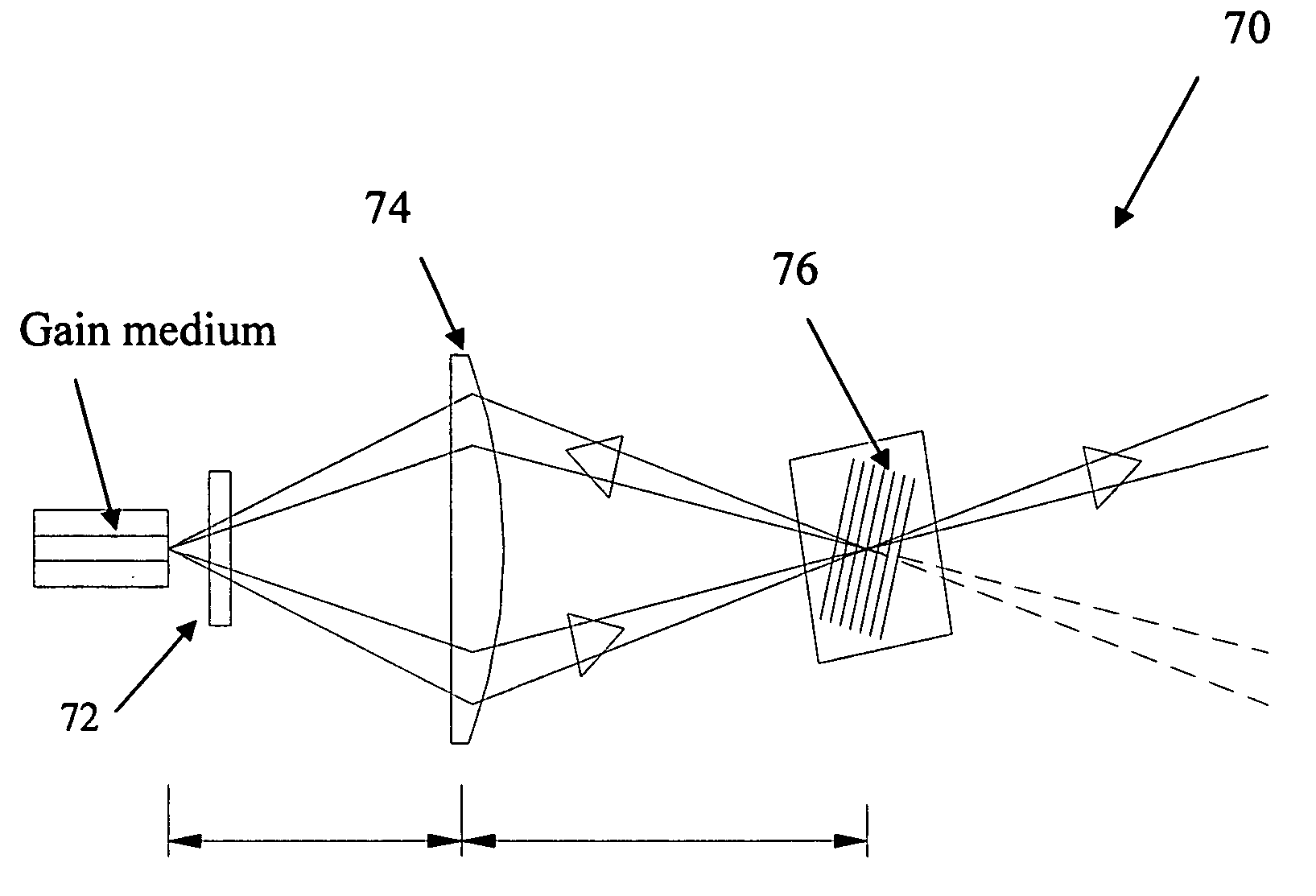
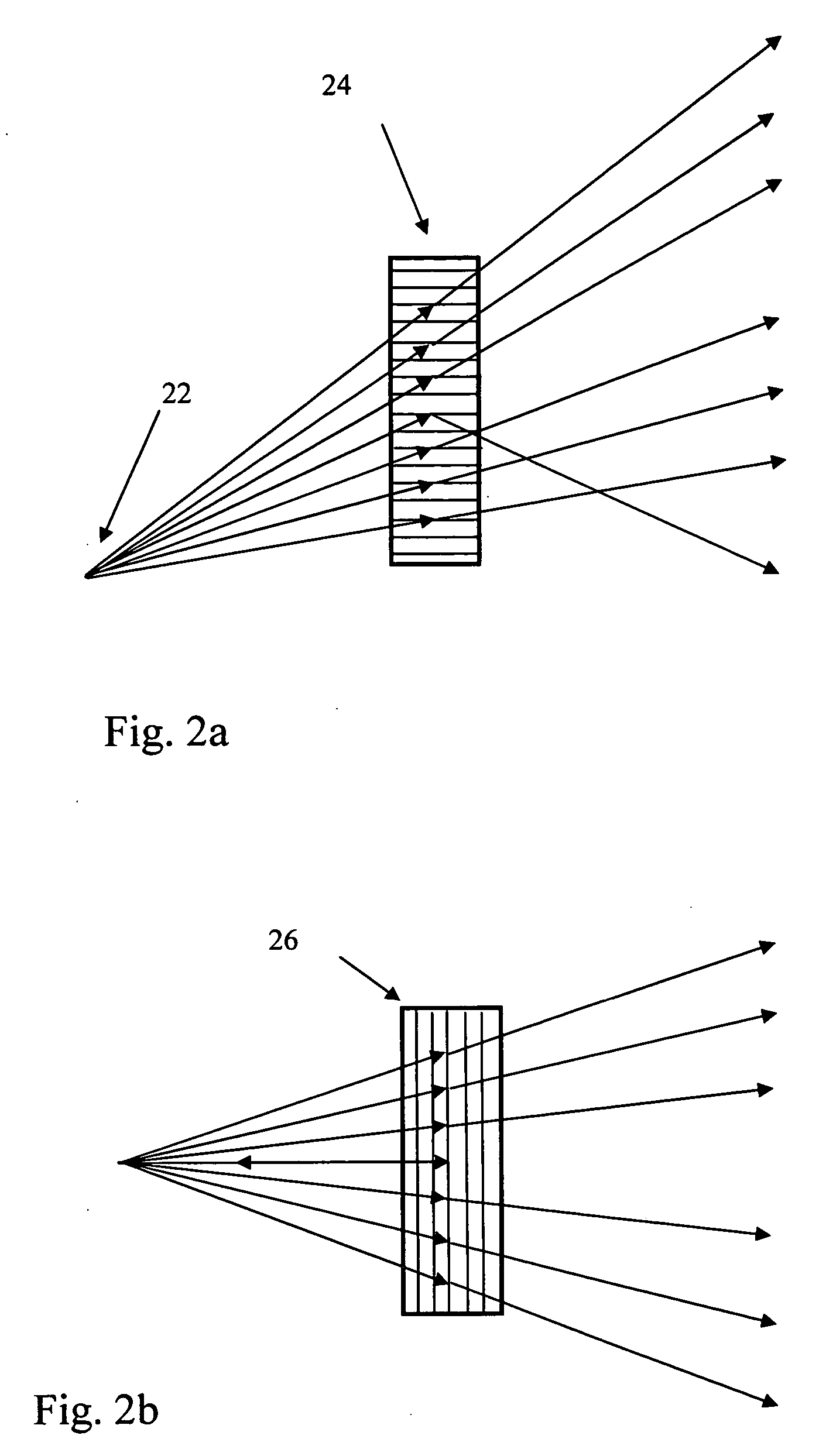
22Beam24Transmitting Bragg grating26Reflecting Bragg grating42Bragg grating43Diffracted radiation44Collimator45Gain medium46Bottom mirror48Top mirror49Output radiation60External resonator62Reflecting volume Bragg grating64Collimating lens65Gain medium70External resonator72Lens74Lens76Bragg grating100Multi-channel Bragg coupledlaser122Bragg grating124Laser126Laser128Mirror130Output beam150Multi-channel Bragg chain laser152Bragg grating154Lasing emitter156Lasing emitter158Single o...

the structure of the environmentally friendly knitted fabric provided by the present invention; figure 2 Flow chart of the yarn wrapping machine for environmentally friendly knitted fabrics and storage devices; image 3 Is the parameter map of the yarn covering machine
Login to View More

PUM

No PUM Login to View More

Abstract

A volume Bragg laser including a resonator comprising photo-thermo-refractive (PTR) volume diffractive elements that can be used in a laser emitting window of transparency of PTR glass to provide control of the lasers spectral and angular parameters, and methods, devices, apparatus and systems related thereto. The high efficiency volume Bragg gratings recorded in photo-thermo-refractive (PTR) glass preferably has an absolute diffraction efficiency exceeding approximately 95% in transmitting and reflecting modes is used for selection of a transverse and longitudinal mode for thermal, optical and mechanical stabilization of the volume Bragg lasers and coherent coupling of different lasers. Robustness, compactness, thermal and laser stability along with the ability to place several elements in the same space allows the use of sophisticated optical system according to the invention in fields of military lasers, optical communications, data storage and processing, and the like.

Description

[0001] This invention is a Continuation-In-Part of U.S. patent application Ser. No. 10 / 665,339 filed Sep. 19, 2003, which is a Continuation-In-Part of U.S. patent application Ser. No. 09 / 750,708 filed Dec. 28, 2000, now U.S. Pat. No. 6,673,497, which is a Continuation-In-Part of U.S. patent application Ser. No. 09 / 648,293 filed on Aug. 24, 2000, now U.S. Pat. No. 6,586,141 which claimed priority from U.S. Provisional Application Ser. No. 60 / 174,432 filed Jan. 4, 2000, by the same assignee as that of the subject invention, and further claims the benefit of priority from U.S. Provisional Application Ser. No. 60 / 606,280 filed on Aug. 31, 2004, and was funded by the Air Forces Research Laboratory contract No. HR-01-1041-0004.FIELD OF THE INVENTION [0002] This invention relates to diffractive optical elements and more specifically those diffractive optical elements produced from photosensitivity photo-thermo-refractive (PTR) glass with absolute diffractive efficiency exceeding 95% and th...

Claims

the structure of the environmentally friendly knitted fabric provided by the present invention; figure 2 Flow chart of the yarn wrapping machine for environmentally friendly knitted fabrics and storage devices; image 3 Is the parameter map of the yarn covering machine
Login to View More

Application Information

Patent Timeline
22 Sep 2005
Publication
US20050207466A1
IPC
H01S3/10; H01S5/14; H01S5/40
CPC
H01S5/40; H01S5/141
Inventors
GLEBOV, LEONID B.; SMIRNOV, VADIM I.