
Apparatus and methods for reducing embolization during treatment of carotid artery disease
a technology of carotid artery disease and appendix, which is applied in the direction of prosthesis, catheter, guide wire, etc., can solve the problems of subclinical cerebral damage, ischemic stroke, endovascular treatment, and especially prone to embolism, so as to reduce the risk
- Summary
- Abstract
- Description
- Claims
- Application Information
AI Technical Summary
Benefits of technology
Problems solved by technology
Method used
Image

Examples
Embodiment Construction
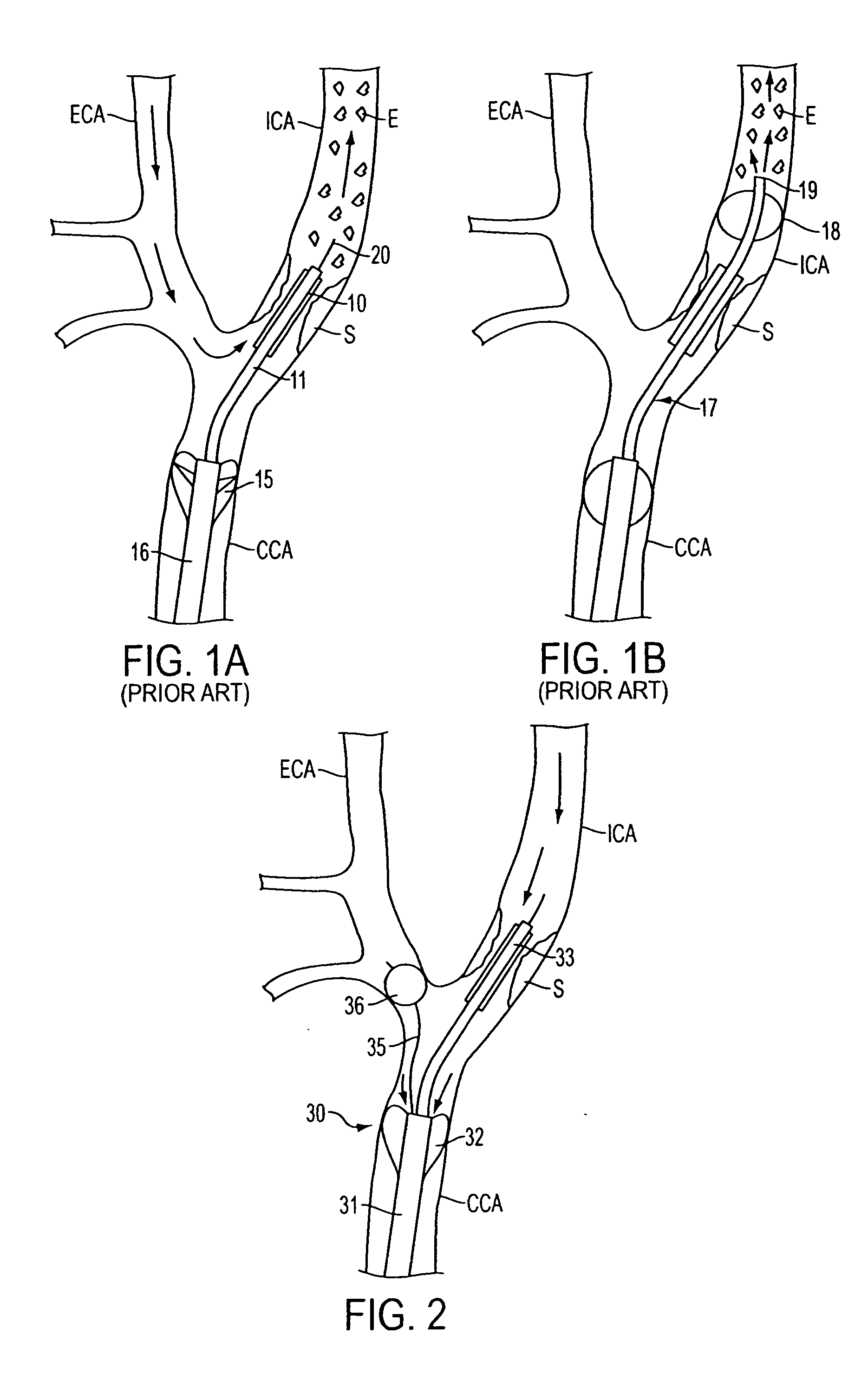
[0041] Referring to FIGS. 1A and 1B, drawbacks of previously known emboli removal catheters are described with reference to performing percutaneous angioplasty of stenosis S in common carotid artery CCA.
[0042] With respect to FIG. 1A, drawbacks associated with naturally-aspirated emboli removal systems, such as described in the above-mentioned patent to Solano and European Patent Publication, are described. No flow reversal is induced by those systems until after balloon 10 of angioplasty catheter 11 first is passed across the stenosis, inflated, and then deflated. However, applicant has determined that once member 15 of emboli removal catheter 16 is inflated, flow within the ECA reverses and provides antegrade flow into the ICA, due to the lower hemodynamic resistance of the ICA. Consequently, emboli E generated while passing guide wire 20 or catheter 11 across stenosis S may be carried irretrievably into the cerebral vasculature, before flow in the vessel is reversed and directed...
PUM
| Property | Measurement | Unit |
|---|---|---|
| movement | aaaaa | aaaaa |
| atmospheric pressure | aaaaa | aaaaa |
| pressure | aaaaa | aaaaa |
Abstract
Description
Claims
Application Information
 Login to View More