Signaling in a wireless network with sequential coordinated channel access

a wireless network and channel access technology, applied in the field of access control and signaling in wireless local area networks, can solve the problems of high signaling overhead, deterioration of throughput, and strict, fine-grained time synchronization of tdma-based methods, so as to achieve more powerful and efficient, maintain simplicity and backward compatibility, and provide extensibility and flexibility

US20060034219A1Inactive Publication Date: 2006-02-16MITSUBISHI ELECTRIC RES LAB INC
1 Cites 81 Cited by

Patent Information

Authority / Receiving Office
US · United States
Patent Type
Applications(United States)
Current Assignee / Owner
Publication Date
2006-02-16
Estimated Expiration
Not applicable · inactive patent

Smart Images

  • Figure 1
    Figure 1
  • Figure 2
    Figure 2
  • Figure 3
    Figure 3
Patent Text Reader

Abstract

A method signals data in a channel of a network including multiple stations and an access point connected by a wireless channel. A station first requests access to the channel using a sequential coordinated channel access method of an access point. After the station receives permission to access the channel during a contention free period at a time corresponding to a sequence index value received by the station from the access point, the station transmits a resource request message to the access point to obtain a bandwidth allocation. In response, the station receives the bandwidth allocation, and the station can then transmit data during the contention free period according to the bandwidth allocation.
Need to check novelty before this filing date? Find Prior Art

Description

FIELD OF THE INVENTION

[0001] This invention relates generally to wireless networks, and more particularly to access control and signaling in wireless local area networks. BACKGROUND OF THE INVENTION

[0002] In a wireless local area network (WLAN) according to the IEEE 802.11 standard, an access point (AP) in a cell coordinates packet transmission for all stations associated with the cell. A single wireless channel, i.e., frequency band, is shared by both the uplink from the station to the AP, and the downlink from the AP to the station for all data and control signals. Every station can communicate with the AP, whereas it is not required for any two stations to be within communication range of each other.

[0003] The transmission rate of the wireless channel can vary, depending on a perceived signal-to-noise ratio (SNR). For example, the physical layer of the IEEE 802.11b standard supports four rates at 1 Mbps, 2 Mbps, 5.5 Mbps and 11 Mbps.

[0004] IEEE 802.11e HCCA

[0005] To support ...

Examples

Embodiment Construction

[0031] The invention provides a signaling method for a wireless network that uses SCCA as described in U.S. patent application Ser. No. 10 / 888,398, “Sequential Coordinated Channel Access in Wireless Networks,” filed on Jul. 9, 2004, by Yuan et al., incorporated herein by reference in its entirety.

[0032] The signaling method for the SCCA method includes the following procedures: resource reservation, resource allocation, resource renegotiation, and resource relinquishment.

[0033] Signaling Method

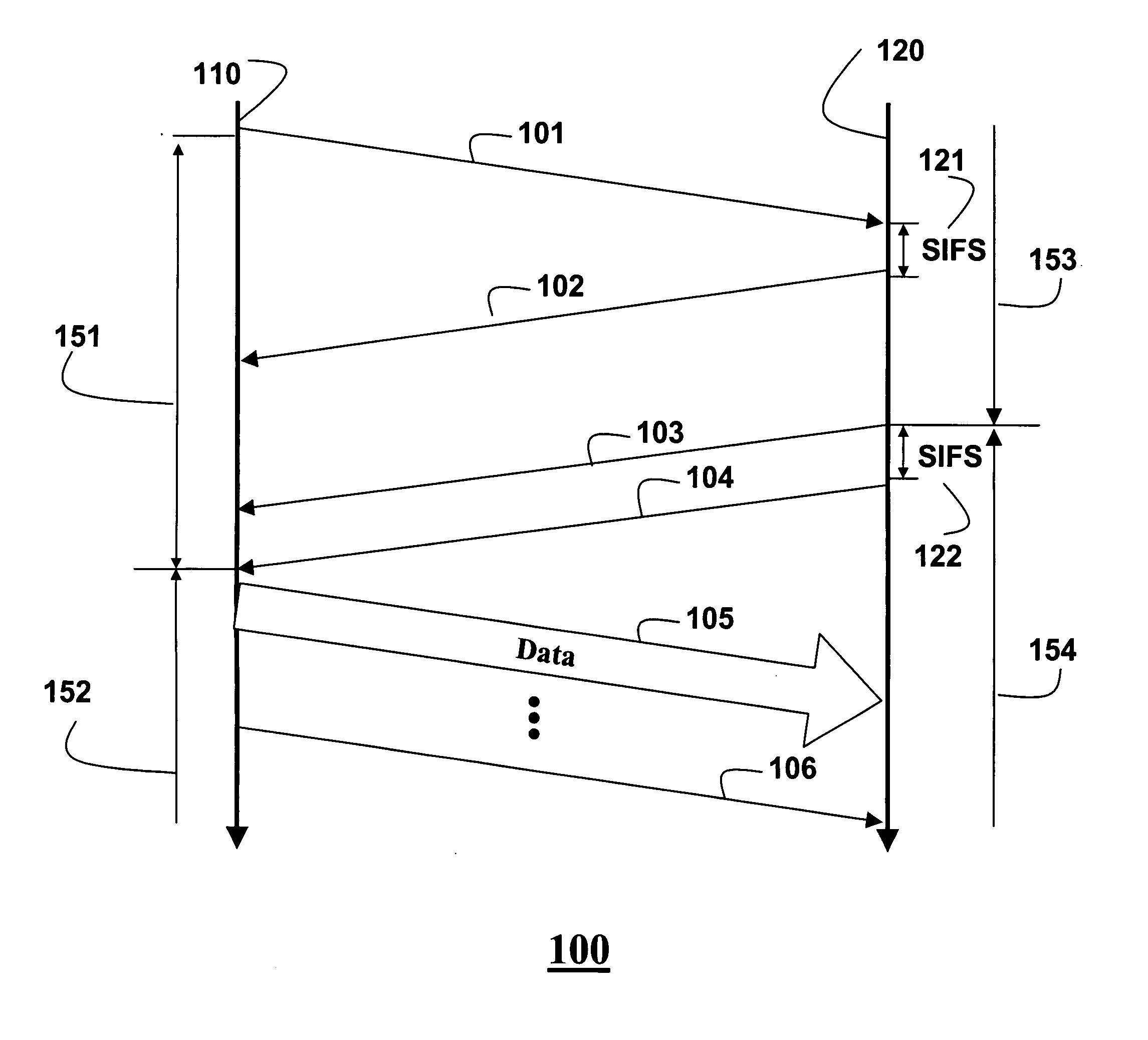
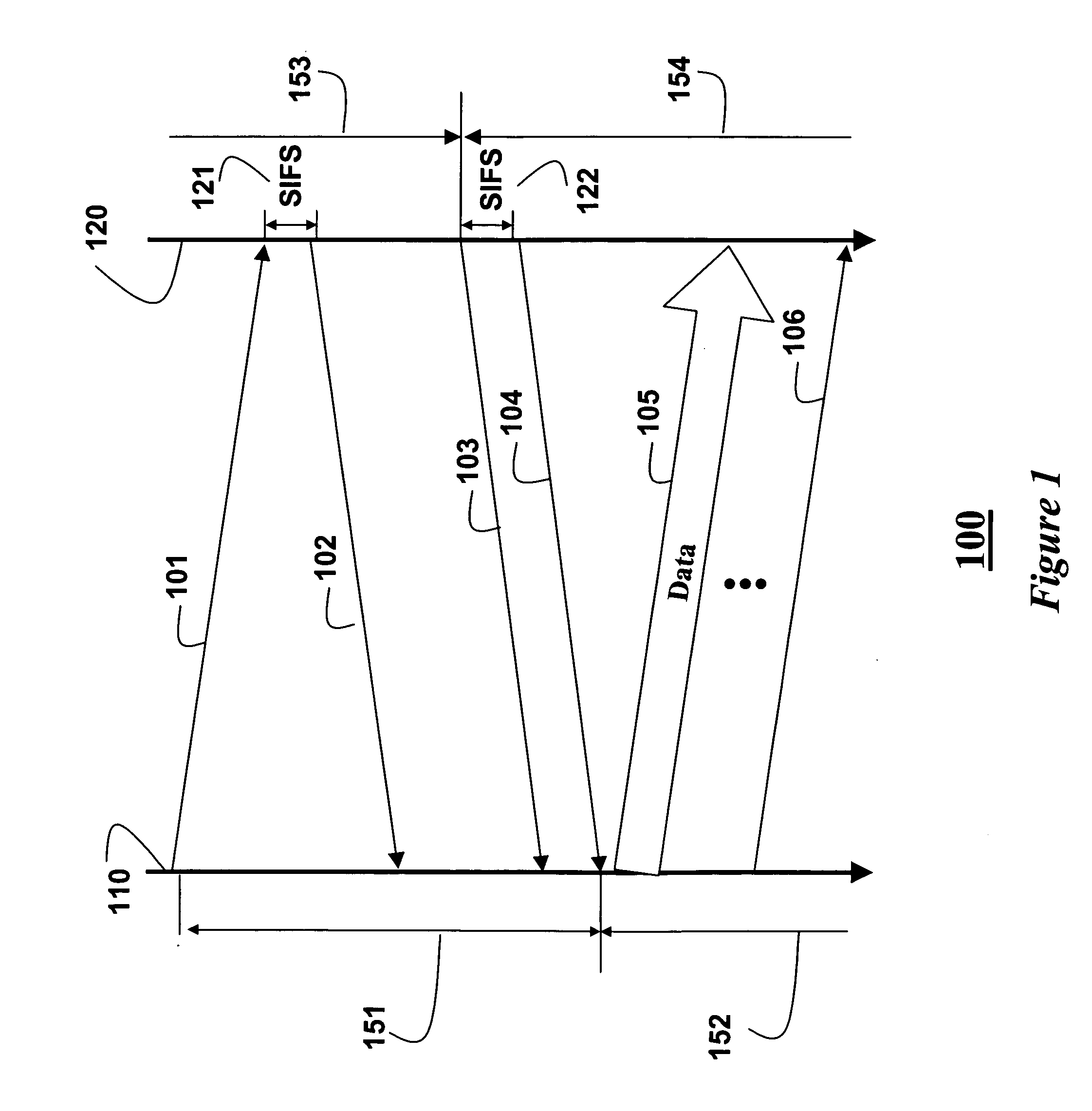
[0034] As shown in FIG. 1, a resource management method 100 includes a station (STA) 110 having a resource reservation and allocation period 151, and a data transmission period 152. An access point (AP) 120 has an adaptive distributed channel access (ADCA) period 153, and a sequential coordinated channel access (SCCA) period 154. In FIG. 1, time increases from top to bottom.

[0035] Resource Reservation

[0036] To request bandwidth, the station 110 sends a resource request message (RRQ) 101 t...