Use of physical barriers to minimize evaporative heat losses

Active Publication Date: 2006-07-20
PALO ALTO RES CENT INC
View PDF16 Cites 28 Cited by
  • Summary
  • Abstract
  • Description
  • Claims
  • Application Information

AI Technical Summary

Problems solved by technology

The temperature rise due to the reaction is typically very small and any loss of heat, for example via heat dissipation, can affect the results of the tests.
Evaporation from the samples can lead to heat effects that are significant compared to the enthalpic changes of interest when the samples, e.g. drops, are small.
When the heat flux from evaporation becomes too large compared to the enthalpic change of interest in a measurement, the evaporation becomes a problem.
In drug discovery or life sciences research, samples often are precious, either because they are difficult to make or are derived from a limited resource.
Samples are sometimes not even fully characterized, rendering it unfeasible to make more of the material “on demand”.
As examples, miniature devices in which thermal effects are used to actuate or move species therein, or in which precise assays require precise control of sample volume, can be adversely affected by evaporation.

Method used

the structure of the environmentally friendly knitted fabric provided by the present invention; figure 2 Flow chart of the yarn wrapping machine for environmentally friendly knitted fabrics and storage devices; image 3 Is the parameter map of the yarn covering machine
View more

Image

Smart Image Click on the blue labels to locate them in the text.
Viewing Examples
Smart Image
  • Use of physical barriers to minimize evaporative heat losses
  • Use of physical barriers to minimize evaporative heat losses
  • Use of physical barriers to minimize evaporative heat losses

Examples

Experimental program
Comparison scheme
Effect test

Embodiment Construction

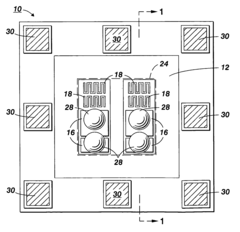
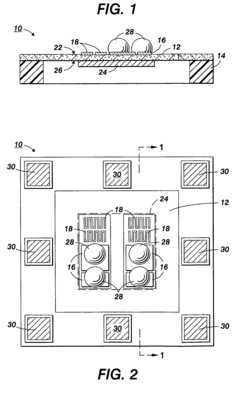
[0030] With reference to FIG. 1, this embodiment of a calorimeter 10 includes a membrane or substrate 12 mounted on a support 14. The substrate in the illustrated embodiment is made of a plastic material, such as Dupont Kapton, 12.5 or 25 μm thick. The calorimeter in the illustrated embodiment is used to detect very small enthalpic changes, in the range of nanocalories to microcalories, and is known in the art as a nanocalorimeter or a microcalorimeter. The calorimeter can be part of an assay device, such as a 96-element array. For the 96-element assay device, each site typically includes one calorimeter and has an assay volume ranging from 20 nL to 10 μL.

[0031] With reference to FIGS. 1 and 2, drop merging devices, such as electrodes 16, and sensing devices, such as thermometers 18, reside on an upper or first surface 22 of the substrate. The drop merging electrodes 16 can be thin metal films patterned using any thin film deposition process known in the art. The electrodes can ran...

the structure of the environmentally friendly knitted fabric provided by the present invention; figure 2 Flow chart of the yarn wrapping machine for environmentally friendly knitted fabrics and storage devices; image 3 Is the parameter map of the yarn covering machine
Login to View More

PUM

PropertyMeasurementUnit
Elastomericaaaaaaaaaa
Currentaaaaaaaaaa
Permeabilityaaaaaaaaaa
Login to View More

Abstract

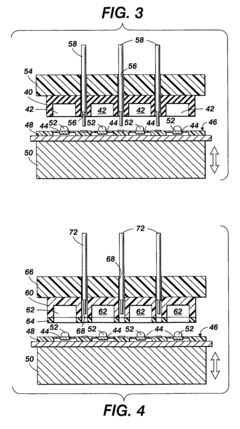
A detection system includes a detection device and an anti-evaporation device. The detection device comprises a region configured to merge at least two small drops and to detect a potential transient signal generated by the merger of the drops. The an anti-evaporation is configured to enclose the region and limit evaporation from the region. A method for detecting a signal includes the following steps: depositing drops of potentially reactive chemical solutions on a detection device within a drop-merging region; placing an anti-evaporation device over the drop-merging region to form a seal around the drop-merging region; merging the drops of potentially reactive chemical solutions; and measuring a signal occurring within the merged solution drops.

Description

INCORPORATION BY REFERENCE [0001] U.S. Pat. Nos. 5,967,659; 6,079,873; 6,096,559; 6,193,413; 6,545,334 and 6,380,605 and U.S. Patent Application Pub. Nos. 2003 / 0186453, 2003 / 0183525, 2004 / 0038228, 2004 / 0038227, 2003 / 0152128, and US20020093070 are each incorporated in their entirety by reference herein BACKGROUND [0002] Calorimetry is used to measure enthalpic changes, including enthaplic changes arising from reactions, phase changes, changes in molecular conformation, temperature variations, and other variations of interest that may occur for a particular specimen. By measuring enthalpic changes over a series of conditions, other thermodynamic variables may be deduced. Calorimetry measurements are commonly used in biophysical and biochemical studies to determine energy changes as indications of biochemical reactions in a specimen. There is a great interest in developing ultra-miniature microcalorimeter devices that require very small volumes of sampled media, e.g. small drops, for a...

Claims

the structure of the environmentally friendly knitted fabric provided by the present invention; figure 2 Flow chart of the yarn wrapping machine for environmentally friendly knitted fabrics and storage devices; image 3 Is the parameter map of the yarn covering machine
Login to View More

Application Information

Patent Timeline
no application Login to View More
IPC IPC(8): G01N25/20
CPCG01K17/006G01N25/482
InventorTORRES, FRANCISCO E.CHABINYC, MICHAELELROD, SCOTTPEETERS, ERICANDERSON, GREGORY B.BELL, ALAN G.BRUCE, RICHARD H.
OwnerPALO ALTO RES CENT INC