[0009] The present invention provides systems and methods that offer high
data availability and geographic
fault tolerance. In particular,
network data storage systems and methods are provided that allow computers reading and writing data at a plurality of data centers separated by, potentially, large distances to replicate data between sites such that the data is protected from failures, including complete Site failures, while not allowing network latency to significantly impede the performance of read or write operations. Optionally, the systems and methods provide a coherence model such that more than one such sites can read or write the same volume of data concurrently. Additionally, and optionally, the systems and methods provide mechanisms that provide a time consistent data image allowing an operational restart after the failure of two sites.
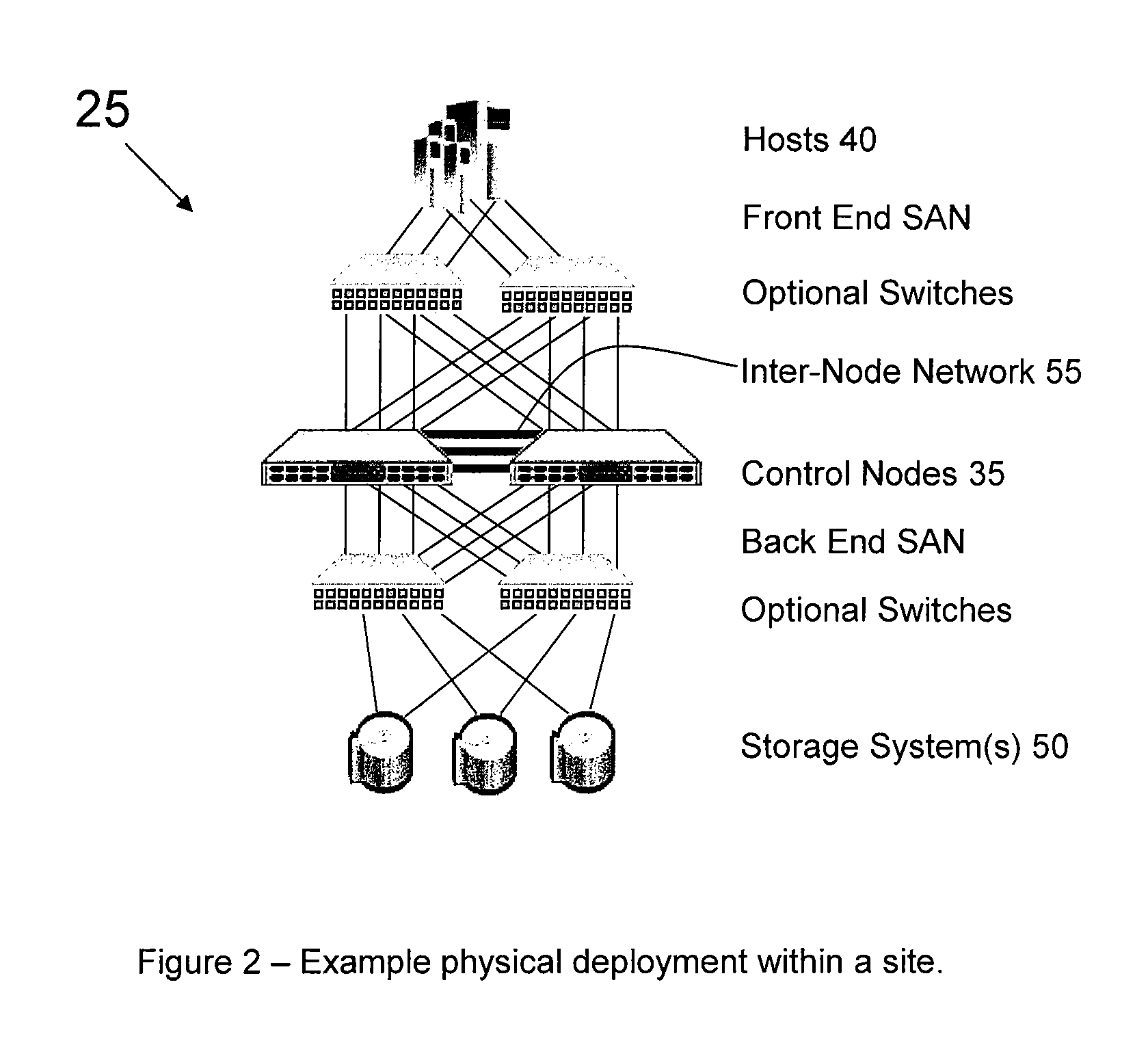
[0011] In certain aspects, all Control Nodes are coherent, as taught by U.S. application Ser. No. 11 / 177,924, filed Jul. 07, 2005, the entire contents of which are herein incorporated by reference for all purposes, such that all Control Nodes behave as if accessing a single disk drive with synchronous coherence while physical data motion may be asynchronous. This allows clustered applications to operate on opposite ends of long asynchronous distances accessing a single common data image with general performance equivalent to local performance. Even for single-instance applications, e.g., an application which does not support clustering of its execution across a plurality of computer systems, this is particularly useful as it allows load-balancing across all asynchronous sites and rapid
failover of applications in the event of
a site or
system failure.
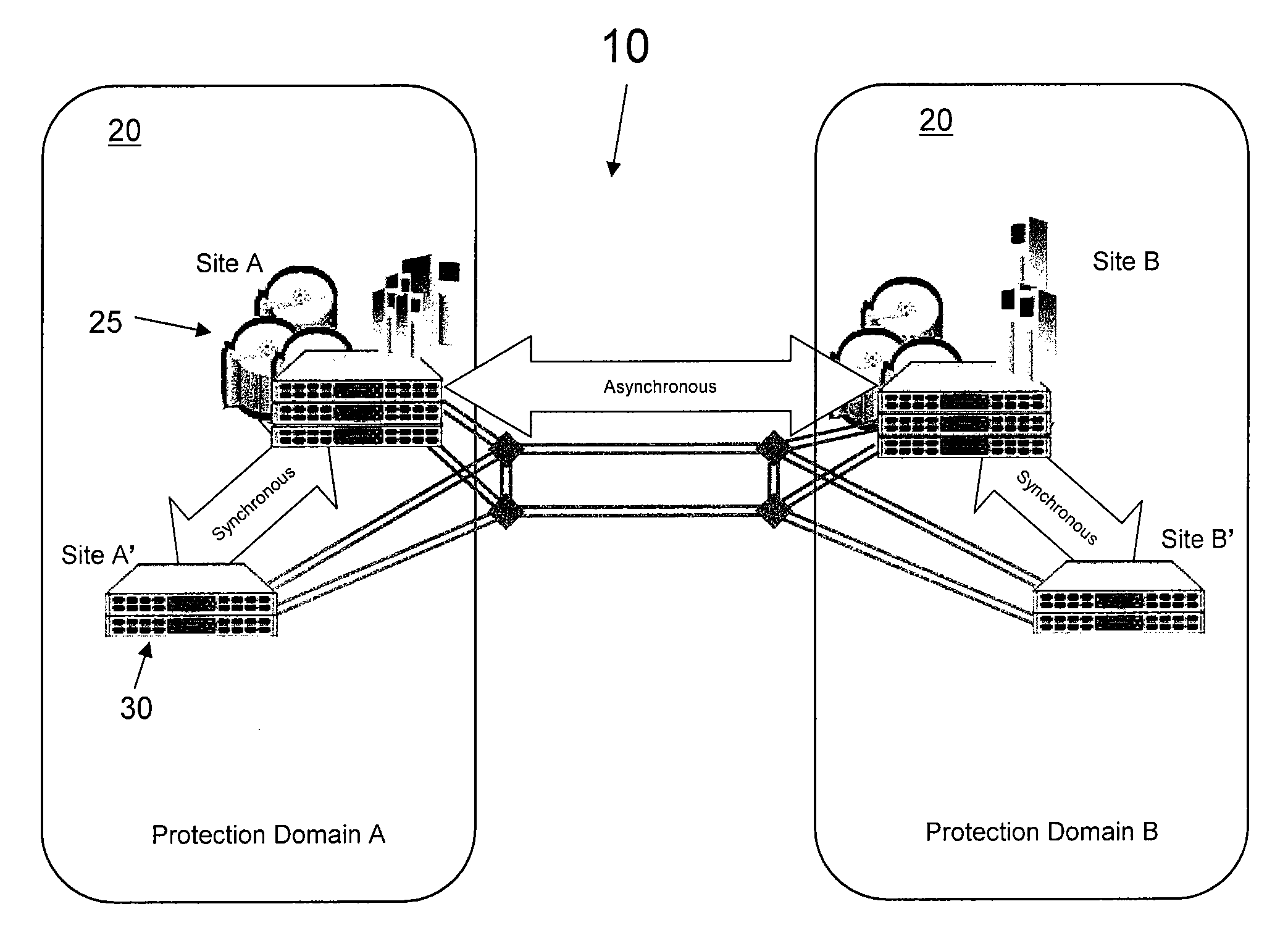
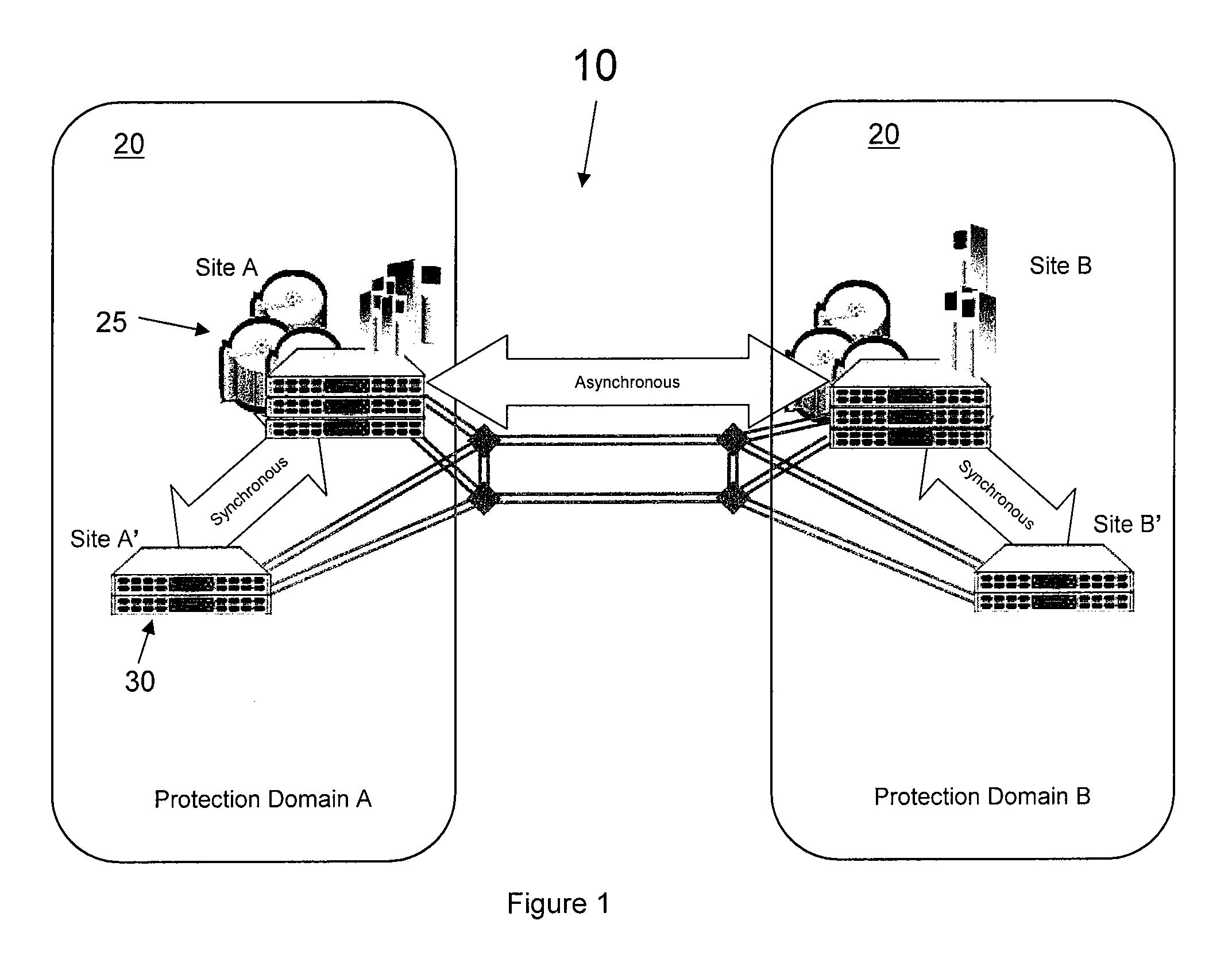
[0012] In one embodiment, two Active sites are provided, where each
active site has a corresponding Protection Site and where writes to the
Active site are synchronously mirrored to the Protection site. Other embodiments include more than one Protection site per
Active site along with additional
network redundancy which allows tolerance of failures at more than a single geographic region. Other embodiments provide for greater than two Active sites. Other embodiments allow the Protection Sites to also have active I / O using other sites within synchronous distances to protect dirty pages, as defined below, while serving I / O to their respective host systems (“Hosts”).
[0013] Aspects of the present invention advantageously support both transaction-intensive workloads, i.e., workloads consisting of a high volume of short, latency-sensitive transactions, as well as
throughput-orientated workloads, i.e., workloads with large regions read from or written to in each transaction. Aspects of the present invention also advantageously allow clustered applications and operations normally restricted to a
single site to be operated between widely separated sites. Further, aspects of the present invention not only increase operational resiliency, but also optimize
network usage.
[0016] According to yet another aspect of the present invention, a data storage network that provides high
data availability and
fault tolerance is provided. The network typically includes a first
protection domain including a first site having a first control node and a second site having a second control node, wherein the first and second control nodes each have a cache, and wherein the first site is geographically remote from the second site. The network also typically includes a second
protection domain having multiple sites, each site having a control node, each control node having a cache, wherein the second
protection domain is geographically remote from the first protection domain. The first control node is typically configured to store a
data access request received from a host within the first site to its cache, and to send the
data access request to the second node. The first control node is also typically configured to, upon receiving an
acknowledgement from the second node that the
data access request is stored in cache, a) acknowledge to the host that the data access request is complete, and thereafter b) send the data access request to a third control node in the second protection domain.



 Login to View More
  Login to View More