
Magnetic resonance imaging apparatus
a magnetic resonance imaging and apparatus technology, applied in the field of magnetic resonance imaging apparatus, can solve the problems of deteriorating s/n ratio of the signal received by the receiver, increasing the length of the received signal cable connected to the lower coil, and taking time to position, so as to reduce the factor obstructing the coil performance, easy to choose, and convenient to position objects
- Summary
- Abstract
- Description
- Claims
- Application Information
AI Technical Summary
Benefits of technology
Problems solved by technology
Method used
Image

Examples
first embodiment
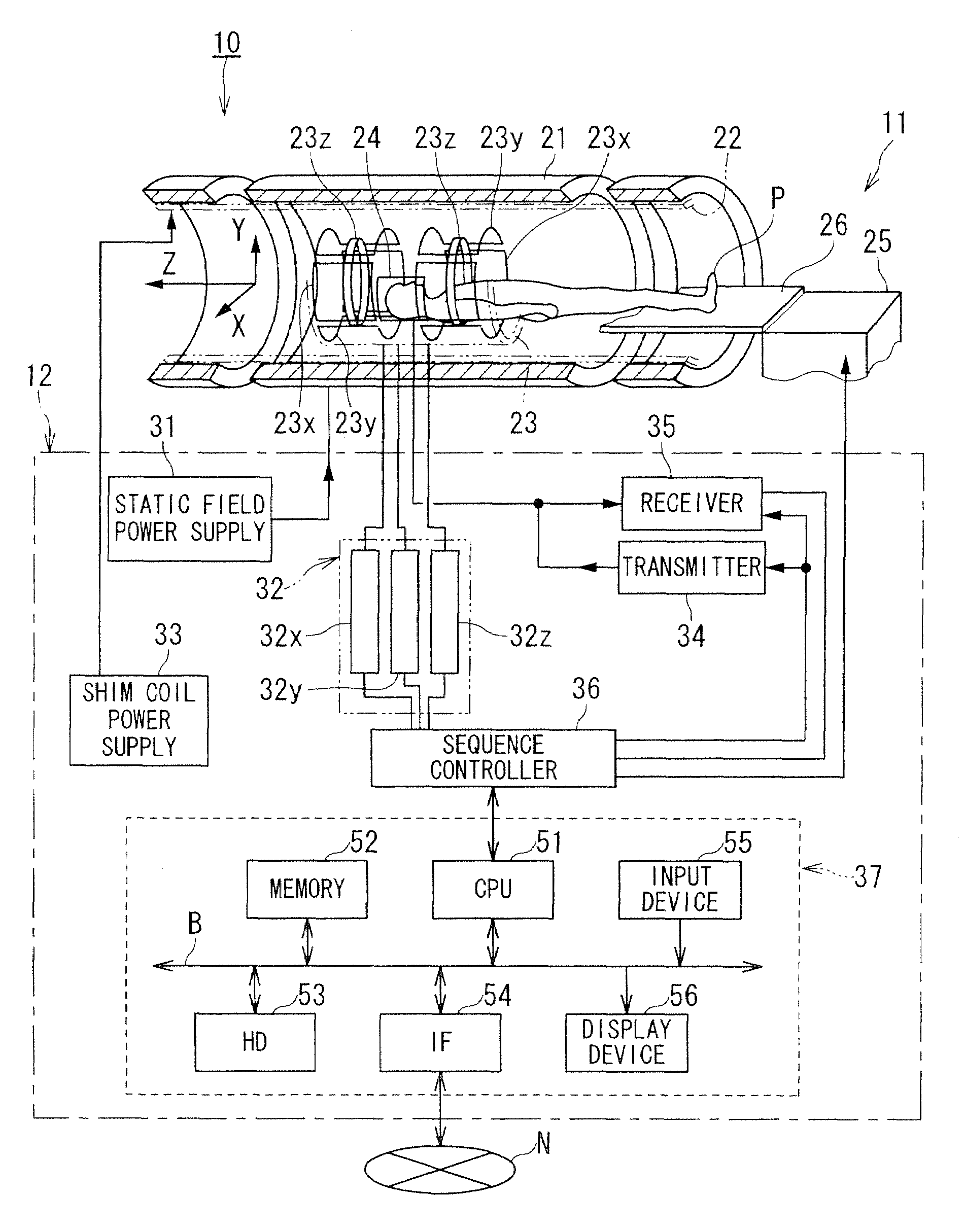
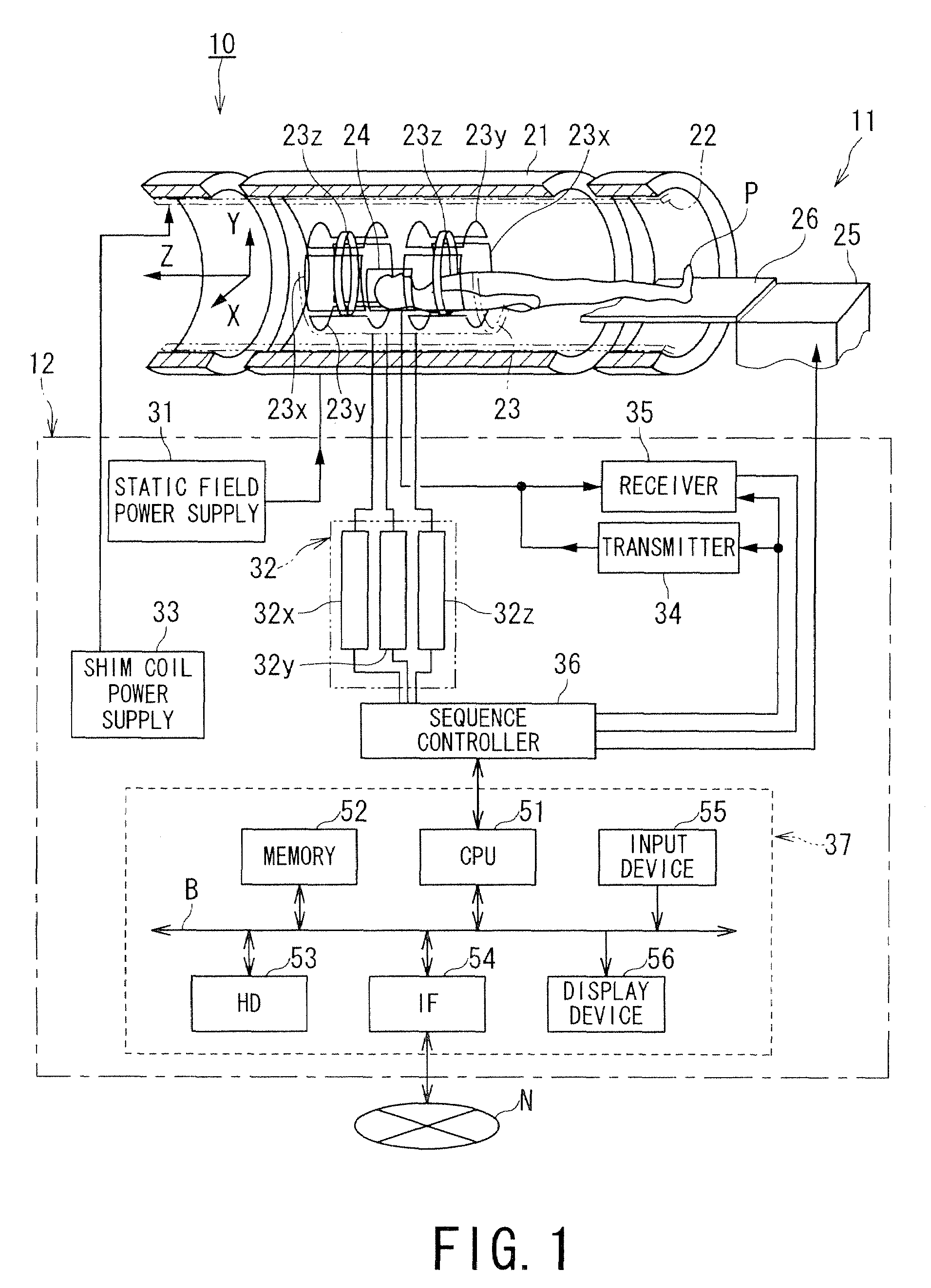
[0057]FIG. 1 is a schematic view illustrating a configuration of a first embodiment of the MRI apparatus according to the present invention.
[0058]FIG. 1 illustrates an MRI apparatus 10 according to the first embodiment, which images a patient (an object) P while continuously moving the patient P. The MRI apparatus 10 is mainly formed by an imaging system 11 and a controlling system 12.
[0059]The imaging system 11 of the MRI apparatus 10 is provided with a gantry (not illustrated). The gantry stores therein a static field magnet 21, a cylindrical shim coil 22 provided inside and coaxial with the static field magnet 21, and a gradient coil unit 23 formed into a cylindrical shape and provided inside the static field magnet 21. Further, the imaging system 11 is provided with an RF coil 24 for transmitting a high-frequency (RF: radio frequency) signal having the Larmor frequency (resonant frequency), and a bed structure 25 for advancing and retreating the patient P with respect to the ins...
second embodiment
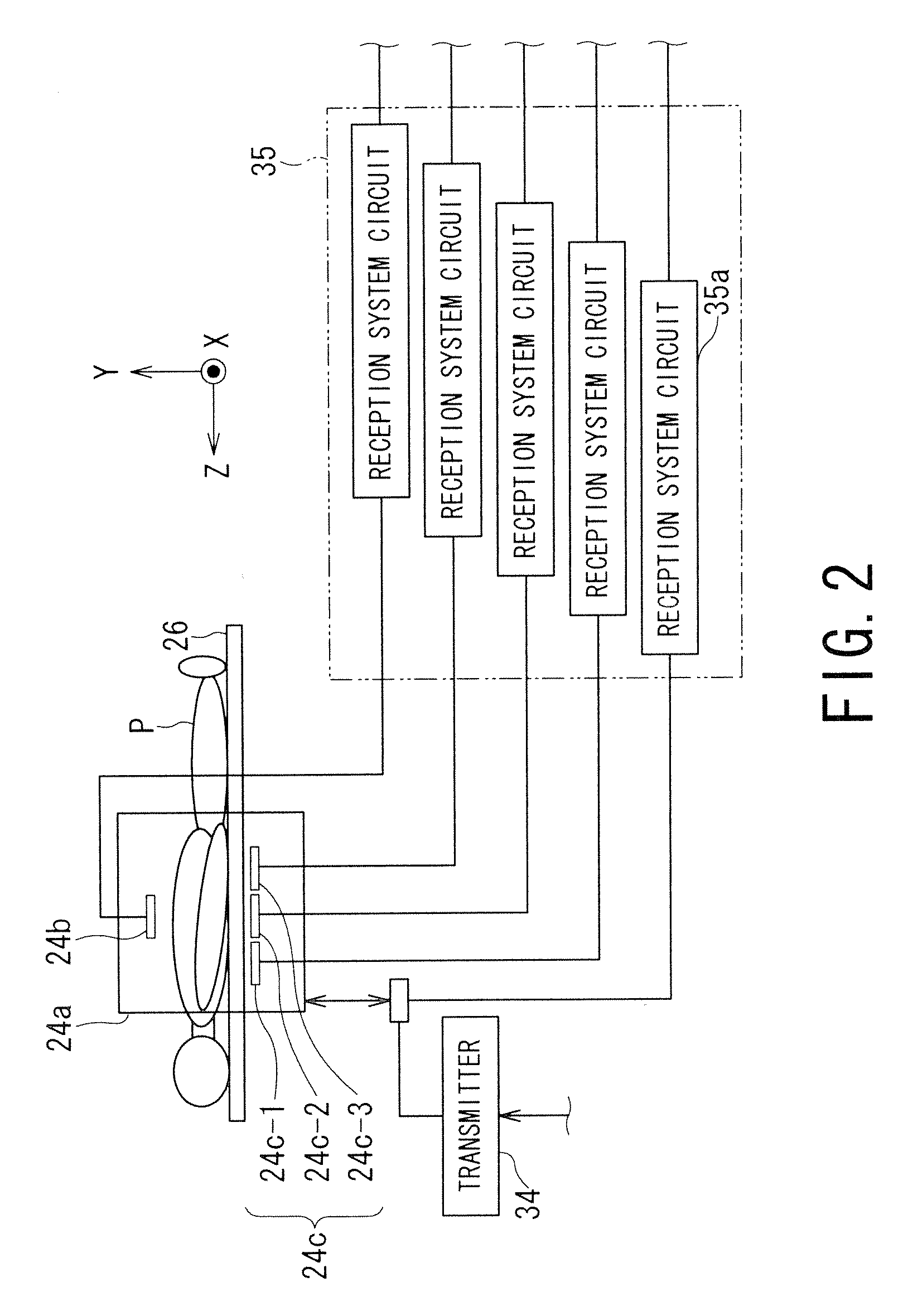
[0129]The configuration of an MRI apparatus 10A according to a second embodiment is the same as the configuration of the MRI apparatus 10 illustrated in FIG. 1. Thus, description thereof will be omitted. Further, similarly to the case of the MRI apparatus 10, FIGS. 2 to 5 also apply to the MRI apparatus 10A.
[0130]FIG. 21 is a cross-sectional view as viewed from a side, illustrating the positional relationship of the table-top 26 and the lower coil 24c and a movement control unit for controlling the movement of the lower coil 24c in the horizontal direction. FIG. 22 is a cross-sectional view as viewed from above, illustrating the movement control unit for controlling the movement of the lower coil 24c in the horizontal direction. FIG. 23 is an arrow view along the XXIII-XXIII line, illustrating the movement control unit for controlling the movement of the lower coil 24c in the horizontal direction. In FIGS. 21 to 35, description will be made by taking an example in which the RF coil ...
PUM
 Login to View More
 Abstract
Description
Claims
Application Information
 Login to View More