

DNA construct and process for the fermentative production of fusion proteins
a fusion protein and construct technology, applied in the field of dna constructs and a process for the fermentation production of fusion proteins, can solve the problems of inclusion body formation, protein contains a total of three cysteine residues, and misfolding of the target protein, and achieve the effect of inexpensive production of the target protein
- Summary
- Abstract
- Description
- Claims
- Application Information
AI Technical Summary
Benefits of technology
Problems solved by technology
Method used
Image


Examples
example 1
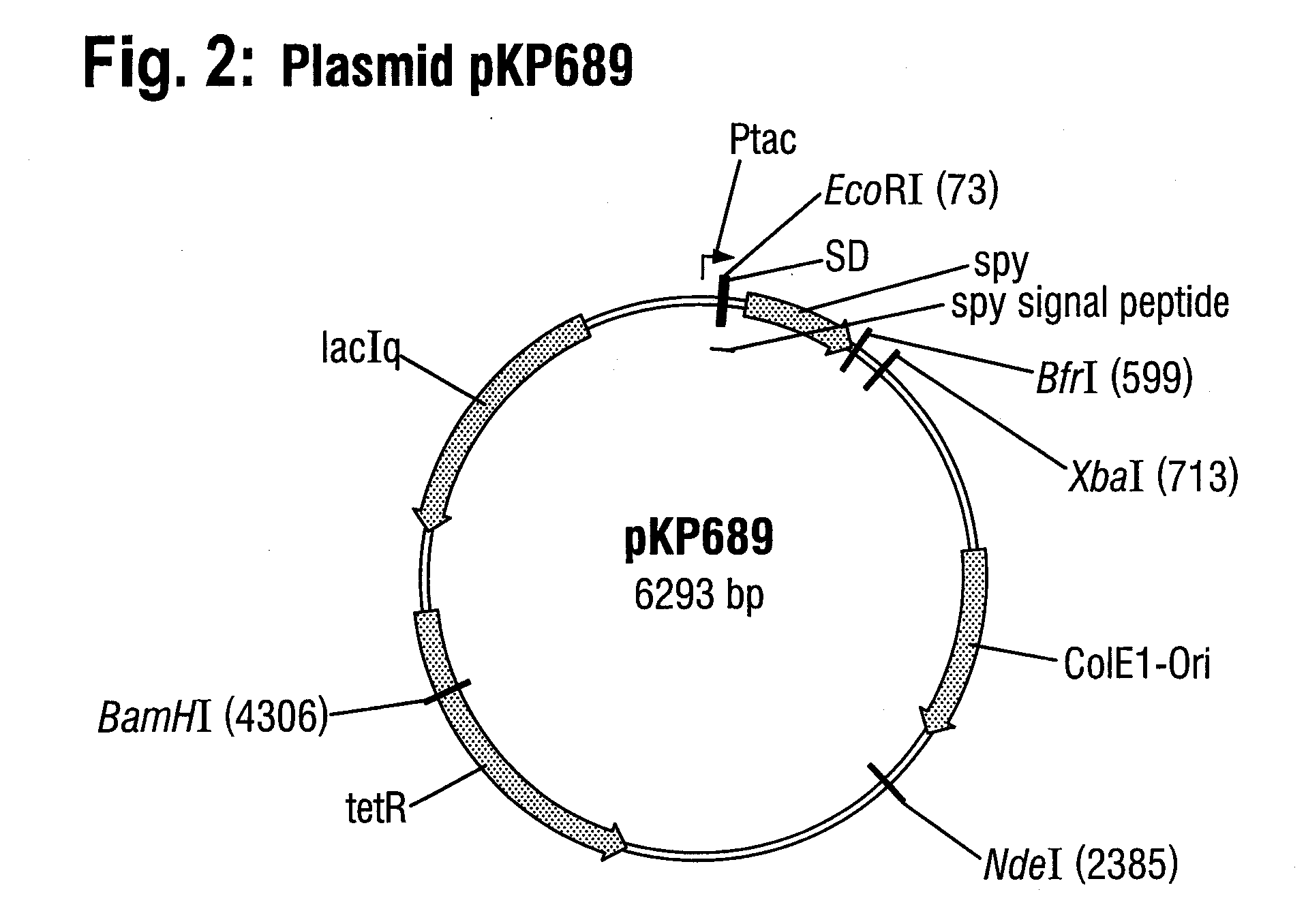
Construction of Plasmid pKP689
a) Amplification of the Spy Gene
[0066]The spy gene from E. coli was amplified by means of the polymerase chain reaction (PCR) using the Taq DNA polymerase (Roche, Mannheim) and proceeding in the customary manner, which is known to the skilled worker. The template used was the chromosomal DNA of the E. coli wild-type strain W3110 (ATCC 27325). The primers used were the oligonucleotides spy-fw (SEQ ID NO: 4) with the sequence 5′ -GGA ATT CTG AAA GGA AGG ATA TAG AAT ATG-3′ and spy-rev (SEQ ID NO: 5) with the sequence 5′-GCT CTA GAT TTA CGT TAG TGG TGA TCA G-3′.
[0067]The DNA fragment obtained in the PCR, which is approximately 651 base pairs in length, was subsequently purified by means of a DNA adsorption column from the QIAprep Spin Miniprep Kit (Qiagen, Hilden) following the manufacturer's instructions.
b) Cloning of the spy gene into the plasmid vector pEX2200
[0068]Two cleavage sites for the restriction endonucleases EcoRI and XbaI were introduced into t...
example 2
Cloning of T1249
[0072]a) Preparation of Vector pCMT203
[0073]To clone the T1249 DNA, the plasmid vector pCMT203 (obtainable as described in EP0448093B1, example 6) was cut with the restriction endonucleases SfuI and PstI under the conditions indicated by the manufacturer (Roche, Mannheim). The plasmid was subsequently dephosphorylated at the 5′ ends by treatment with alkaline phosphatase (Roche, Mannheim) and then purified by means of QIAquick Gel Extraction Kit (Qiagen, Hilden), as in the case of the PCR fragment.
b) Phosphorylation of T1249 DNA Fragments
[0074]The nucleic acid sequence for the peptide T1249 was generated synthetically with the aid of oligonucleotides. The oligonucleotides T1 (SEQ ID NO: 6), T2 (SEQ ID NO: 7), T3 (SEQ ID NO: 8), T4 (SEQ ID NO: 9) and T5 (SEQ ID NO: 10) were phosphorylated with the aid of a polynucleotide kinase (Roche, Mannheim) following the manufacturer's instructions.
c) Ligation
[0075]The ligation of the phosphorylated T1249 DNA fragments with the c...
example 3
Construction of pT1249
[0078]a) Preparation of the Vector pBaBIFN1
[0079]To clone the T1249 DNA, the plasmid vector pBaBIFN1 (which can be isolated from strain DH5∝ / pBaBIFN1 deposited at the DSMZ (Deutsche Sammlung fur Mikroorganismen and Zellkulturen GmbH, D-38142 Brunswick) as DSM 18343, in compliance with the provisions of the Budapest Treaty) was cleaved with the restriction endonucleases BglII and XbaI under the conditions specified by the manufacturer (Roche, Mannheim). The plasmid was subsequently dephosphorylated at the 5′ ends by treatment with alkaline phosphatase (Roche, Mannheim) and then purified by means of QIAquick Gel Extraction Kit (Qiagen, Hilden), as in the case of the PCR fragment.
b) Phosphorylation of T1249 DNA Fragments
[0080]The nucleic acid sequence for the peptide T1249 was generated synthetically with the aid of oligonucleotides. The oligonucleotides T6 (SEQ ID NO: 11), T7 (SEQ ID NO: 12), T8 (SEQ ID NO: 13), T9 (SEQ ID NO: 14) and T10 (SEQ ID NO: 15) were pho...
PUM
| Property | Measurement | Unit |
|---|---|---|
| molecular weight | aaaaa | aaaaa |
| temperature | aaaaa | aaaaa |
| temperature | aaaaa | aaaaa |
Abstract
Description
Claims
Application Information
 Login to View More