Unlock instant, AI-driven research and patent intelligence for your innovation.

Low modulus solar cell encapsulant sheets with enhanced stability and adhesion

Active Publication Date: 2008-08-14
DOW GLOBAL TECH LLC
View PDF38 Cites 38 Cited by
  • Summary
  • Abstract
  • Description
  • Claims
  • Application Information

AI Technical Summary

Problems solved by technology

Ethylene vinyl acetate compositions, which have commonly been utilized as the encapsulant material within solar cell modules, suffer the shortcomings of low adhesion to the other components incorporated within the solar cell module, low creep resistance during the lamination process and end-use and low weathering and light stability.
These shortcomings have generally been overcome through the formulation of adhesion primers, peroxide curing agents, and thermal and UV stabilizer packages into the ethylene acetate compositions, which complicates the sheet production and ensuing lamination processes.
However, none of the currently known encapsulant layer materials can encompass all of the end-use requirements.
However, it has generally been found that ethylene acrylate esters do not provide adhesion to commonly utilized solar cell structural layers, such as glass.
In addition, the ethylene acrylate ester materials have been found to creep under end-use conditions, such as in roof solar cell modules which can reach high temperatures.

Method used

the structure of the environmentally friendly knitted fabric provided by the present invention; figure 2 Flow chart of the yarn wrapping machine for environmentally friendly knitted fabrics and storage devices; image 3 Is the parameter map of the yarn covering machine
View more

Image

Smart Image Click on the blue labels to locate them in the text.
Viewing Examples
Smart Image
  • Low modulus solar cell encapsulant sheets with enhanced stability and adhesion
  • Low modulus solar cell encapsulant sheets with enhanced stability and adhesion

Examples

Experimental program
Comparison scheme
Effect test

examples

[0080]The following Examples are intended to be illustrative of the present invention, and are not intended in any way to limit the scope of the present invention. The solar cell interconnections are omitted from the examples below to clarify the structures, but any common art solar cell interconnections may be utilized within the present invention.

Methods

[0081]The following methods are used in the Examples presented hereafter.

I. Embossed Sheet Structure:

[0082]Embossed sheet structures are prepared on a 24 inch width Sano multilayer co-extrusion line equipped with embossing rolls utilizing common art sheet formation processes. This essentially entails the use of an extrusion line consisting of a twin-screw extruder with a sheet die feeding melt into a calendar roll stack. The calendar rolls have an embossed surface pattern engraved into the metal surface which imparts to varying degrees a reverse image of the surface texture onto the polymer melt as it passes between and around the ...

examples 1-11

[0085]Examples 1-5 are a series of bi-layer film structures prepared through a blown film process, as is commonly known within the art. The composition of the bi-layer film structures are listed in Table 1. Based on these structures, a series of laminate structures (Examples 6-11, listed in

TABLE 1Bi-layer Film StructuresLayer 1Layer 2Example(Thickness)(Thickness)1Ionomer 1EBA 1(0.5 mils, (0.013 mm))(2 mils, (0.05 mm))2Ionomer 2EEA(1 mil, (0.03 mm))(3 mils, (0.08 mm))3Ionomer 3EMA 1(0.7 mils, (0.018 mm)(2 mils, (0.05 mm)4ACR 1EBA2(0.5 mils, (0.013 mm)(2 mils, (0.05 mm))5ACR 2EMA 2(1 mil, (0.03 mm))(3 mils, (0.08 mm))ACR 1 is a poly(ethylene-co-methacrylic acid) containing 12 wt % of polymerized residues of methacrylic acid and having a MI of 1 g / 10 minutes (190° C., ISO 1133, ASTM D1238).ACR 2 is a poly(ethylene-co-methacrylic acid) containing 19 wt % of polymerized residues of methacrylic acid and having a MI of 2 g / 10 minutes (190° C., ISO 1133, ASTM D1238).EBA 1 is a poly(ethylene...

examples 12-49

[0086]Examples 12-17 are a series of embossed bi-layer sheet structures, with their compositions listed in Table 3.

TABLE 3Bi-layer Sheet StructuresLayer 1Layer 2Example(Thickness)(Thickness)12Ionomer 1EBA 1(0.5 mils, (0.013 mm))(19 mils, (0.48 mm))13Ionomer 3EEA(1 mil, (0.03 mm))(18 mils, (0.4 mm))14Ionomer 4EMA 1(0.7 mils, (0.018 mm)(13 mils, (0.33 mm))15Ionomer 5EBA 2(1 mil, (0.03 mm))(18 mils, (0.4 mm))16ACR 1EBA 3(0.5 mils, (0.013 mm))(19 mils, (0.48 mm))17ACR 2EMA 2(1 mil, (0.03 mm))(18 mils, (0.4 mm))EBA 3 is a compounded composition consisting of 99.8 wt % of EBA 1 and 0.2 wt % of 3-aminopropyltrimethoxysilane.Ionomer 4 is a poly(ethylene-co-methacrylic acid) containing 19 wt % of polymerized residues of methacrylic acid that is 37% neutralized with sodium ion and having a MI of 2 g / 10 minutes (190° C., ISO 1133, ASTM D1238). Ionomer 4 is prepared from the comparable acid copolymer having a MI of 60 g / 10 minutes.Ionomer 5 is a poly(ethylene-co-methacrylic acid) with 19 wt % o...

the structure of the environmentally friendly knitted fabric provided by the present invention; figure 2 Flow chart of the yarn wrapping machine for environmentally friendly knitted fabrics and storage devices; image 3 Is the parameter map of the yarn covering machine
Login to View More

PUM

PropertyMeasurementUnit
Fractionaaaaaaaaaa
Lengthaaaaaaaaaa
Lengthaaaaaaaaaa
Login to View More

Abstract

The present invention provides a pre-formed bi-layer thermoplastic film or sheet comprising a first surface layer made of acid copolymers, or ionomers, or combinations thereof and a second surface layer made of ethylene acrylate ester copolymers, a solar cell pre-laminate assembly comprising the same, and a simplified process for manufacturing a solar cell module derived therefrom.

Description

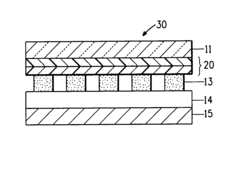
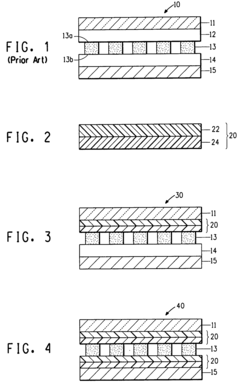
FIELD OF THE INVENTION[0001]The present invention relates to certain low modulus thermoplastic bi-layer films or sheets with enhanced stability and adhesion and their utility in manufacturing solar cell modules.BACKGROUND OF THE INVENTION[0002]As a renewable energy resource, the use of solar cell modules is rapidly expanding. With increasingly complex solar cell modules, also referred to as photovoltaic modules, comes an increased demand for enhanced functional encapsulant materials. Photovoltaic (solar) cell modules or laminates are units that convert light energy into electrical energy. A typical or conventional solar cell pre-laminate assembly consists of at least 4 or 5 structural layers. As shown in FIG. 1, they are constructed in the following order starting from the top, or incident layer (that is, the layer first contacted by light) and continuing to the backing (the layer furthest removed from the incident layer): (1) incident layer 11, (2) front-sheet encapsulant layer 12,...

Claims

the structure of the environmentally friendly knitted fabric provided by the present invention; figure 2 Flow chart of the yarn wrapping machine for environmentally friendly knitted fabrics and storage devices; image 3 Is the parameter map of the yarn covering machine
Login to View More

Application Information

Patent Timeline
no application Login to View More
IPC IPC(8): H01L31/048C08L33/02
CPCB32B17/10587B32B17/10743B32B17/10853Y02E10/50C08L23/0876H01L31/048C08L23/0869H01L31/0481
Inventor HAYES, RICHARD ALLENLENGES, GERALDINE M.PESEK, STEVEN C.
Owner DOW GLOBAL TECH LLC