[0009]The present disclosure relates to independently-defined alteration of original output from an executable software application to provide altered output according to an alteration scheme. The software, for example, an executable
computer game, is configured to produce original output in response to user inputs when operating in a specific hardware environment. The software may comprise an executable file that is compiled from a higher-level language and recognized as executable by a computer
operating system, or as other discrete static code, e.g., binary code, that is executable in the applicable hardware environment. The software is therefore in executable form, and may sometimes be referred to herein as an “executable.” The original output may comprise, for example, audio, video, or electronic output from an
output device connected to a processor that is running the software executable. The software executable may be configured to
cause specific defined output in response to
user input. For example, in response to
user input from a
joystick, the executable may cause a rendered sprite or avatar to move in a direction indicated by the
joystick input in a modeled game environment, which is then rendered as output by a
graphics engine and displayed on a display screen. The software executable may be designed to operate in stand-alone mode, for example, to provide
game play on a client node without requiring real-time or near realtime communication with a remote node. The software executable may also function in a networked multiplayer mode, in which real-time or near realtime communication is performed with one or more remote nodes.
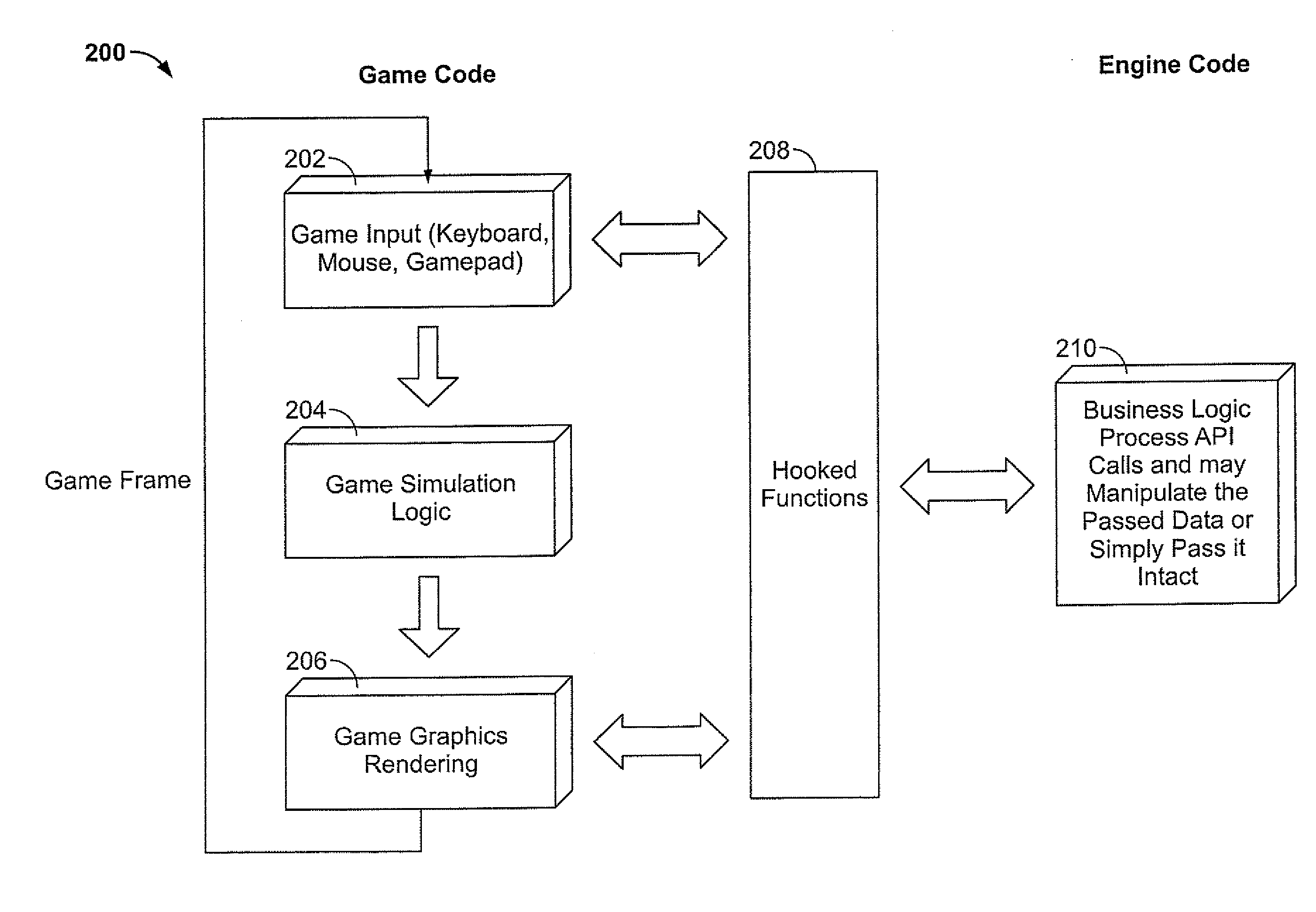
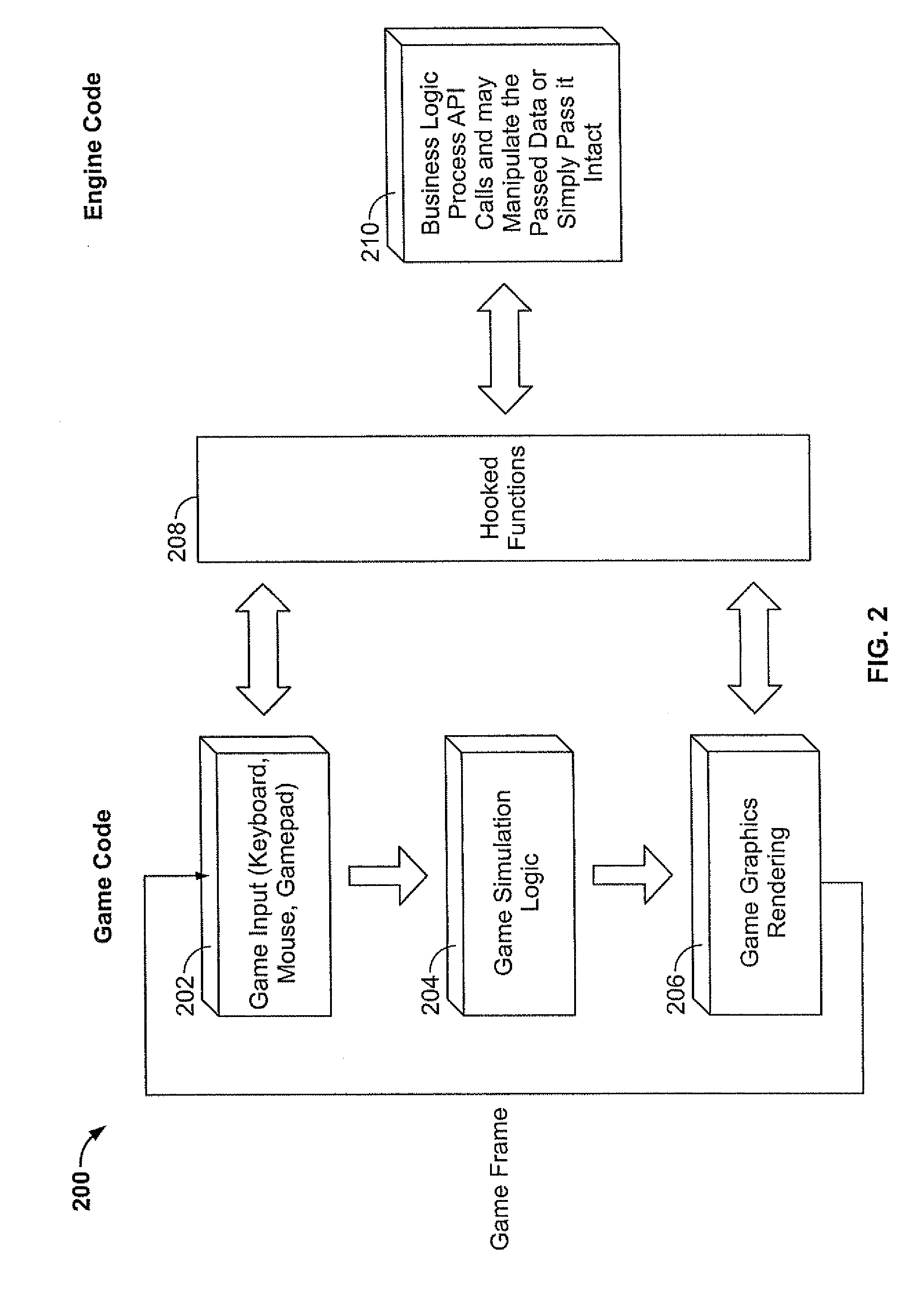
[0012]The client-side alteration engine may be installed on the client after installation of the game executable for which it is designed, such that when the client receives input requesting that the game executable be executed, the client first initializes and loads a client-side alteration engine DLL, and then calls the game code. The alteration engine may then monitor the
client machine state during operation of the original game code to detect trigger events. When a trigger event as defined by the alteration scheme is detected, the alteration engine refers to the alteration scheme to identify an action triggered by the event. The alteration engine then causes the action to be carried out. The alteration scheme may be contained in one or more data files separate from the executable code running the original executable and alteration engine. In this way, the alteration scheme may be updated without requiring an update of executable code.
[0026]By avoiding the need for
source code integration with the underlying game or other application, the present technology may be used to minimize the cost, complexity and time of
software development and publishing, making it easy for software publishers to add features that benefit the end
consumer. The methods and
system described herein also enable the monetization and enhancement of already developed games where modification to the
source code is no longer possible.
[0030]Another useful application of the methods and
system described herein is post-launch configuration of creative and advertising content. Creative or business decisions—for example, where to put ads, the contents of an ad hoc tournament, what achievements are worthy of reward, etc.—may be delayed until after distribution of an original game to the
end user. This creates the opportunity to postpone or revise the creative decisions which, because games and other forms of entertainment software can be very complex, are often a large driver of integration time, complexity, and cost. Such creative decisions, which may also include or affect business decisions, may therefore be delayed until after software release, when more information may be known about the advertiser and gamer
market dynamics A game title (and especially high-end “AAA” titles) may take 2 years or more to develop, thus making certain creative decisions so far in advance very difficult. Also, relatively few releases achieve widespread popularity, and so doing all the work upfront on many releases may mean much wasted effort for games that are played by relatively few users. Thus, the method and
system described herein may shorten pre-
launch time and reduce the associated
cost burden of enabling games with advertising or
community technology, in addition to its other potential benefits as described above.



 Login to View More
  Login to View More