[0062]The bore through the
abutment is such that a screw can be inserted through the bore which is capable of engaging the threaded part located in the indention (4) of the dental implant (1). The bore preferably comprises at least two different diameters or a conical region, with the smaller
diameter bore being positioned at the apical end of the bore (19). This narrowing of the bore allows the
screw head to engage the
abutment (12) and prevent movement of the
abutment (12) along the longitudinal axis of the
hybrid two-part dental implant. Preferably, the smallest
diameter of the bore (19) is between 0.5 and 4 mm, preferably 0.5, 0.6, 0.7, 0.8, 0.9, 1.0, 1.2, 1.4, 1.6, 1.8, 2.0, 2.2, 2.4, 2.6, 2.8, 3.0, 3.2, 3.4, 3.6, 3.8, 4.0 mm. It is preferred that the larger
diameter is between 0.1 to 2 mm larger than the smaller diameter of the bore (19). The diameter of the smallest bore is preferably slightly larger than the outer diameter of the threaded part of the screw to be inserted.
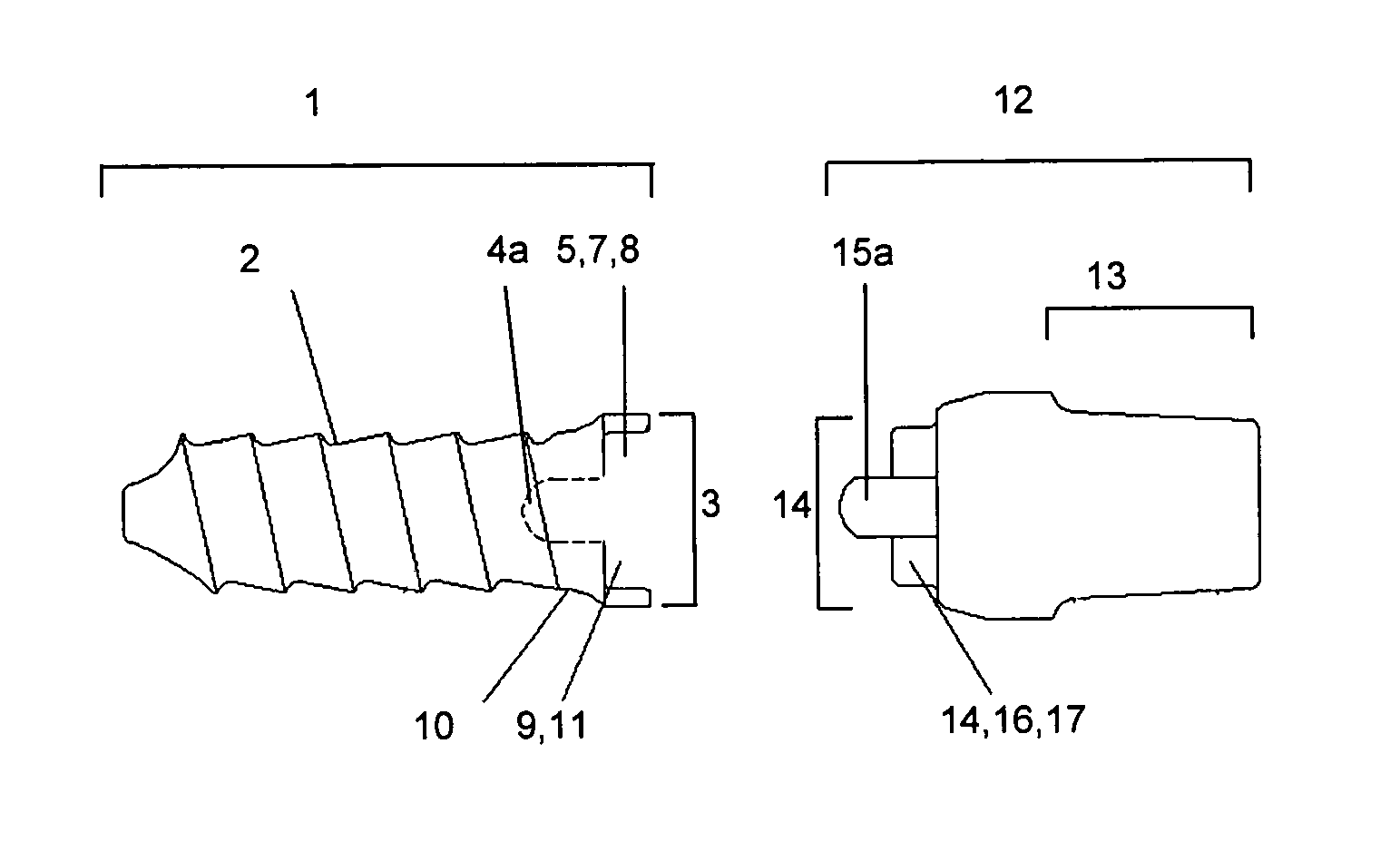
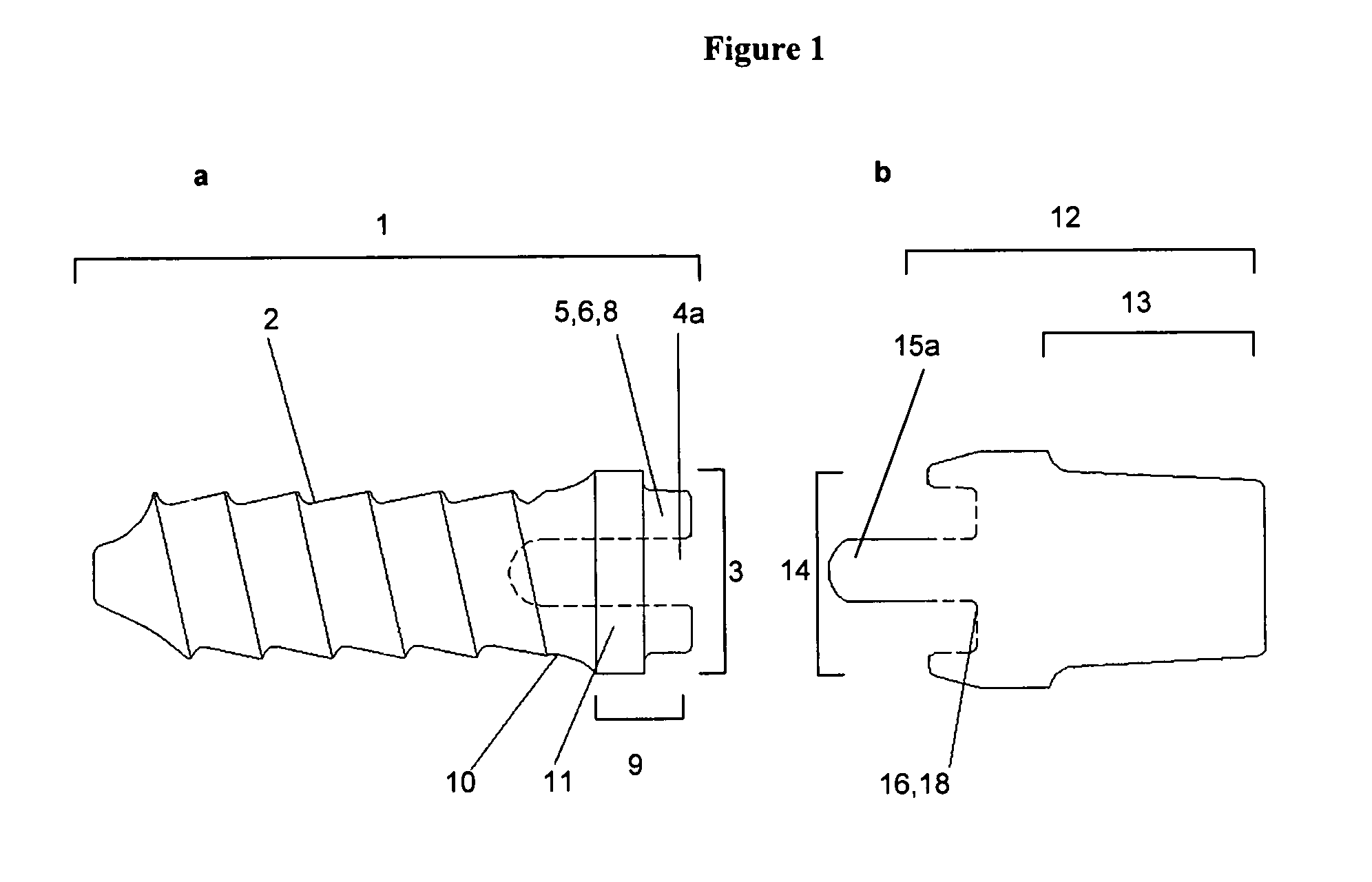
[0077]In a preferred embodiment of the hybrid two-part dental implant of the first and second aspect of the present invention the thread-profile of said outer threaded part (2) of said dental implant (1) comprises an apical flank and a distal flank, wherein an
acute angle (β) between the apical flank and the longitudinal axis is smaller than an
acute angle (γ) between the distal flank and the longitudinal axis. This particular thread design leads to a secure attachment of the dental implant almost immediately after
insertion of the dental implant (1) and, thus, provides reduced healing times, i.e. the abutment (12) can already be attached to the dental implant (1) after only a few days of healing.
[0085]The outer threaded part (2) will in most embodiments extend over the entire length of the part of the dental implant (1) inserted into the bone. These threads are preferably present on the cylindrical sections of the dental implant (1), while a tip, which might be attached at the apical end of the dental implant, will preferably not comprise threads. Such a tip can have any shape as long as its diameter does not extend over the diameter of the outer threaded part (2) to which it is attached, i.e. the outer diameter of the outer threaded part. Preferably the diameter of the tip does not extend beyond the inside diameter of the outer threaded part (2). The tip preferably has a round, pointed or blunt shape. As it is not always required that the entire part of the detnal implant (1) inserted into the bone is threaded, the dental implant (1) in some embodiments may comprise further parts inserted into the bone, which are not threaded. These one or more further parts are preferably located towards the apical end of the dental implant and / or towards the distal end, preferably towards the transgingival part (9). Preferably any further part which is not threaded and is inserted into the bone is also provided with a
rough surface as defined above, to facilitate osseo-integration.
[0110]In another preferred embodiment the prosthetic head (13) is of conical shape. In this embodiment it has above indicated preferred widths at its base and is tapered to the top. The tapering is preferably with an angle of between 1° to 15°, e.g. 1°, 2°, 3°, 4°, 5°, 6°, 7°, 8°, 9°, 10°, 11°, 12°, 13°, 14°, or 15°. This tapering facilitates the attachment of crowns or superstructures and / or the scanning of the prosthetic head once the abutment of the present invention has been attached to the dental implant of the present invention. Such a scan can then be used, e.g. to manufacture the crown or
superstructure to be attached to the prosthetic head, e.g. by CAD /
CAM devices or by a dental
technician, in such a way that it on one hand fits exactly to the protruding prosthetic head (13) and on the other hand will be positioned correctly with respect to the surrounding teethes.



 Login to View More
  Login to View More