
2,4,6-trisubstituted phenols having anesthetic properties
a technology of trisubstituted phenols and anesthetic properties, which is applied in the direction of anti-noxious agents, drug compositions, biocides, etc., can solve the problems of dose-dependent hypotension, hypotriglyceridemia and pancreatitis, and “propofol syndromes" and other problems, to achieve the effect of preventing cellular damage and cellular damage from oxygen free radicals
- Summary
- Abstract
- Description
- Claims
- Application Information
AI Technical Summary
Benefits of technology
Problems solved by technology
Method used
Image

Examples
example 1
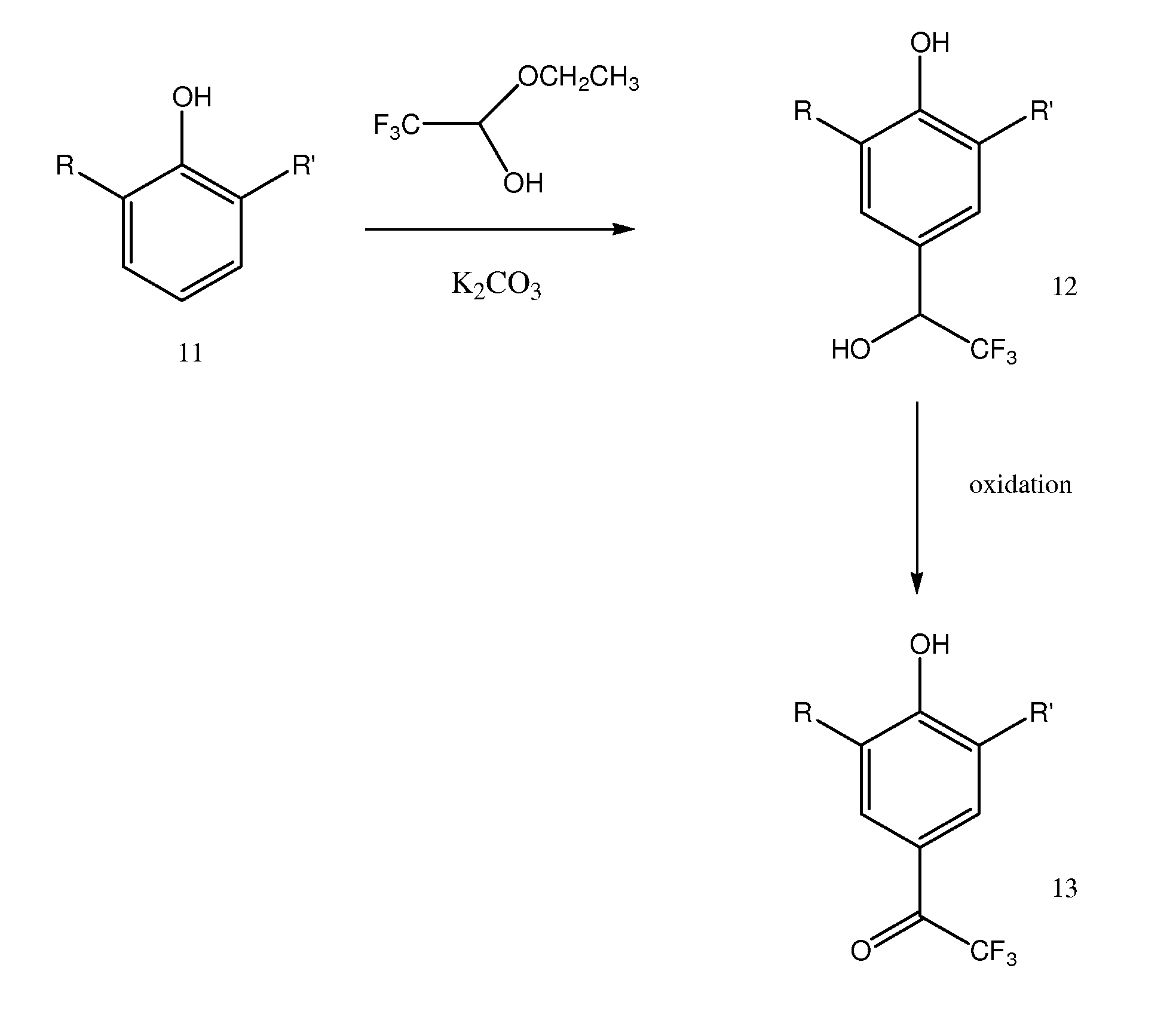
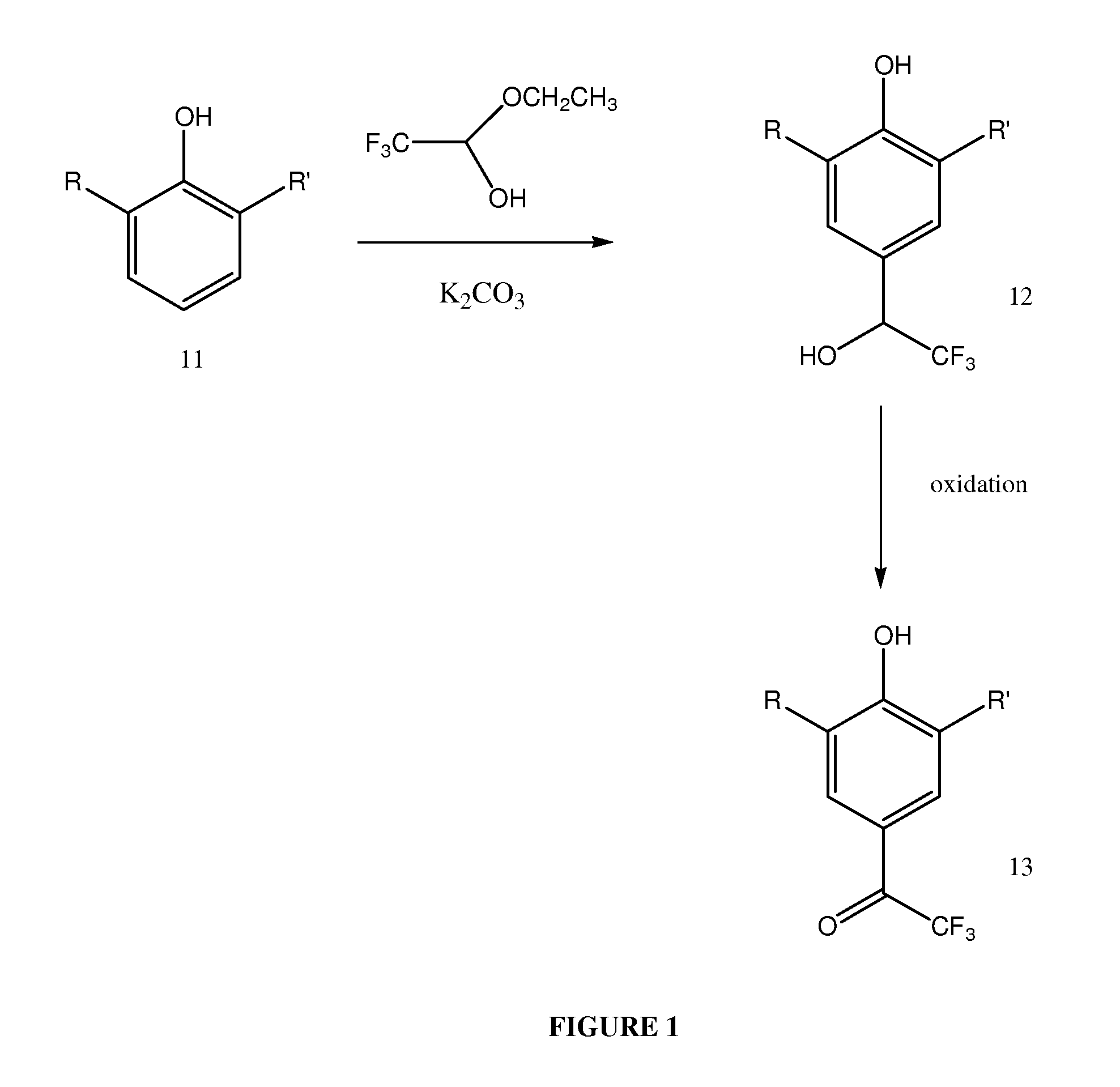
[0125]Compound 1 (2,6-diisopropyl-4-(2,2,2-trifluoro-1-hydroxy-ethyl)-phenol) was prepared as follows:
[0126]2,6-diisopropyl-phenol (2 ml) was reacted with trifluoroacetaldehyde ethyl hemiacetal (2.3 ml) in the presence of potassium carbonate (0.16 g); no solvent was used. The reaction mixture was placed in a round-bottomed flask and refluxed for approximately 3 hours at 80-100° C. The reaction mixture may be dark green, but will generally become a reddish color during the course of the reaction.
[0127]Following reaction, the mixture was diluted with ethyl acetate (about 20-25 ml) and washed with water. The organic and aqueous phases were separated in a separatory funnel; the addition of n-heptane (or a mixture of n-heptane / ethyl acetate up to 50 / 50) can improve the separation of phases. The organic phase was washed 3-4 times with water and the solvent was removed by vacuum or under stream of nitrogen gas. As the solvent was removed, the product began to crystallize; a reddish byprodu...
example 2
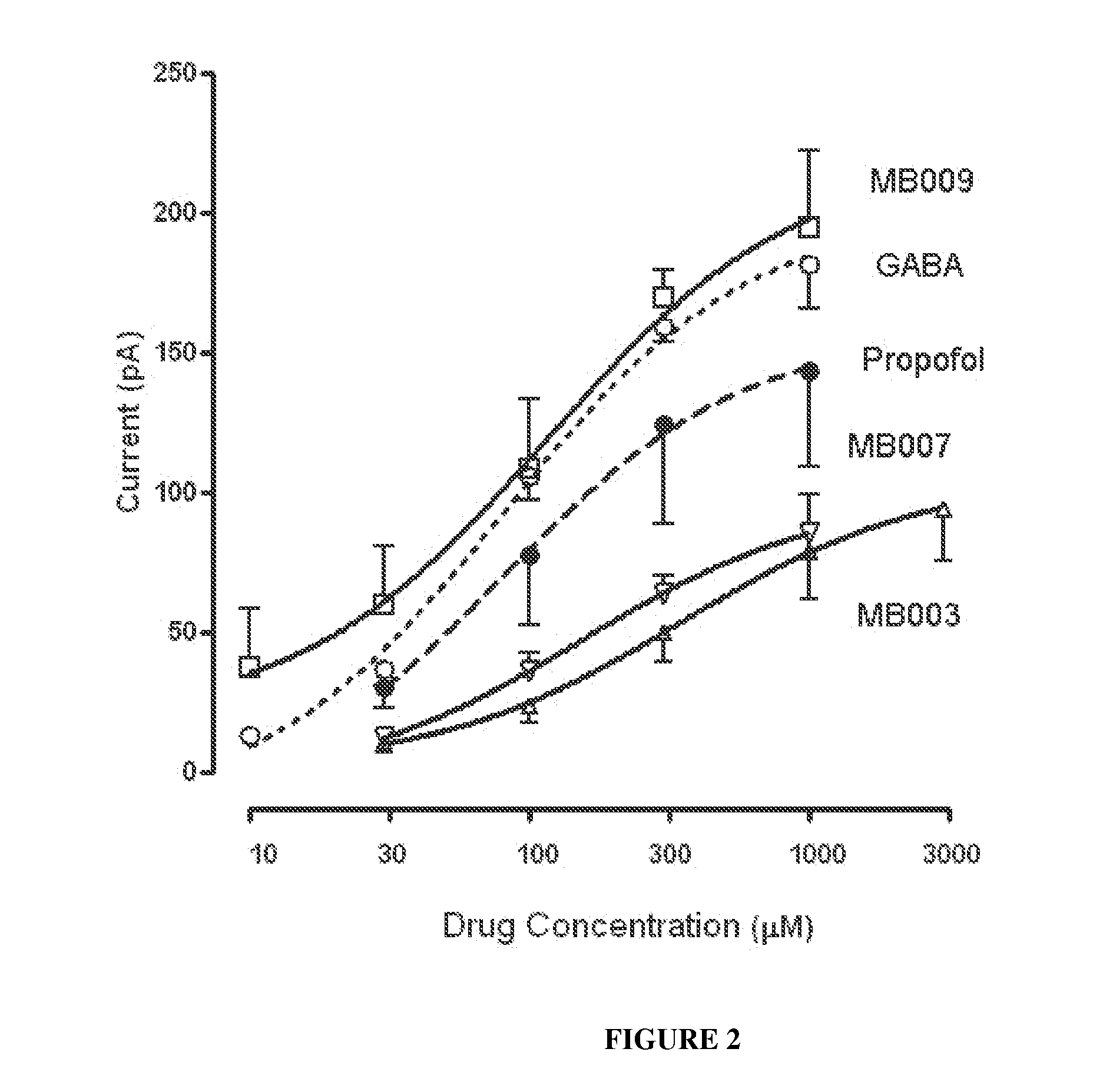
[0130]Compound 1 was synthesized as described in Example 1. The compound was tested in an in vitro assay for direct GABA activation. As shown in FIG. 2, Compound 1 (MB003) is capable of direct activation of GABA receptors (MB007 is 2-Isopropyl-6-(2,2,2-trifluoro-ethyl)-phenol; MB009 is 2-Isopropyl-6-(2,2,2-trifluoro-1-methyl-ethyl)-phenol; GABA is gamm-aminobutyric acid).
[0131]Compound 1 was formulated in 16% Cremophor EL solution in water at a concentration of approximately 15 mg / ml and tested in rats as follows.
Approximately 15 mg / kg of Compound 1 in the suspension were injected into the lateral tail vein of two rats (weight 330-340 g). Rat 1 lost its righting reflex for a total of about 3.5 minutes but appeared normal at about 7.5 minutes post-injection. Rat 2 lost its righting reflex for a total of about 2.0 minutes but appeared normal at about 4.75 minutes post-injection (Rat 2 had been agitated prior to injection). Thus, at a dose of about 15 mg / kg administered i.v., Compound ...
example 3
[0133]Compound 2 (2,2,2-trifluoro-1-(4-hydroxy-3,5-diisopropyl-phenyl)-ethanone or 2,6-diisopropyl-4-trifluoroacetylphenol) was prepared from Compound 1 by oxidation with Jones' reagent.
[0134]When injected into a rat under conditions similar to those of Example 2, (similar dose and route of administration), Compound 2 caused tremors and shaking upon i.v. injection and did not appear to induce anesthesia.
PUM
 Login to View More
 Abstract
Description
Claims
Application Information
 Login to View More