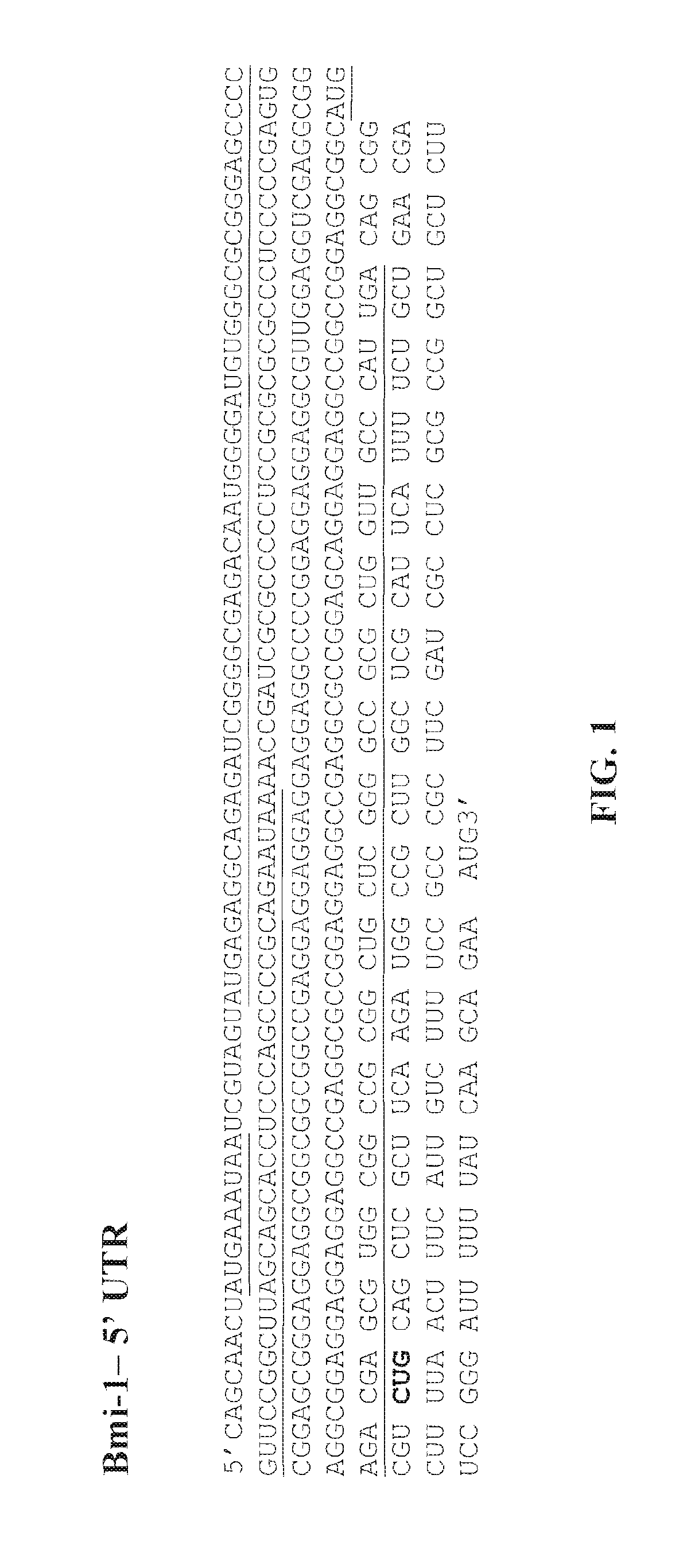
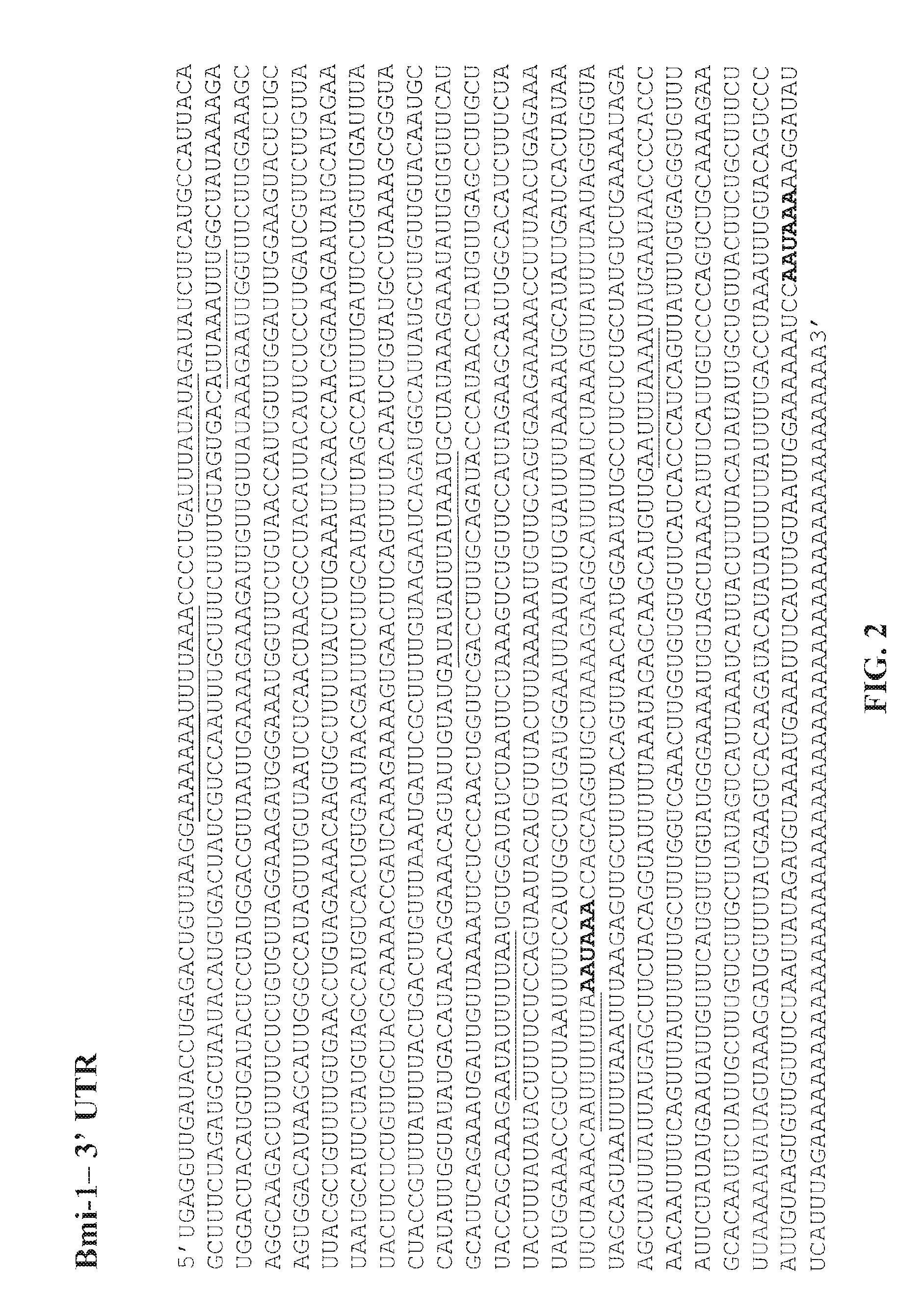
[0041]The UTR targeted approach of the methods described herein has several advantages. In particular, the sequences of the 5′-UTR and 3′-UTR appear to be unique to the Bmi-1 transcripts. Therefore, compounds that are highly specific for these UTRs can be used to selectively down-regulate post-
transcriptional expression of Bmi-1 by disrupting the interaction between the 5′-UTR and 3′-UTR, or the function of the 5′-UTR or the function of the 3′-UTR of Bmi-1. Further, down-regulating the post-transcriptional expression of the Bmi-1
gene selectively targets only cells that contain the Bmi-1 transcript. The use of such compounds in the methods described herein should, therefore, have reduced side effects to non-specific targets and cells. Moreover, the UTR targeted approach of the methods described herein may further
exploit the endogenous regulatory elements of Bmi-1 expression, thus, avoiding many technical, safety, and
efficacy issues involved with other therapeutic approaches envisioned for the treatment cancer, e.g., genetic approaches to deliver
DNA encoding therapeutic genes or to modify endogenous mutated genes. Thus, the methods of the present
assay offer several advantages, in terms of increased specificity and
efficacy and reduced side effects.
[0058]As used herein, the term “effective amount” in the context of administering a compound to a subject refers to the amount of a compound which is sufficient to achieve at least one or more of the following effects: (i) the reduction or amelioration of the severity of cancer and / or a symptom associated therewith; (ii) the reduction in the duration of a symptom associated with cancer; (iii) the prevention in the recurrence of a symptom associated with cancer; (iv) the regression of cancer and / or a symptom associated therewith; (v) the reduction in hospitalization of a subject; (vi) the reduction in hospitalization length; (vii) the increase in the survival of a subject; (viii) the inhibition of the progression of cancer and / or a symptom associated therewith; (ix) the enhancement or improvement the
therapeutic effect of another therapy; (x) a reduction or
elimination in the
cancer cell population; (xi) a reduction in the growth of a tumor or
neoplasm; (xii) a decrease in
tumor size; (xiii) a reduction in the formation of a tumor; (xiv) eradication, removal, or control of primary, regional and / or metastatic cancer; (xv) a decrease in the number or size of metastases; (xvi) a reduction in mortality; (xvii) an increase in cancer-free
survival rate of patients; (xviii) an increase in relapse free survival; (xix) an increase in the number of patients in remission; (xx) a decrease in hospitalization rate; (xxi) the size of the tumor is maintained and does not increase or increases by less of the tumor after administration of a standard therapy as measured by conventional methods available to one of skill in the art, such as MRI, X-
ray, and CAT Scan; (xxii) the prevention of the development or onset of cancer or a symptom associated therewith; (xxiii) an increase in the length of remission in patients; (xxiv) the reduction in the number of symptoms associated with cancer; and / or (xxv) an increase in symptom-free survival of cancer patients.
[0087]As used herein, the term “synergistic,” refers to the effect of the administration of a
combination product as described herein which is more effective than the additive effects of any two or more single agents. In a specific embodiment, a synergistic effect of a
combination product permits the use of lower dosages of one or more agents and / or less frequent administration of said agents to a subject with cancer. In certain embodiments, the ability to utilize lower dosages of an agent and / or to administer said agents less frequently reduces the
toxicity associated with the administration of said agents to a subject without reducing the
efficacy of said agents in the prevention or treatment of cancer. In some embodiments, a synergistic effect results in improved efficacy of each of the agents in treating cancer. In some embodiments, a synergistic effect of a combination of agents avoids or reduces adverse or unwanted side effects associated with the use of any
single agent. The combination of agents in such a product can be administered to a subject in the same pharmaceutical composition. Alternatively, the agents can be administered concurrently to a subject in separate pharmaceutical compositions. The agents may also be administered to a subject by the same or different routes of administration. In a specific embodiment, at least one of the agents is a compound.
[0089]As used herein, the term “treat” refers to treatment from which a subject receives a beneficial effect such as the reduction, decrease, attenuation, diminishment, stabilization, remission, suppression, inhibition or arrest of the development or progression of cancer, or a symptom thereof. In certain embodiments, the treatment that a subject receives results in at least one or more of the following effects: (i) the reduction or amelioration of the severity of cancer and / or a symptom associated therewith; (ii) the reduction in the duration of a symptom associated with cancer; (iii) the prevention in the recurrence of a symptom associated with cancer; (iv) the regression of cancer and / or a symptom associated therewith; (v) the reduction in hospitalization of a subject; (vi) the reduction in hospitalization length; (vii) the increase in the survival of a subject; (viii) the inhibition of the progression of cancer and / or a symptom associated therewith; (ix) the enhancement or improvement the
therapeutic effect of another therapy; (x) a reduction or
elimination in the
cancer cell population; (xi) a reduction in the growth of a tumor or
neoplasm; (xii) a decrease in
tumor size; (xiii) a reduction in the formation of a tumor; (xiv) eradication, removal, or control of primary, regional and / or metastatic cancer; (xv) a decrease in the number or size of metastases; (xvi) a reduction in mortality; (xvii) an increase in cancer-free
survival rate of patients; (xviii) an increase in relapse free survival; (xix) an increase in the number of patients in remission; (xx) a decrease in hospitalization rate; (xxi) the size of the tumor is maintained and does not increase or increases by less of the tumor after administration of a standard therapy as measured by conventional methods available to one of skill in the art, such as MRI, X-
ray, and CAT Scan; (xxii) the prevention of the development or onset of cancer or a symptom associated therewith; (xxiii) an increase in the length of remission in patients; (xxiv) the reduction in the number of symptoms associated with cancer; and / or (xxv) an increase in symptom-free survival of cancer patients. In some embodiments, the treatment that a subject receives does not cure cancer, but prevents the progression or worsening of the
disease.


 Login to View More