
Ring oscillator and control method of ring oscillator
a control method and oscillator technology, applied in the direction of pulse automatic control, pulse generation by logic circuits, pulse techniques, etc., can solve the problems of low operating bandwidth of oscillators, low linearity, and low frequency response, and achieve continuous adjustment of the loading of each ring stage, wide adjustable frequency range, and high linearity
- Summary
- Abstract
- Description
- Claims
- Application Information
AI Technical Summary
Benefits of technology
Problems solved by technology
Method used
Image

Examples
first embodiment
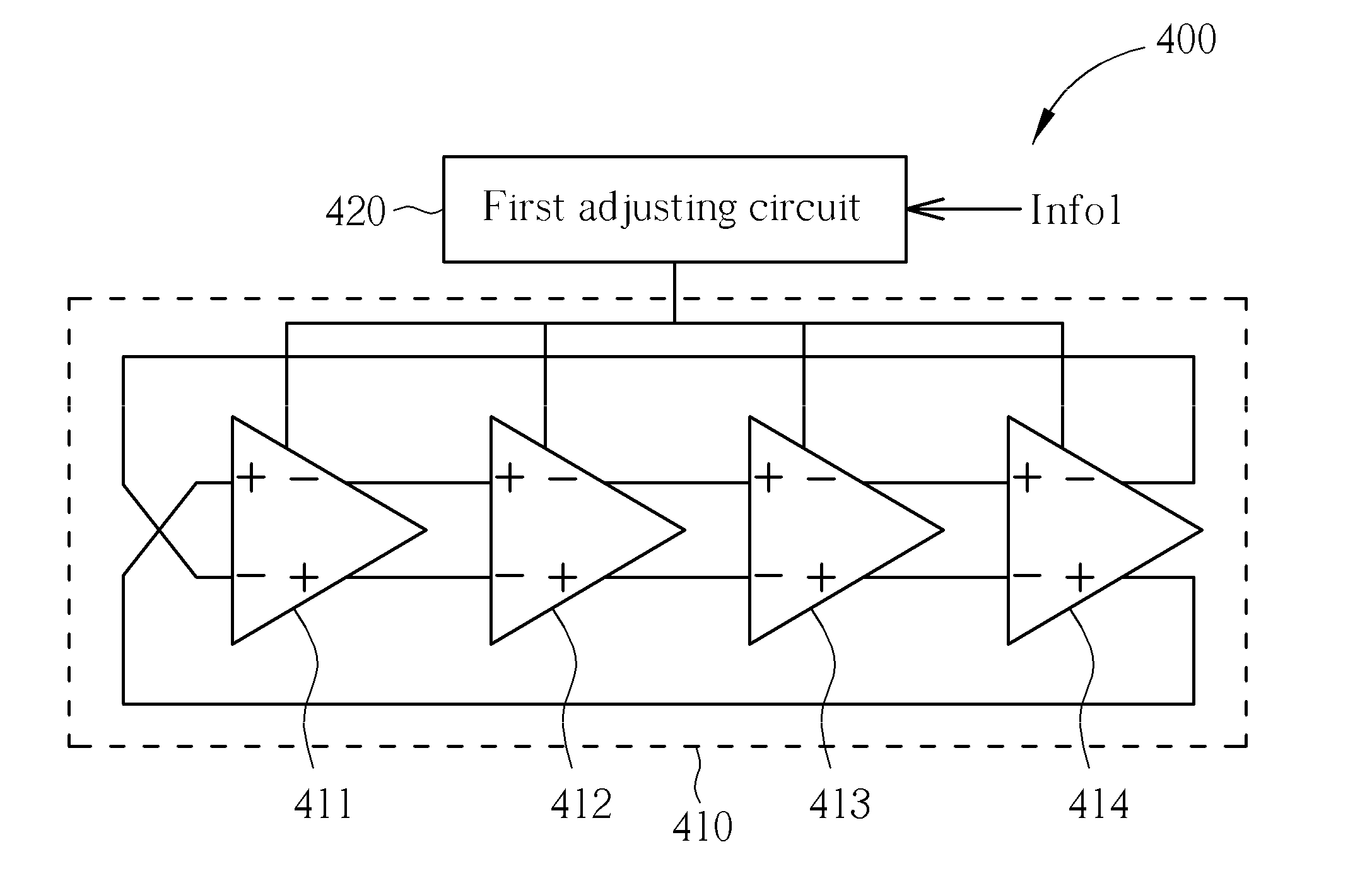
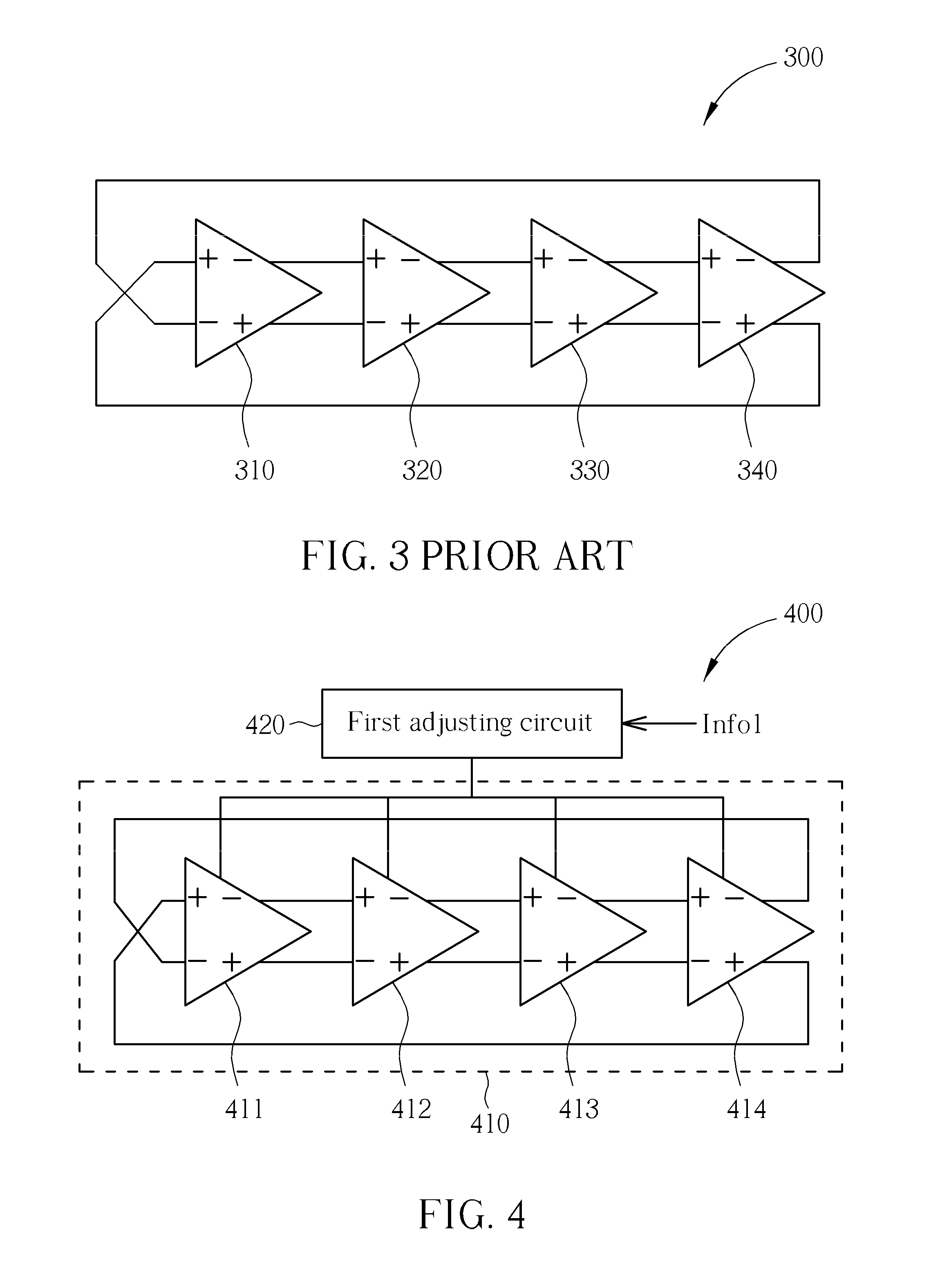
[0029]Please refer to FIG. 4, which is a diagram of a ring oscillator 400 according to the present invention. In this embodiment, the ring oscillator 400 includes (but not limited to) a core circuit 410 for outputting a clock signal and a first adjusting circuit 420. In addition, the core circuit 410 includes four differential ring stages 411, 412, 413 and 414; however, the aforementioned structure of the ring oscillator 400 is for illustrative purpose only. In other embodiments, the ring oscillator 400 may also be implemented by single-ended ring stages, and the number of the ring stages is not limited as well. As shown in the figure, in the core circuit 410, each ring stage includes an output terminal (−,+) and an input terminal (+,−), where the output terminal (−,+) is coupled to the input terminal (+,−) of a next ring stage, and the input terminal (+,−) is coupled a previous output terminal (−,+). The first adjusting circuit 420 is for receiving a plurality of first control info...
second embodiment
[0035]Regarding the circuit structure shown in FIG. 4, the first adjusting circuit 420 provides a mechanism of altering the gain of each ring stage in the ring oscillator 400, so as to adjust a frequency of the clock signal generated by the core circuit 410. However, the first adjusting circuit 420 only provides a mechanism of adjusting the clock signal frequency of the ring oscillator 400 non-continuously, to adjust the frequency of the clock signal more accurately, the present invention further provides another fine-tune mechanism. Please refer to FIG. 8, which is a diagram of a ring oscillator 800 according to the present invention. The ring oscillator 800 includes (but not limited to) a core circuit 810 for outputting a clock signal, a first adjusting circuit 820, and a second adjusting circuit 830. The function and structure of the core circuit 810 and the first adjusting circuit 820 are substantially identical to the core circuit 410 and the first adjusting circuit 420 shown i...
third embodiment
[0039]The aforementioned embodiments are for illustrative purpose only, and the adjusting circuits therewithin can be utilized independently or combined together. For example, please refer FIG. 13, which is a diagram of a ring oscillator 1300 according to the present invention. The ring oscillator 1300 includes a current source IB, a core circuit 1310 and an adjusting circuit 1330, wherein the current source IB is for providing a constant bias current to the core circuit 1310, the function and structure of the core circuit 1310 and the adjusting circuit 1330 are substantially identical to the core circuit 810 and the second adjusting circuit 830 shown in FIG. 8, and the adjusting circuit 1330 will adjust a loading of each ring stage in the core circuit 1310 according to control information Info, thereby controlling a frequency of a clock signal generated from the ring oscillator 1300. However, for ring oscillator 1300, the adjusting circuit 1330 is utilized to continuously adjust th...
PUM
 Login to View More
 Abstract
Description
Claims
Application Information
 Login to View More