

Electrical deionization apparatus
a technology of electric deionization apparatus and ion exchange, which is applied in the direction of peptides, water/sewage treatment by ion exchange, liquid/fluent solid measurement, etc., to achieve the effect of reducing the ion concentration and reducing the ionic concentration of the influen
- Summary
- Abstract
- Description
- Claims
- Application Information
AI Technical Summary
Benefits of technology
Problems solved by technology
Method used
Image

Examples
Embodiment Construction
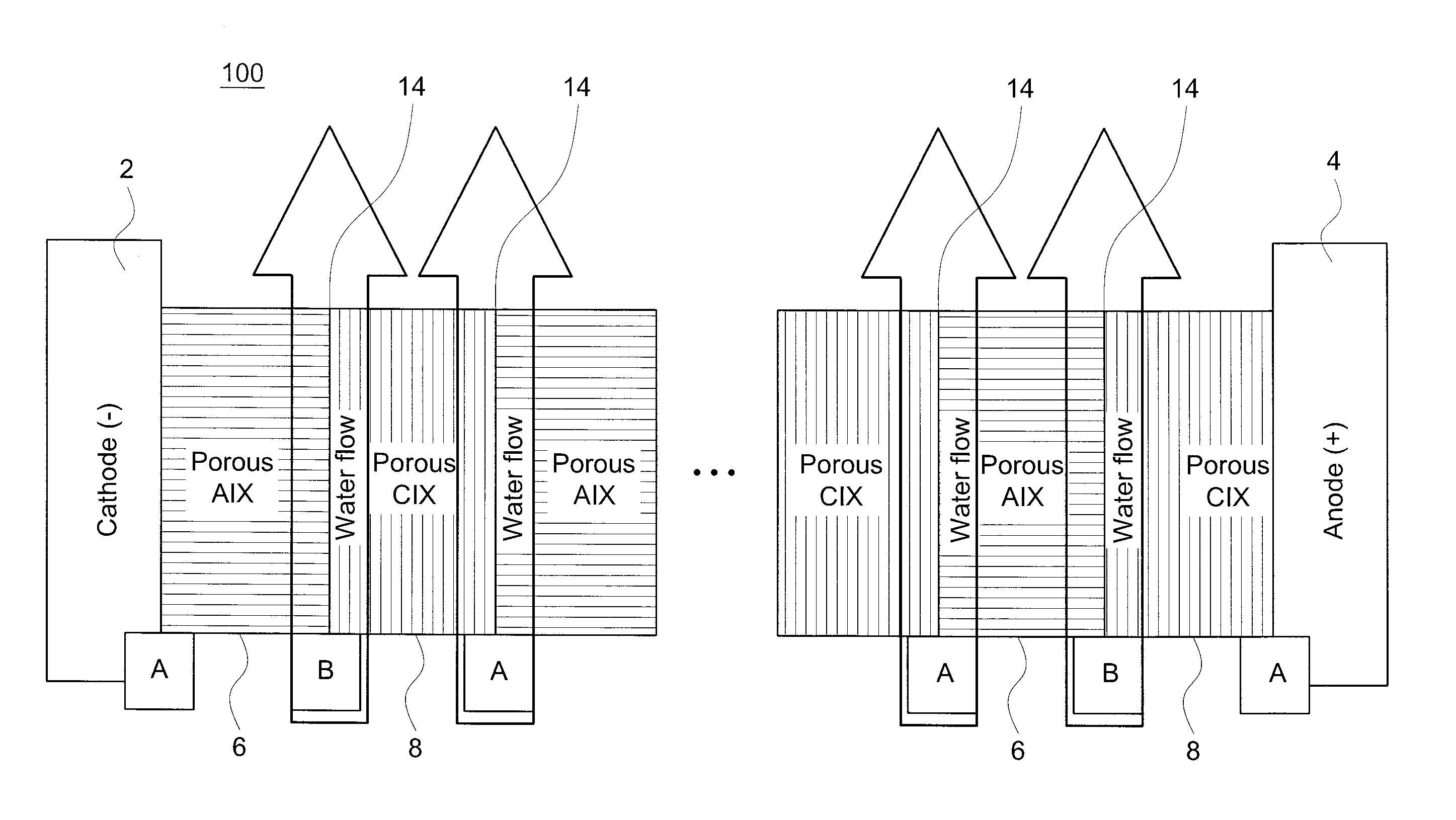
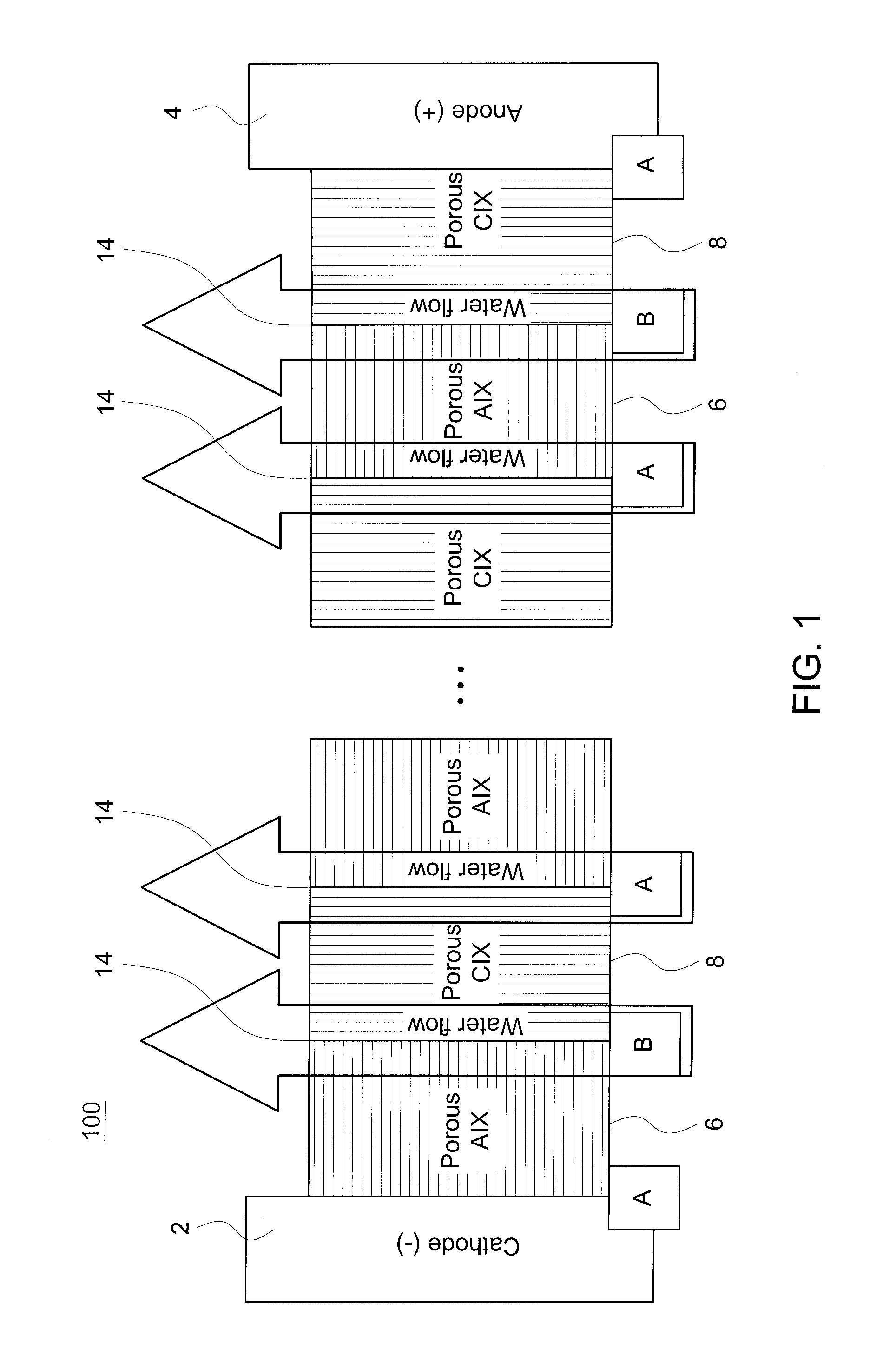
[0013]Turning first to FIG. 1, there is shown a first exemplary embodiment of the invention comprising a membraneless electrodeionization (EDI) stack configuration. As shown, the EDI stack 100 comprises opposing cathode 2 and electrode 4 with the space between the electrodes composed entirely of alternating contiguous layers of porous anion ion exchange materials 6, and porous cation ion exchange materials 8. As shown, a plurality of interfacial AIX and CIX areas 14 are formed by this alternating, sandwich structure.
[0014]The electrodes 2, 4 may be composed of conventional materials such as corrosion resistant metals such as titanium, niobium, stainless, etc., and in some instances, these materials may be provided with an outer coating of a noble metal such as platinum. In the embodiment shown, cathode 2 is composed of stainless with anode 4 composed of Ti coated with IrO2.
[0015]The alternating contiguous layers of the stack construction span the entirety of the distance between the...
PUM
| Property | Measurement | Unit |
|---|---|---|
| Area | aaaaa | aaaaa |
Abstract
Description
Claims
Application Information
 Login to View More