
Semiconductor device
a semiconductor device and semiconductor technology, applied in the direction of solid-state devices, transistors, instruments, etc., can solve the problems of difficult to sufficiently reduce power consumption, short data holding period, and high cost per storage capacity, so as to improve the degree of integration of a semiconductor device, increase storage capacity per unit area, and reduce the area occupied by memory cells
- Summary
- Abstract
- Description
- Claims
- Application Information
AI Technical Summary
Benefits of technology
Problems solved by technology
Method used
Image

Examples
embodiment 1
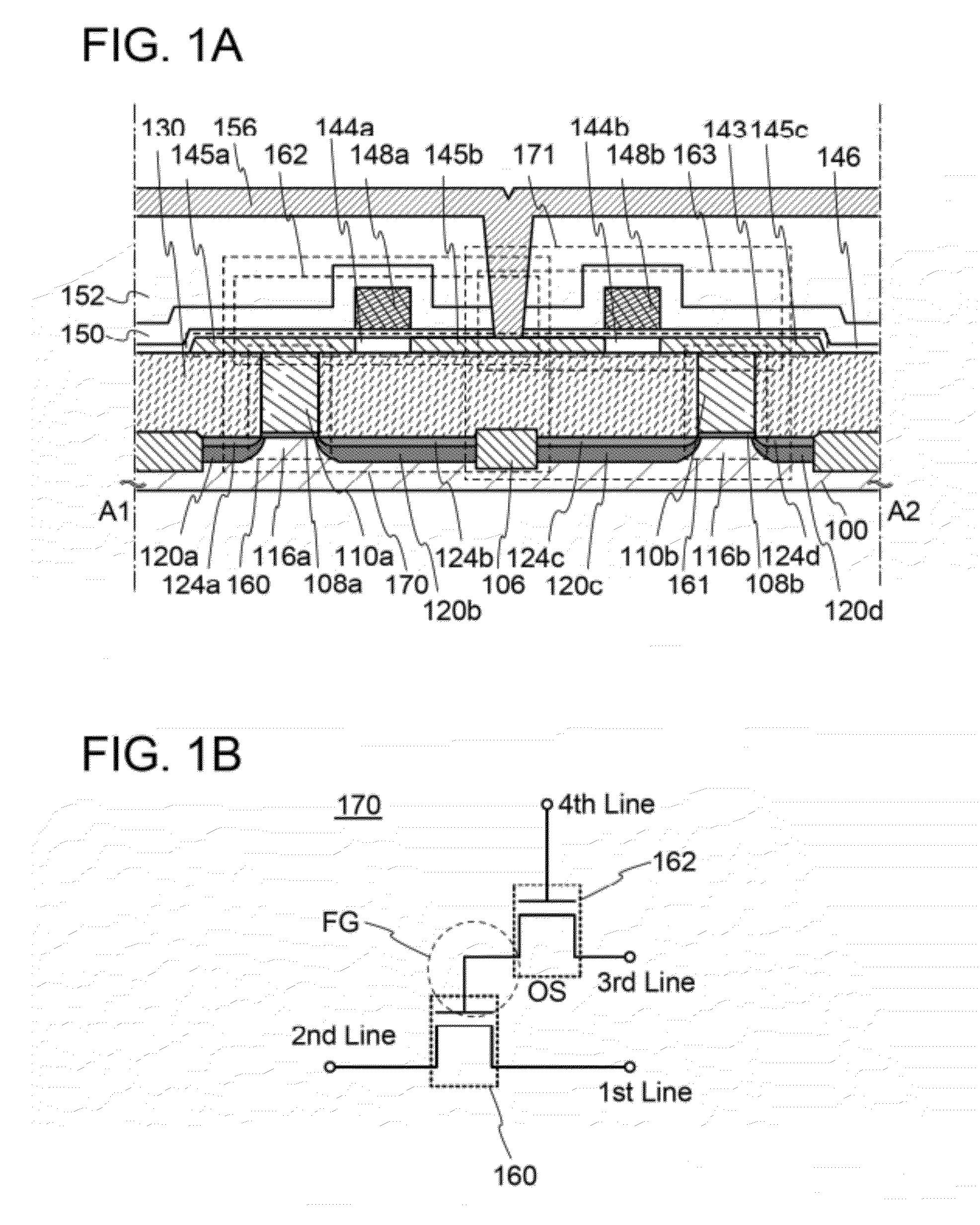
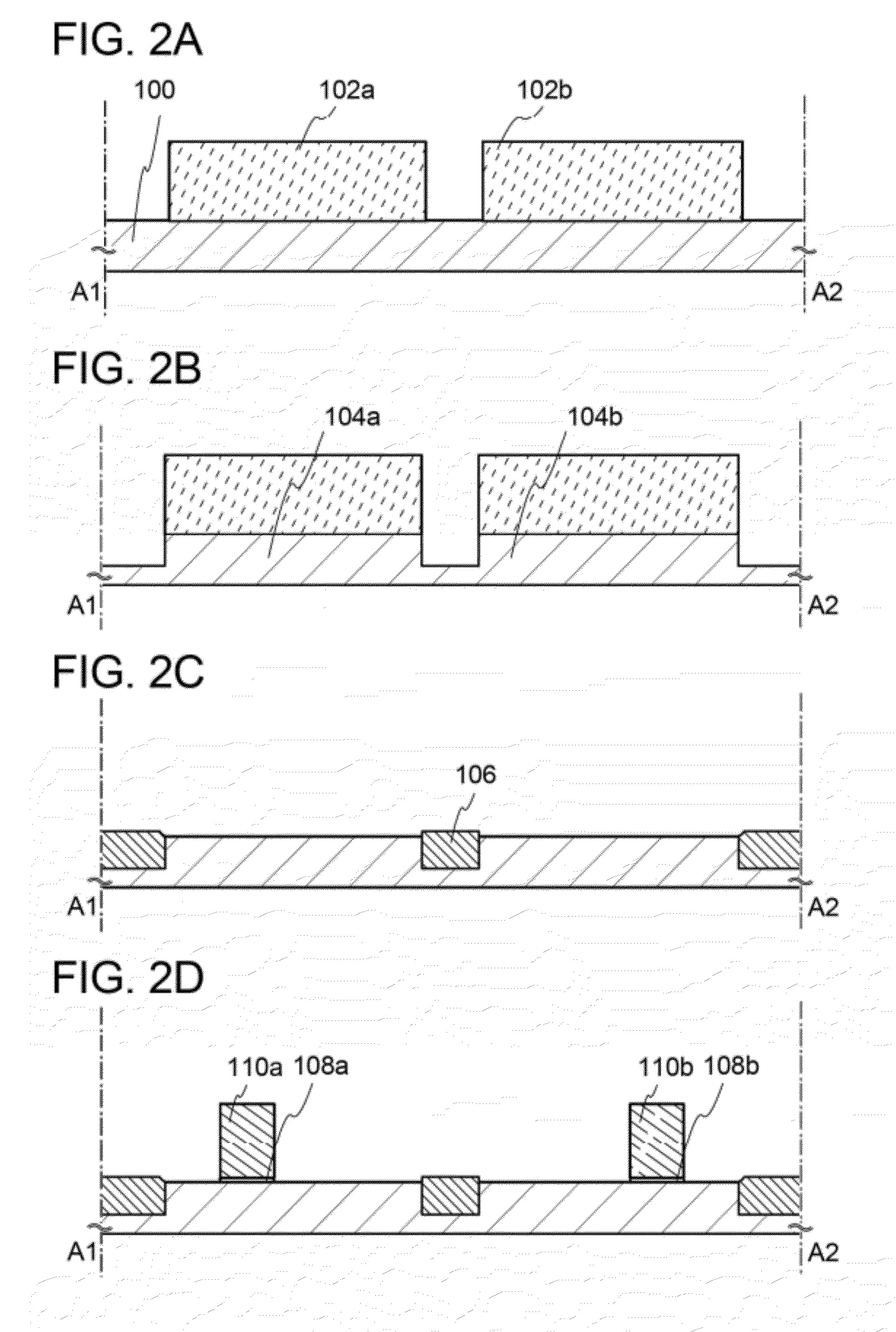
[0046]In this embodiment, a structure and a manufacturing method of semiconductor devices according to one embodiment of the present invention will be described with reference to FIGS. 1A and 1B, FIGS. 2A to 2D, FIGS. 3A to 3D, FIGS. 4A to 4C, and FIGS. 5A to 5C.
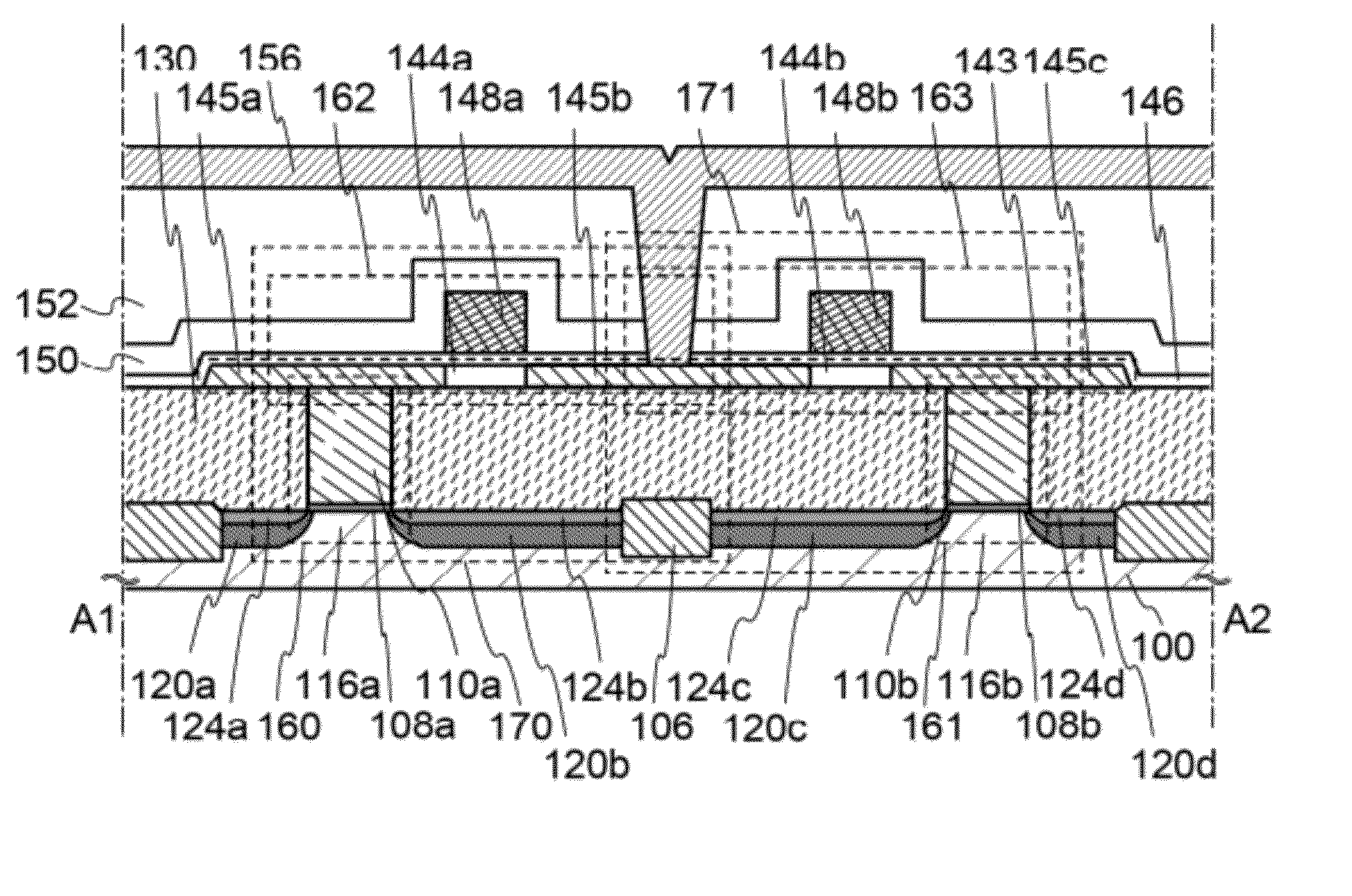
[0047]FIGS. 1A and 1B illustrate an example of a structure of the semiconductor device. FIG. 1A is a cross-sectional view of the semiconductor device, and FIG. 1B is a circuit diagram of the semiconductor device. The semiconductor device in FIGS. 1A and 1B can be used as a memory device. Note that the semiconductor device illustrated in FIGS. 1A and 1B is just an example of a semiconductor device having predetermined functions and does not represent all semiconductor devices according to one embodiment of the present invention. The semiconductor device according to one embodiment of the present invention can have another function by changing connection of an electrode or the like as appropriate.
[0048]The semiconductor device...
embodiment 2
[0148]In this embodiment, a semiconductor device partly different from the semiconductor device shown in the above embodiment is described with reference to FIGS. 6A and 6B and FIGS. 7A to 7D. Note that in this embodiment, only different portions from the above embodiment will be described.
[0149]FIG. 6A is a cross-sectional view of the semiconductor device, and FIG. 6B is a circuit diagram of the semiconductor device. The semiconductor device in FIGS. 6A and 6B can also be used as a memory device.
[0150]The semiconductor device illustrated in FIG. 6A includes, in a lower portion, the transistors 160 and 161, and in an upper portion, the transistors 162 and 163, a capacitor 164, and a capacitor 165. In addition, the transistors 160 and 162 and the capacitor 164 can form a memory cell 172, and the transistors 161 and 163 and the capacitor 165 can form a memory cell 173.
[0151]The capacitor 164 includes the gate electrode 110a, the oxide semiconductor layer 143, the gate insulating layer...
embodiment 3
[0171]In this embodiment, a semiconductor device partly different from the semiconductor device shown in the above embodiment is described with reference to FIG. 8 and FIGS. 9A to 9C. Note that in this embodiment, only different portions from the above embodiment will be described.
[0172]The semiconductor device illustrated in FIG. 8 includes, in a lower portion, the transistors 160 and 161, and in an upper portion, a transistor 166, a transistor 167, a capacitor 168, and a capacitor 169. In addition, the transistors 160 and 166 and the capacitor 168 can form a memory cell 174, and the transistors 161 and 167 and the capacitor 169 can form a memory cell 175. Note that the structures of the transistors 160 and 161 in the lower portion are similar to those of the transistors 160 and 161 illustrated in FIG. 6A and thus is not described in detail.
[0173]The capacitor 168 includes the gate electrode 110a, the oxide semiconductor layer 143, the gate insulating layer 146, and the electrode 1...
PUM
| Property | Measurement | Unit |
|---|---|---|
| Electrical resistance | aaaaa | aaaaa |
| Electrical conductor | aaaaa | aaaaa |
| Semiconductor properties | aaaaa | aaaaa |
Abstract
Description
Claims
Application Information
 Login to View More