
Catalyst for Synthesizing 1-Hexene from Ethylene Trimerization and Application Thereof
a technology of ethylene trimerization and catalyst, which is applied in the direction of organic compound/hydride/coordination complex catalyst, physical/chemical process catalyst, bulk chemical production, etc., can solve the problems of catalysts that cannot meet current requirements, the activity and selectivity of this composition have not been significantly improved, etc., to facilitate the coordination of ethylene molecular, facilitate long periodic run of reactor, and facilitate the effect of ethylene molecular coordination
- Summary
- Abstract
- Description
- Claims
- Application Information
AI Technical Summary
Benefits of technology
Problems solved by technology
Method used
Image

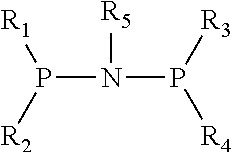
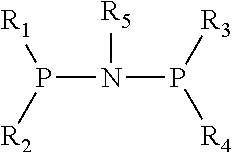
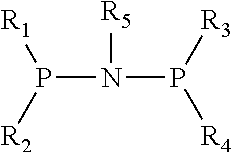
Examples
example 1
[0020]1. Preparation of (diphenyl)phosphonitryl(cyclopropyl)phosphine(diphenyl) ligand
[0021](1) Preparation of N,N-diisopropyldichlorophosphoamide
[0022]To a 250 ml reactor with N2 sufficient exchange, the dehydrated toluene (100 ml), and PCl3 (21.87 ml, 0.25 mol) are added under stirring. Then the temperature is reduced to −20° C. At room temperature, diisopropylamine (70 ml, 0.5 mol) is added slowly under stirring. After stirring for 3 hours, the temperature is raised to room temperature and then the reaction is continued for 2 hours. 38.1 g (0.19 mol, 74%) product is finally obtained after filtrating and drying.
[0023](2) Preparation of Grignard Reagent Phenylmagnesium Bromide
[0024]To a 250 ml reactor with N2 sufficient exchange, the dehydrated THF (100 ml), and magnesium powder (9.11 g, 0.375 mol) are added under stirring. The temperature is reduced by ice bath and brombenzene (11.775 g, 0.075 mol) is added dropwise slowly. Two hours later, under heating and refluxing, the reactio...
example 2
[0031]1. Preparation of (diphenyl)phosphonitryl(cyclopentyl)phosphine(diphenyl) ligand
[0032](1) Preparation of N,N-diisopropyldichlorophosphoamide
[0033]The process is the same as that in Example 1.
[0034](2) Preparation of Grignard Reagent Phenylmagnesium Bromide
[0035]The process is the same as that in Example 1.
[0036](3) Preparation of Diphenyl Phosphorus Chloride
[0037]The process is the same as that in Example 1.
[0038](4) Preparation of (diphenyl)phosphonitryl(cyclopentyl)phosphine(diphenyl)
[0039]To a 100 ml reactor with N2 sufficient exchange, the dehydrated dichlormethane (20 ml), triethylamine (3.75 ml) and diphenyl phosphorus chloride (1.326 ml, 7.2 mmol) are added under stirring. The temperature is reduced to 0° C. The cyclopentylamine (0.415 ml, 3.5 mmol) is added slowly. The reaction is carried out under stirring for 30 minutes and then raised to room temperature to continue for 12 hours. The product (0.55 g, 32.68%) is finally obtained after filtrating and drying.
2. Prepara...
example 3
[0042]1. Preparation of (diphenyl)phosphonitryl(fluorenyl)phosphine(diphenyl) ligand
[0043](1) Preparation of N,N-diisopropyldichlorophosphoamide
[0044]The process is the same as that in Example 1.
[0045](2) Preparation of Grignard Reagent Phenylmagnesium Bromide
[0046]The process is the same as that in Example 1.
[0047](3) Preparation of Diphenyl Phosphorus Chloride
[0048]The process is the same as that in Example 1.
[0049](4) Preparation of (diphenyl)phosphonitryl(fluorenyl)phosphine(diphenyl)
[0050]To a 100 ml reactor with N2 sufficient exchange, the dehydrated dichlormethane (20 ml), triethylamine (3.75 ml) and diphenyl phosphorus chloride (1.326 ml, 7.2 mmol) are added under stirring. The temperature is reduced to 0° C. The fluorenamine (0.652 g, 3.6 mmol) is added slowly. The reaction is carried out under stirring for 30 minutes and then raised to room temperature to continue for 12 hours. The product (0.48 g, 24.3%) is finally obtained after filtrating and drying.
2. Preparation of Ca...
PUM
| Property | Measurement | Unit |
|---|---|---|
| Temperature | aaaaa | aaaaa |
| Temperature | aaaaa | aaaaa |
| Temperature | aaaaa | aaaaa |
Abstract
Description
Claims
Application Information
 Login to View More