Power semiconductor devices and fabrication methods

a technology of power semiconductors and fabrication methods, applied in semiconductor devices, instruments, electrical appliances, etc., can solve the problems of increased on-state losses, increased voltage drop in on-state, and smaller or larger pitch between the two depletion layers, so as to reduce device on-resistance, uniform on-state behaviour, and shorten the channel

a technology of power semiconductors and fabrication methods, applied in semiconductor devices, instruments, electrical appliances, etc., can solve the problems of increased on-state losses, increased voltage drop in on-state, and smaller or larger pitch between the two depletion layers, so as to reduce device on-resistance, uniform on-state behaviour, and shorten the channel

US20130069712A1Inactive Publication Date: 2013-03-21POWER INTEGRATIONS INC

Image

Smart Image Click on the blue labels to locate them in the text.
Viewing Examples
Smart Image
  • Power semiconductor devices and fabrication methods
  • Power semiconductor devices and fabrication methods
  • Power semiconductor devices and fabrication methods

Examples

Experimental program
Comparison scheme
Effect test

Embodiment Construction

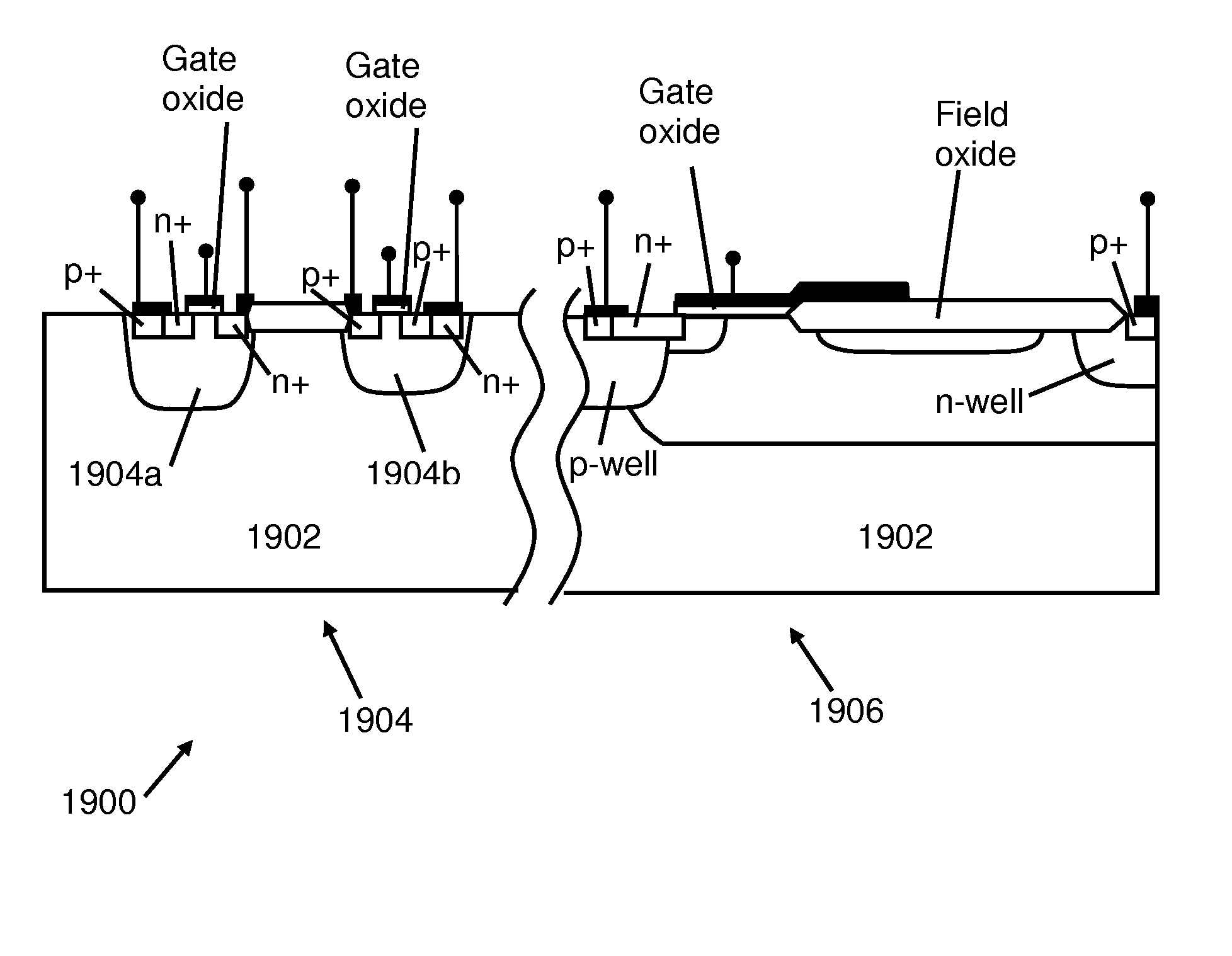
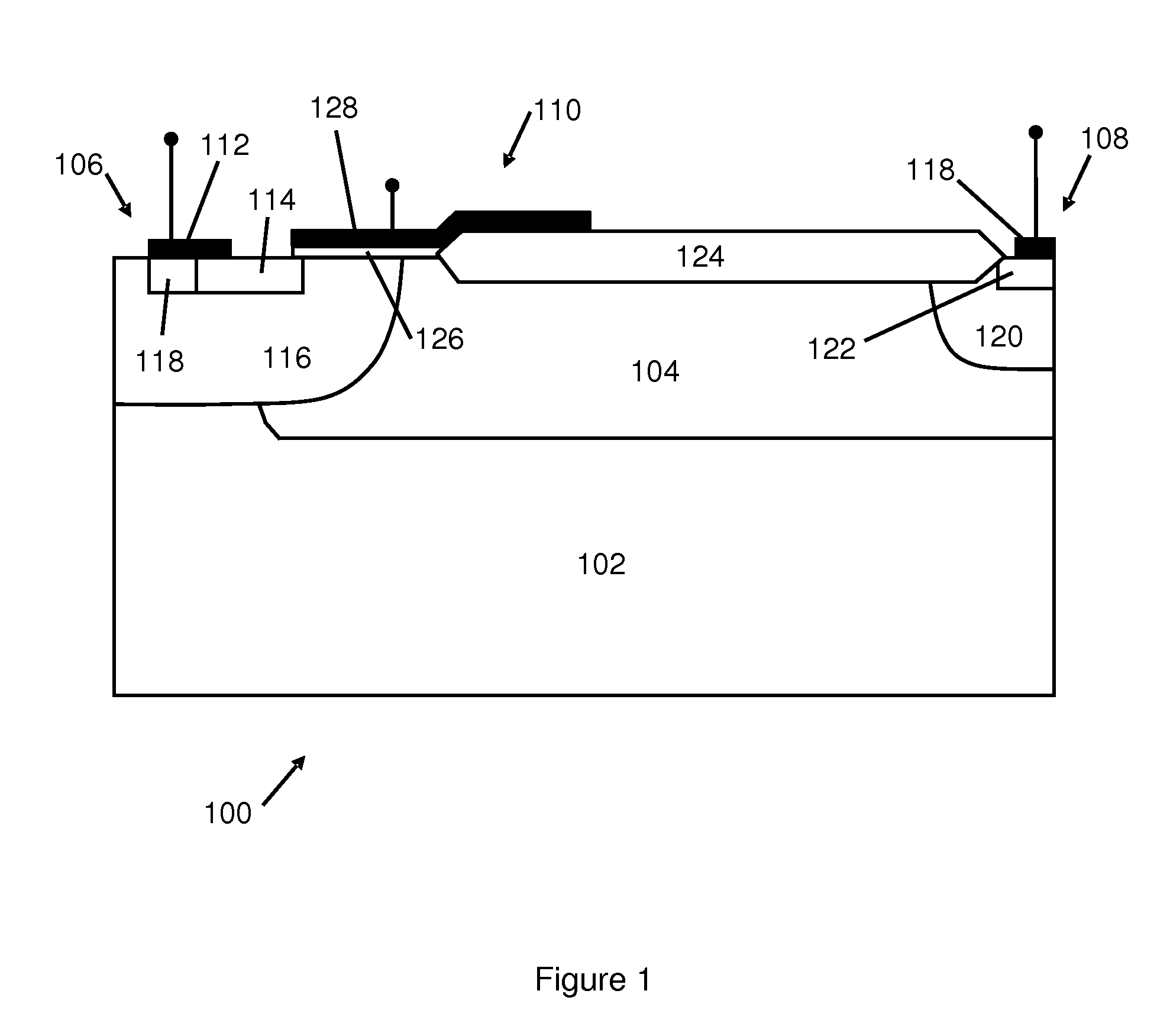
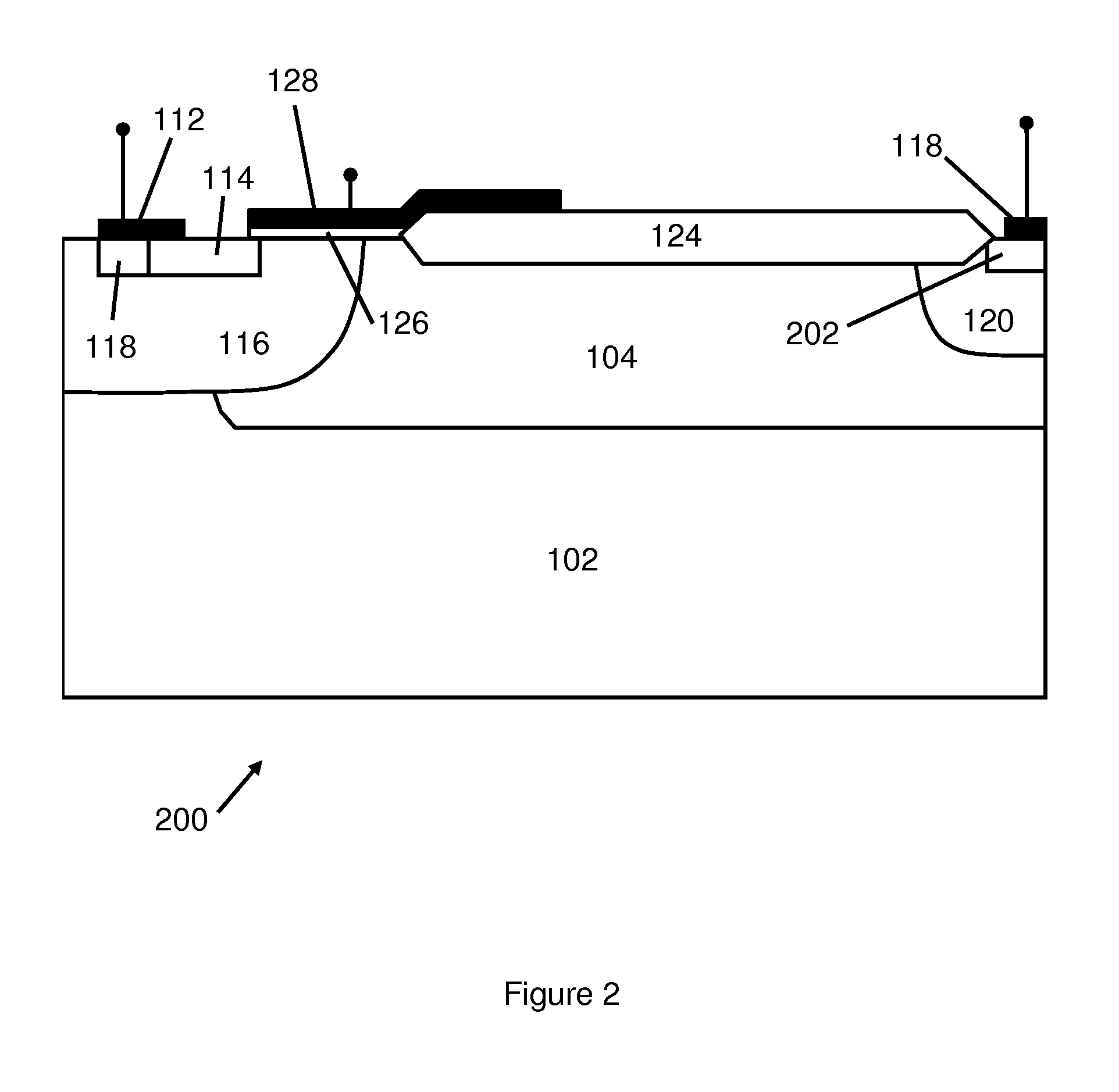
[0058]Broadly speaking we will describe a lateral high voltage device where the p-top is used both as a double RESURF layer and as the background doping for the MOS channel in a high voltage lateral device. The process of forming the p-top in the channel region does not require any additional mask layer or processing steps as it is done at the same time and using the same mask as that for the double RESURF layer.

[0059]Instead of using the p-well as the background region for the MOS channel which could result in a long lateral diffusion and therefore high channel length, the use of the p-top in the channel region leads to a shorter channel length and therefore higher transconductance for the MOS channel. The reason that the channel formed in the p-top is shorter is because the p-top is a shallower layer and hence its lateral diffusion is significantly smaller than that of the p-well. In addition, due to the fact that the p-top is a much shallower layer than the p-well, the parasitic ...

the structure of the environmentally friendly knitted fabric provided by the present invention; figure 2 Flow chart of the yarn wrapping machine for environmentally friendly knitted fabrics and storage devices; image 3 Is the parameter map of the yarn covering machine
Login to View More

PUM

No PUM Login to View More

Abstract

We describe a RESURF semiconductor device having an n-drift region with a p-top layer and in which a MOS (Metal Oxide Semiconductor) channel of the device is formed within the p-top layer.

Description

FIELD OF THE INVENTION[0001]This invention relates to lateral power semiconductor devices, and more particularly to improved RESURF (REduced SURface Field) semiconductor devices and their fabrication methods. The techniques we describe are useful for high voltage semiconductor devices incorporated into power hybrid and integrated circuits. They are particularly advantageous for RESURF MOS (metal oxide semiconductor) devices such as LDMOSFETs and for MOS-bipolar transistors such as lateral insulated gate bipolar transistors (LIGBTs) incorporating RESURF.BACKGROUND TO THE INVENTION[0002]Lateral power devices typically operate with a voltage in the range 20 V to 1.2 KV. Power devices typically operate with a current in the range 10 mA to 50 A and typically higher than 0.1 A and smaller than 5 A. Such devices may also be referred to as “high voltage / power devices”. These devices are typically capable of delivering from a few milliwatts to 1 Watt or even a few tens of Watts of power. The...

Claims

the structure of the environmentally friendly knitted fabric provided by the present invention; figure 2 Flow chart of the yarn wrapping machine for environmentally friendly knitted fabrics and storage devices; image 3 Is the parameter map of the yarn covering machine
Login to View More

Application Information

Patent Timeline
21 Mar 2013
Publication
US20130069712A1
IPC
H01L29/78; G05F3/02; H01L21/336
CPC
H01L29/7816; H01L29/1095; H01L29/42368; H01L29/66325; H01L29/66681; H01L29/7393; H01L2924/0002; H01L29/7824
Inventors
TRAJKOVIC, TANYA; UDREA, FLORIN