
Controlled release pharmaceutical composition
a technology of pharmaceutical compositions and controlled release, which is applied in the direction of biocide, animal repellents, dispersed delivery, etc., can solve the problems of large dosage form and weight, difficulty in swallowing children and elder people, and controlled release pharmaceutical compositions, so as to improve geriatric and pediatric patient compliance, reduce the frequency of dosing, and improve stability
- Summary
- Abstract
- Description
- Claims
- Application Information
AI Technical Summary
Benefits of technology
Problems solved by technology
Method used
Image

Examples
example-1
[0113]The present, controlled release pharmaceutical composition can be prepared as shown in table 1 and table 2 and described below.
Drug Loading Composition
[0114]
TABLE 1Ingredientsmg / unitmicrocrystalline cellulose spheres100.0(Celphere ® CP 203)ondansetron24.0hydroxypropyl cellulose (Klucel ® IP)6.0Talc10.0isopropyl alcohol130.0water80.0solid content in coating dispersion40.0weight of ondansetron drug loaded pellets140.0
Procedure
[0115]Isopropyl alcohol and water were mixed to get a solvent mixture.[0116]Talc and ondansetron were dispersed in ⅔rd of solvent mixture using rotor stator disperser.[0117]Hydroxypropyl cellulose was dissolved in the remaining solvent mixture and mixed with the above dispersion.[0118]Drug dispersion was sprayed on to microcrystalline cellulose spheres to get drug loaded pellets and used for controlled release, coating.
CR Coating Composition
[0119]
TABLE 2Ingredientsmg / unitPolyvinyl acetate dispersion52.5(Kollicoat ® SR 30 D)Triethyl citrate0.8Talc4.5Water47....
example-2
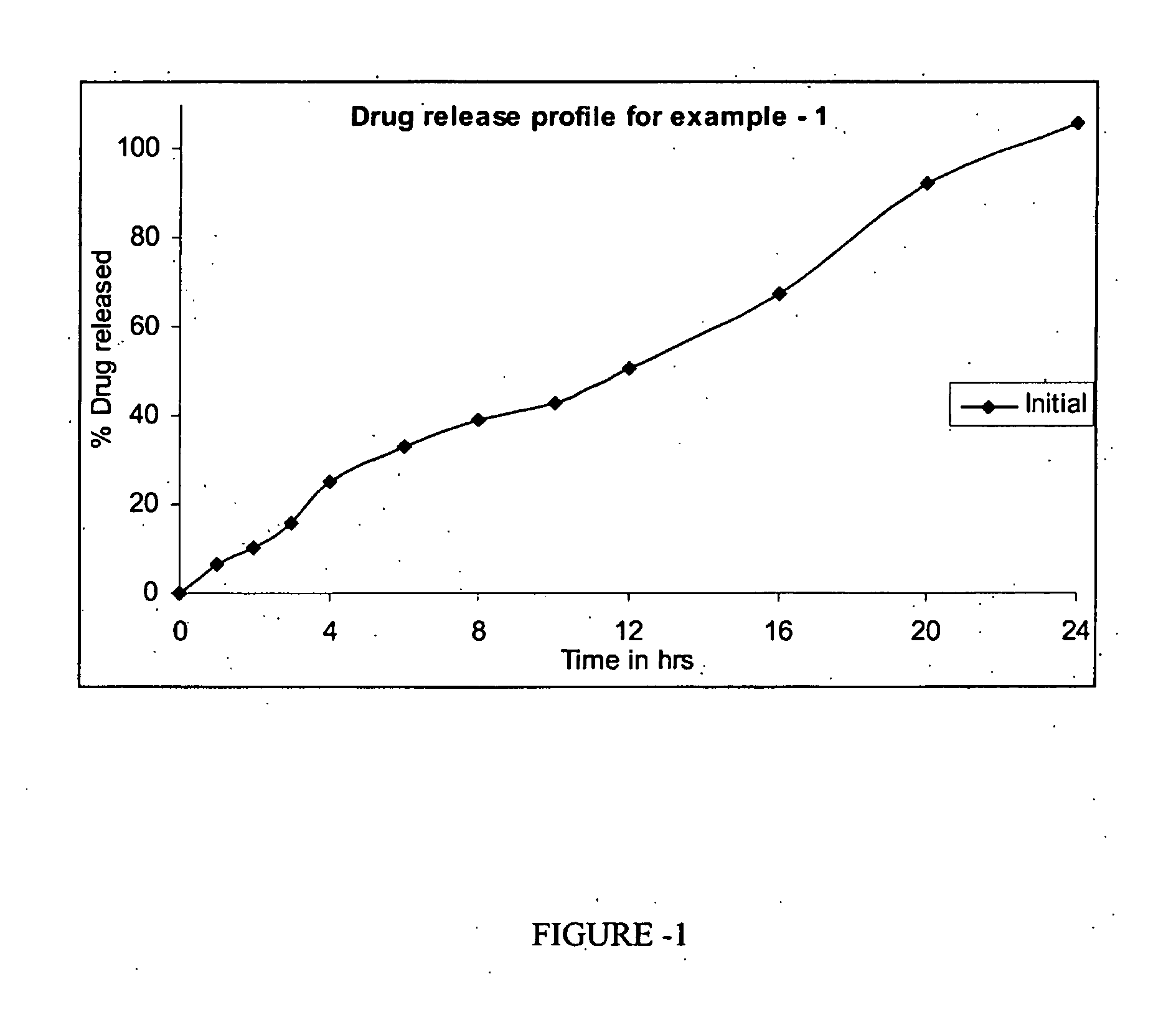
[0127]The pharmaceutical composition as prepared in example-1 was studied for dissolution and the results obtained are shown in table 4 and FIG. 1.
Dissolution Conditions—
[0128]USP dissolution apparatus I (Basket), 0.01N HCl, 37° C. ±0.5° C., 75 rpm
TABLE 4% dissolutionTime in hoursTest example -116.4210.3315.9425.1633.3839.21042.81250.61667.62092.524105.6
example-3
Stability Studies:
[0129]The controlled release pharmaceutical composition as prepared in example-1 was kept for stability studies at 40° C. / 75% RH and 30° C. / 65% RH for 3 months and the results are shown in table 5.
TABLE 5Test40° C. / 30° C. / 75% RH65% RHInitial2M3M% Assay - (limit 90-110)102.2103.5100.9% Loss on drying0.820.930.75% Dissolution (N = 6) 1 h6.43.44.0in 0.01N HCl, USP 2 h10.312.611.2Apparatus I, 100 rpm 3 h15.921.419.0 4 h25.129.025.0 6 h33.341.633.1 8 h39.252.339.110 h42.860.144.212 h50.665.852.516 h67.673.760.320 h92.579.481.124 h105.683.699.3
PUM
| Property | Measurement | Unit |
|---|---|---|
| solubility | aaaaa | aaaaa |
| solubility | aaaaa | aaaaa |
| solubility | aaaaa | aaaaa |
Abstract
Description
Claims
Application Information
 Login to View More