Gravity Gradiometer

US20140000362A1Active Publication Date: 2014-01-02SRC INC
6 Cites 8 Cited by

Patent Information

Authority / Receiving Office
US · United States
Current Assignee / Owner
Publication Date
2014-01-02

Smart Images

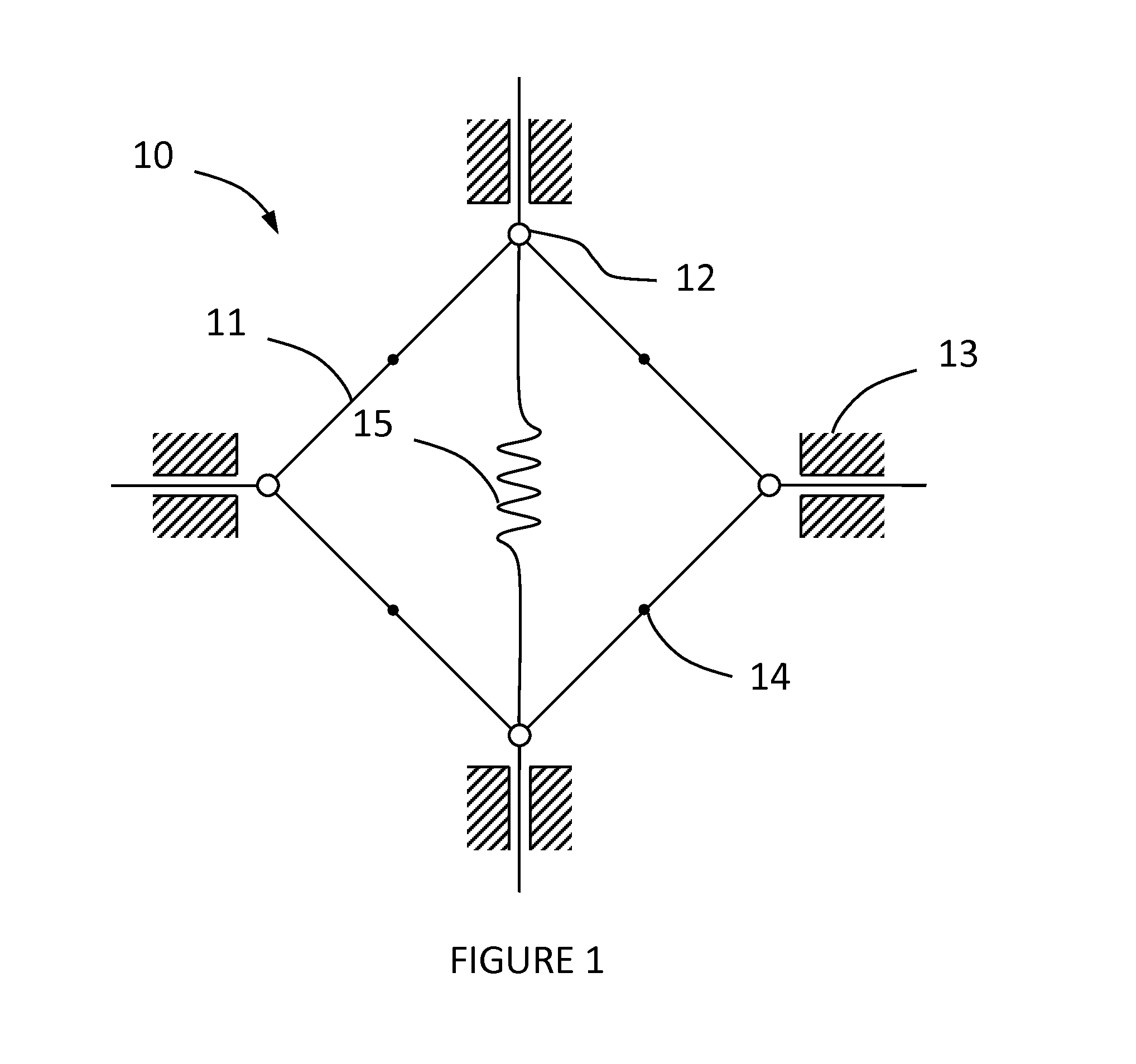
  • Figure 1
    Figure 1
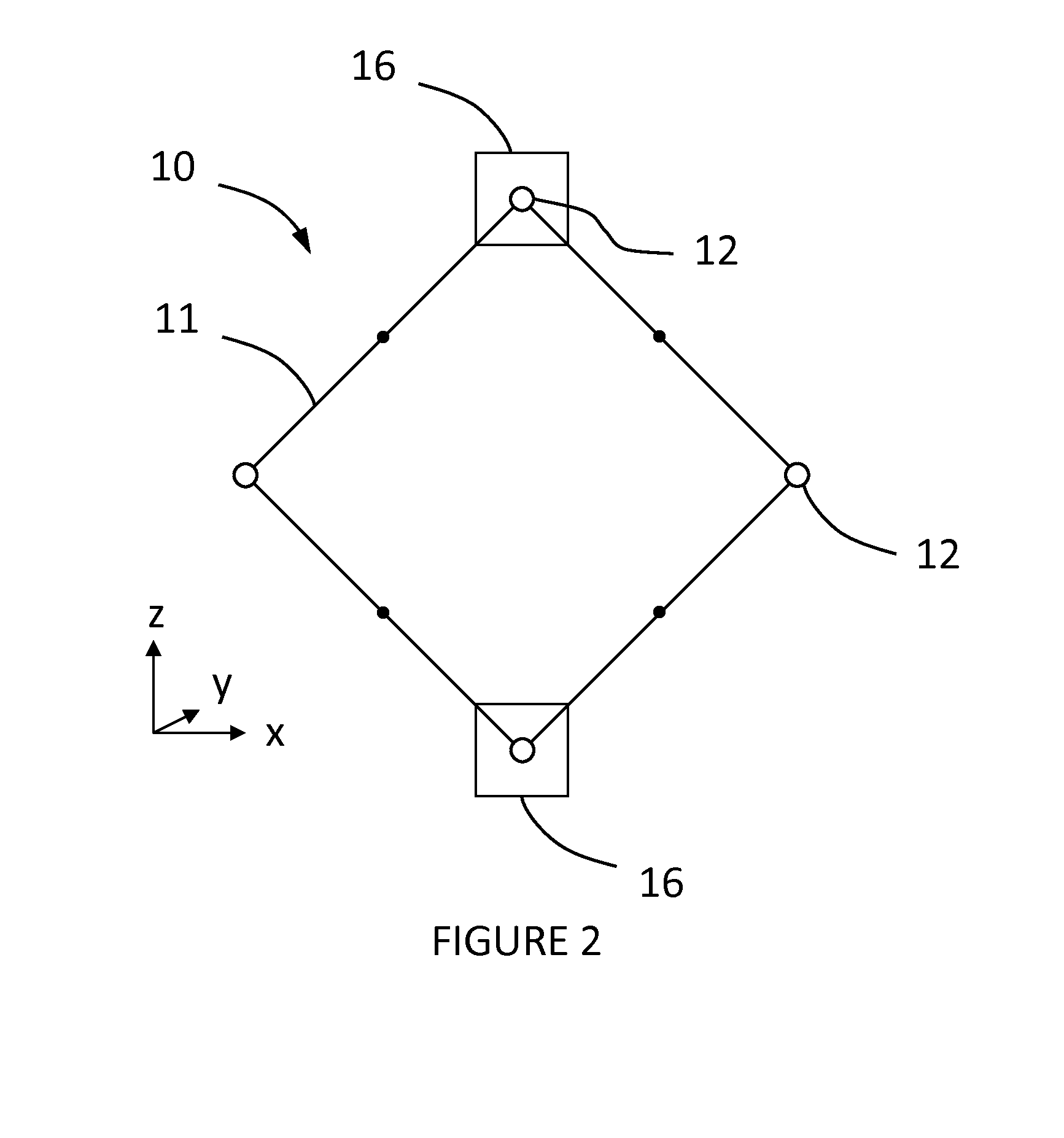
  • Figure 2
    Figure 2
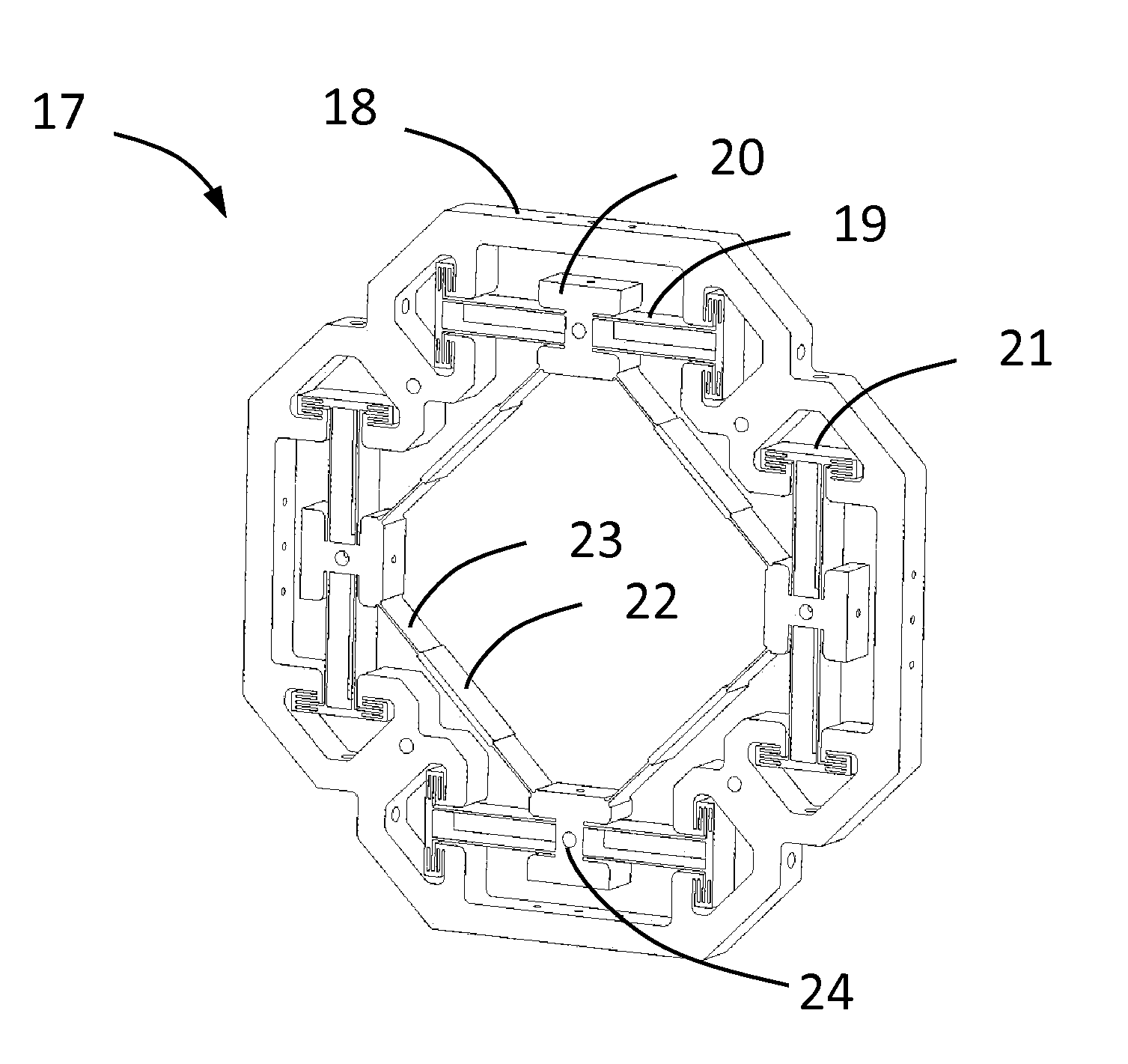
  • Figure 3
    Figure 3
Patent Text Reader

Abstract

A gravity gradiometer having at least three differential accelerometers with a low response to linear accelerations and at least six angular accelerometers that give it the capability of measuring angular rates by integrating the angular accelerations. Both types of accelerometers are based on a compliant mechanism with very low and adjustable stiffness that is achieved by using flexures under compressive load that contribute a negative stiffness to the total elastic response of the mechanism. Both types of accelerometers are operated in a servo-compensation feedback mode so that at no time is the mechanism far from its equilibrium position.
Need to check novelty before this filing date? Find Prior Art

Description

BACKGROUND OF THE INVENTION

[0001] 1. Field of the Invention

[0002] The present invention relates to gravity gradiometry and, more particularly, to quadrupole gravity gradiometers.

[0003] 2. Description of the Related Art

[0004] Measuring the gravitational field involves quantifying the gravitational forces acting on test masses. Gravimeter instruments measure the acceleration of gravity and are sensitive to linear accelerations. Doing measurements with an instrument carried by a non-inertial moving platform requires evaluating the inertial forces acting on test masses and subtracting their effect from the measured signal. Also, platform induced forces are many orders of magnitude higher than the variations of acceleration of gravity measured and an appropriate suspension is required on order to reduce such forces to a level that can be handled by the dynamic range of the instrument. For that reason gravity gradiometer instruments are more useful, since they have low sensitivity to linear a...

Examples

Embodiment Construction

[0025]Referring now to the drawings, wherein like numbers refer to like parts throughout, there is seen in FIG. 1 a differential accelerometer mechanism 10 according to the present that is constrained to move in the plane of the figure. Mechanism 10 includes a linkage comprising four rigid beams 11 of equal length, articulated at a series of nodes 12. Nodes 12 are constrained to move perpendicularly to the symmetry axes of mechanism 10. The constraint is achieved by suspensions, symbolically represented by a series of guides 13, attached to a fixed frame. While nodes 12 execute rectilinear movements, the beam midpoints 14 move along a circle centered at the geometric center of mechanism 10. If an elastic element, such as a spring 15, and a test mass (not shown) are added to mechanism 10, it becomes an accelerometer.

[0026]It is obvious that mechanism 10 has one degree of freedom. Therefore any combination of springs, in any positions, can be represented symbolically by spring 15. Spr...