
Computerized tomography (CT) fluoroscopy imaging system using a standard intensity ct scan with reduced intensity ct scan overlays
a fluoroscopy and computerized tomography technology, applied in computerized tomographs, medical science, diagnostics, etc., can solve the problems of significantly higher radiation emission during imaging than conventional 2d x-ray machines, and generally impossible to substantially continuously operate a conventional ct machine, and achieve the effect of reducing the intensity of ct scan overlays
- Summary
- Abstract
- Description
- Claims
- Application Information
AI Technical Summary
Benefits of technology
Problems solved by technology
Method used
Image


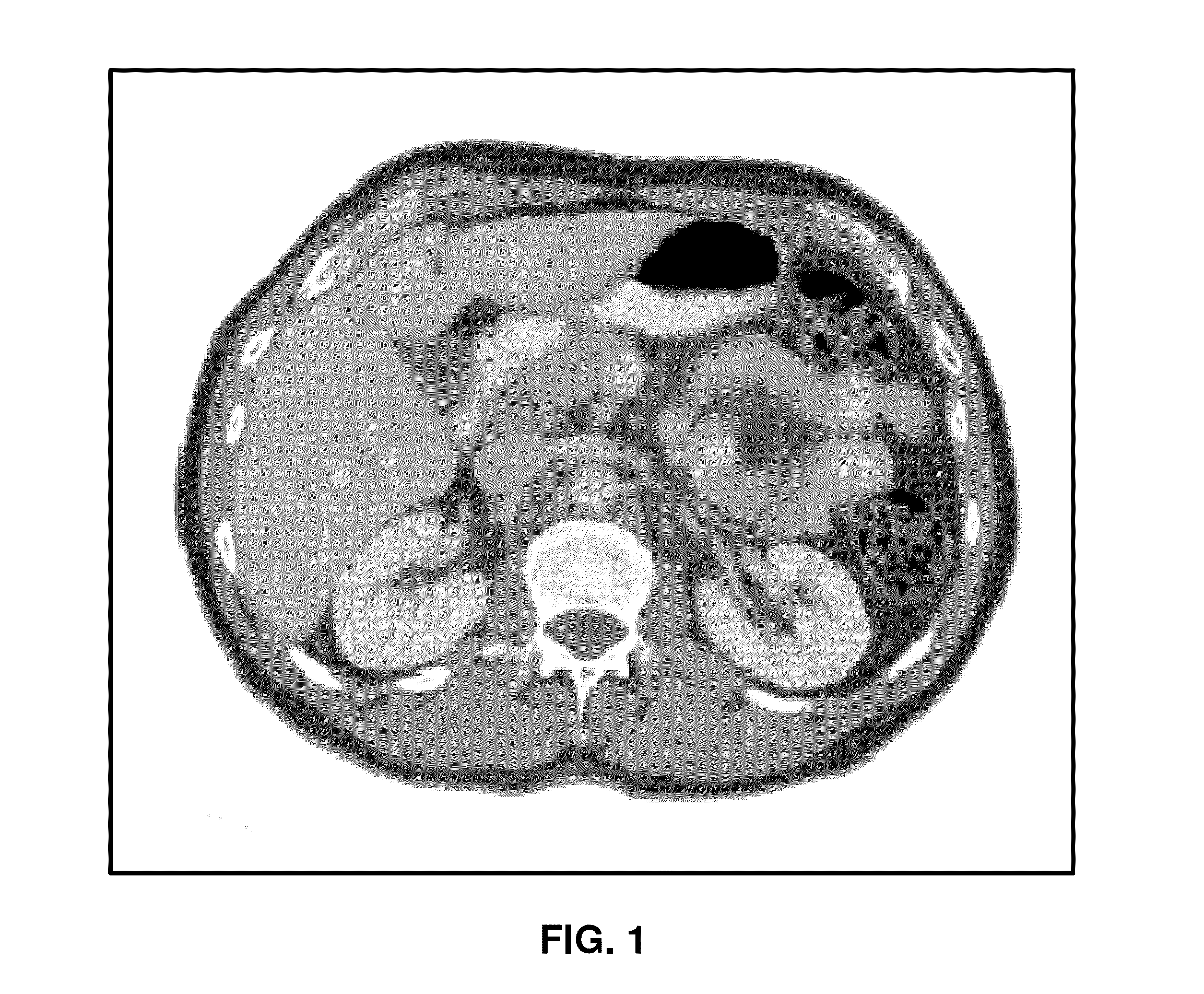
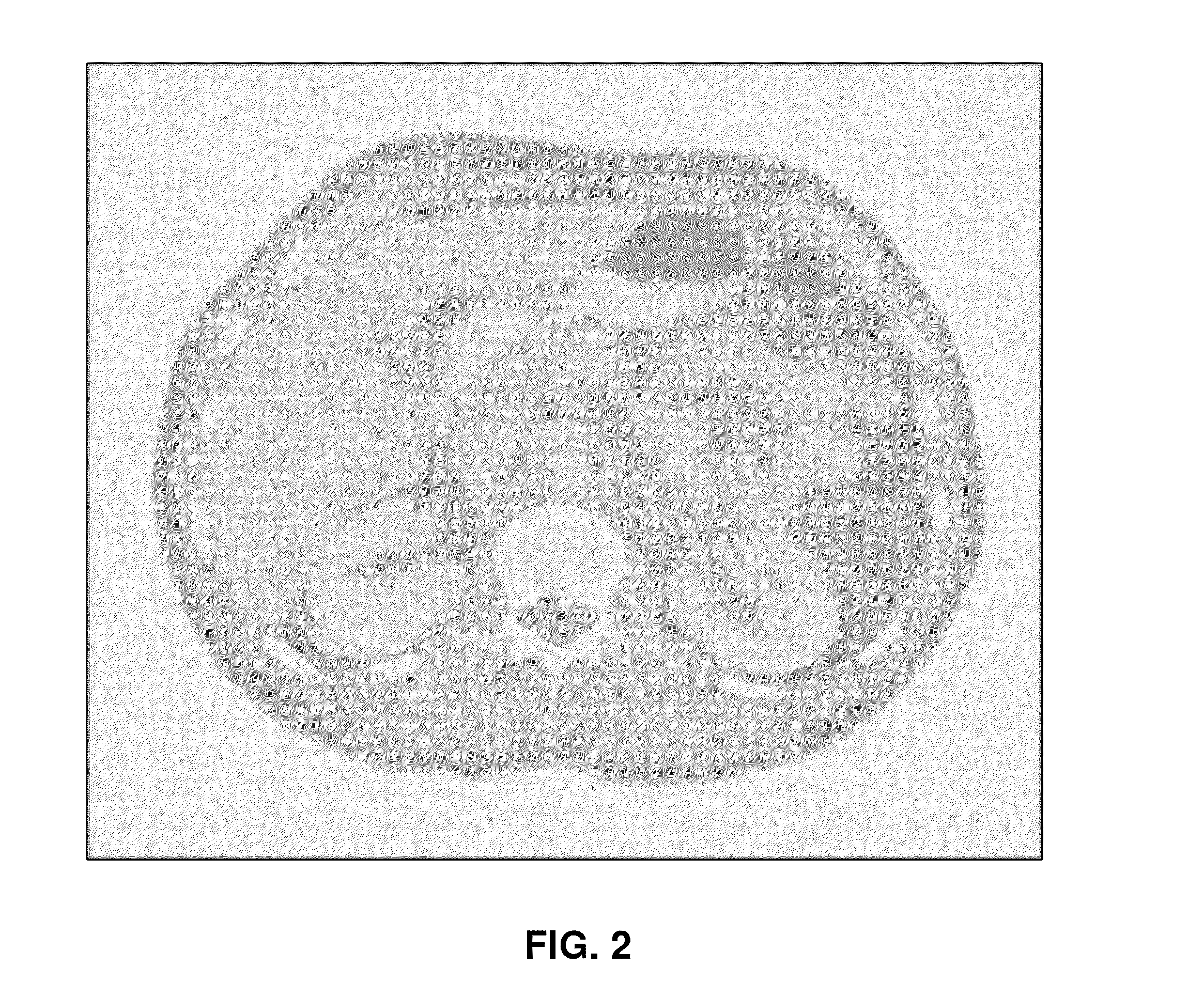
Examples
Embodiment Construction
[0035]The present invention provides a novel CT system capable of providing 3D fluoroscopy of an internal procedure site during a medical procedure so as to visualize patient anatomy, medical instruments, prostheses, etc. during the medical procedure without subjecting the patient to unacceptable quantities of X-ray radiation. This new CT system provides 3D fluoroscopy of the internal procedure site using a standard intensity CT scan with reduced intensity CT scan overlays.
[0036]More particularly, it has been noted that certain medical elements (e.g., surgical instruments, prostheses, catheters, needles, injectable substances such as iodine, etc.) are relatively high-contrast elements which are capable of being accurately visualized using lower X-ray intensities than is generally necessary in order to accurately visualize low-contrast (e.g., soft tissue) anatomy. Thus, for example, FIG. 3 shows a high-contrast surgical instrument disposed within the anatomy imaged by a CT machine op...
PUM
 Login to View More
 Abstract
Description
Claims
Application Information
 Login to View More