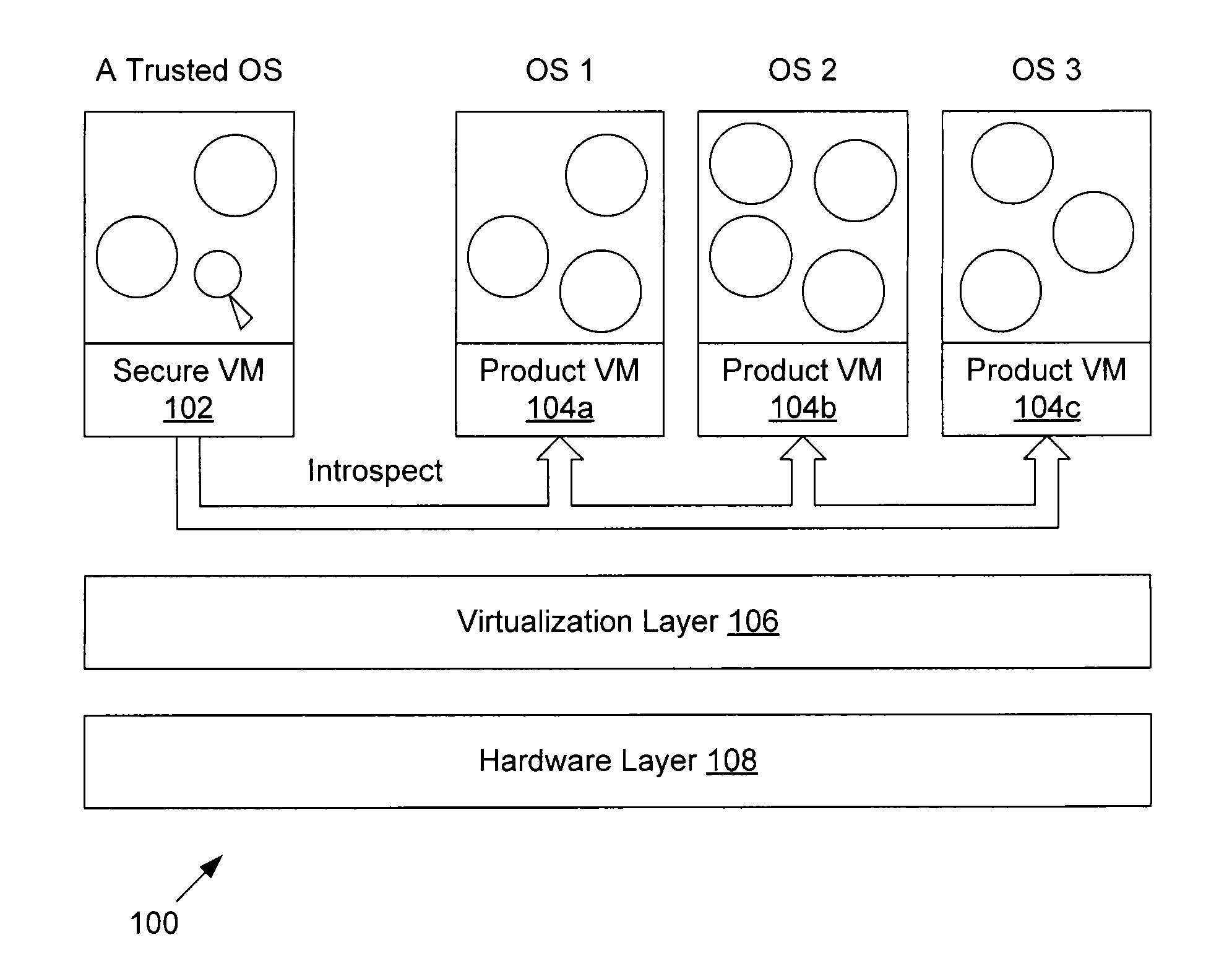
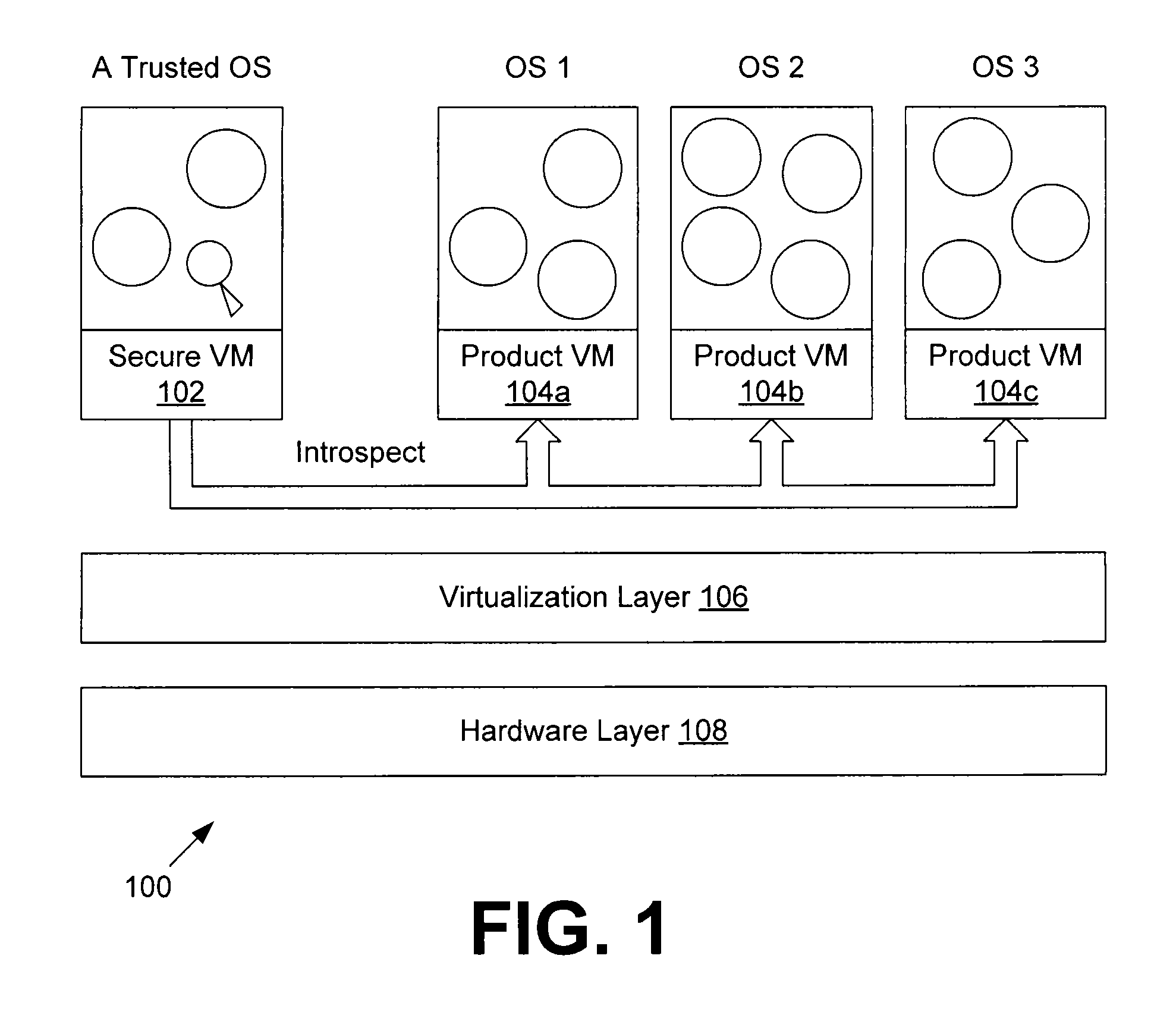
For example, the secured and monitoring virtual machine 102 may not be connected to
the Internet, and as such it is very difficult for hackers to compromise this machine.
Acquiring such knowledge can be tedious and time-consuming, even for an OS whose
source code is available.
For a closed source OS, one may have to manually reverse engineer the internal kernel workings and determine how to introspect, which may be error-prone.
As previously mentioned, the
semantic gap refers to the difficulty in interpreting the low level bits and bytes from the virtual machine being monitored into a high level semantic state that the secured, monitoring virtual machine can understand.
In addition, such a manual process has to be repeated for different kernels, which may suffer from frequent changes due to the new releases or patches.
Furthermore, it may also introduce opportunities for attackers to evade these hand-built introspection tools if they are not carefully written.
However, due to the nature of dynamic analysis, such an approach is limited to reproducing introspection code that has been executed and trained.
Thus, these approaches fail to provide a mechanism for bridging the semantic gap in machine introspection that is automatic and transparent to end users, native developers, and the
operating system.
Meanwhile, it may be that not all kernel
data access can be redirected.
For example, an
interrupt handler expects to read some hardware states, but after the redirection, the
interrupt handler may receive an inconsistent state leading to kernel panics.
Also, data in the kernel stack cannot be redirected; otherwise kernel
control flow will be disrupted.
It may be adverse to redirect the kernel
data access in context switches,
page fault handlers, or interrupt service routines, or redirect the data access in the execution context of any other processes.
It may be adverse to redirect the kernel stack read, as such action may lead to a kernel
crash (because of
control data such as return addresses in the stack).
Otherwise the system may not be able to find the correct in-guest memory data.
However, the
system call context identification still may not fully isolate all the system call service routines.
However, this may only be true for operands which are both global and heap addresses as well as their propagations (to registers and other memory).
From a security perspective, the traditional program
execution model has at least the following issues: (1) In-VM programs (e.g.,
hostname, rmmod, ps) and kernel states are directly faced by user level, as well as
kernel level malware, and they can often be attacked.
(2) End-users or administrators often have to be authenticated before running in-VM programs to update the kernel state, which may not be ideal for a timely response to intrusions (e.g., kill a
rootkit hidden process), especially for cloud providers who in many cases do not have a user account in the guest-OS.
It may be much harder for attackers to tamper with the
software running out-of-VM, because there is a world switch for the attacks from in-VM to out-of-VM (unless the VMM has vulnerabilities).
Unfortunately, again any in-VM responses can be disabled by attackers because they run at the same
privilege level.
However, the kernel stack data is not reused because the data in the stack is transient and mostly related to kernel
control flow.
Using CR3 and process name can pin-point the process execution context but may not be able to precisely isolate the specific system call context.
However, the
Linux kernel may not have any thread specific support (to the
Linux kernel, a thread may be uniformly treated as a process) and multi-threading may be implemented at user level (e.g., pthread
library which takes care of creating unique stack address for each thread).
Otherwise, when reading these data from the GVM 208, the SVM kernel may enter an inconsistent state (such as
deadlock) and even
crash during the execution of these execution contexts.
However, this may be tedious, challenging, and also kernel-specific (such analysis is performed for each kernel to filter these PCs).
However, this may be expensive as each time there may be three memory references.



 Login to View More
  Login to View More