Ultralow power carbon nanotube logic circuits and method of making same
- Summary
- Abstract
- Description
- Claims
- Application Information
AI Technical Summary
Benefits of technology
Problems solved by technology
Method used
Image

Examples
example one
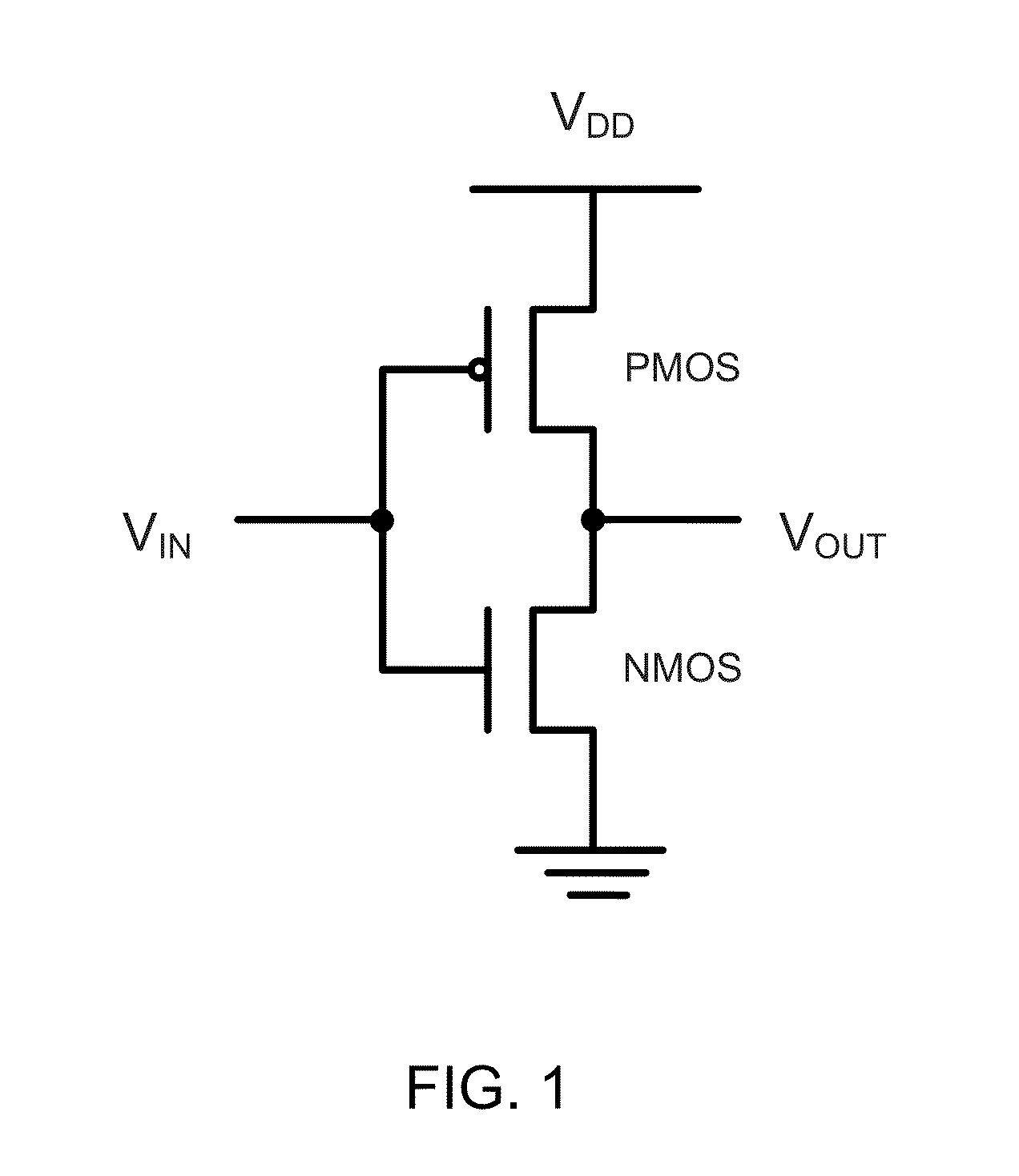
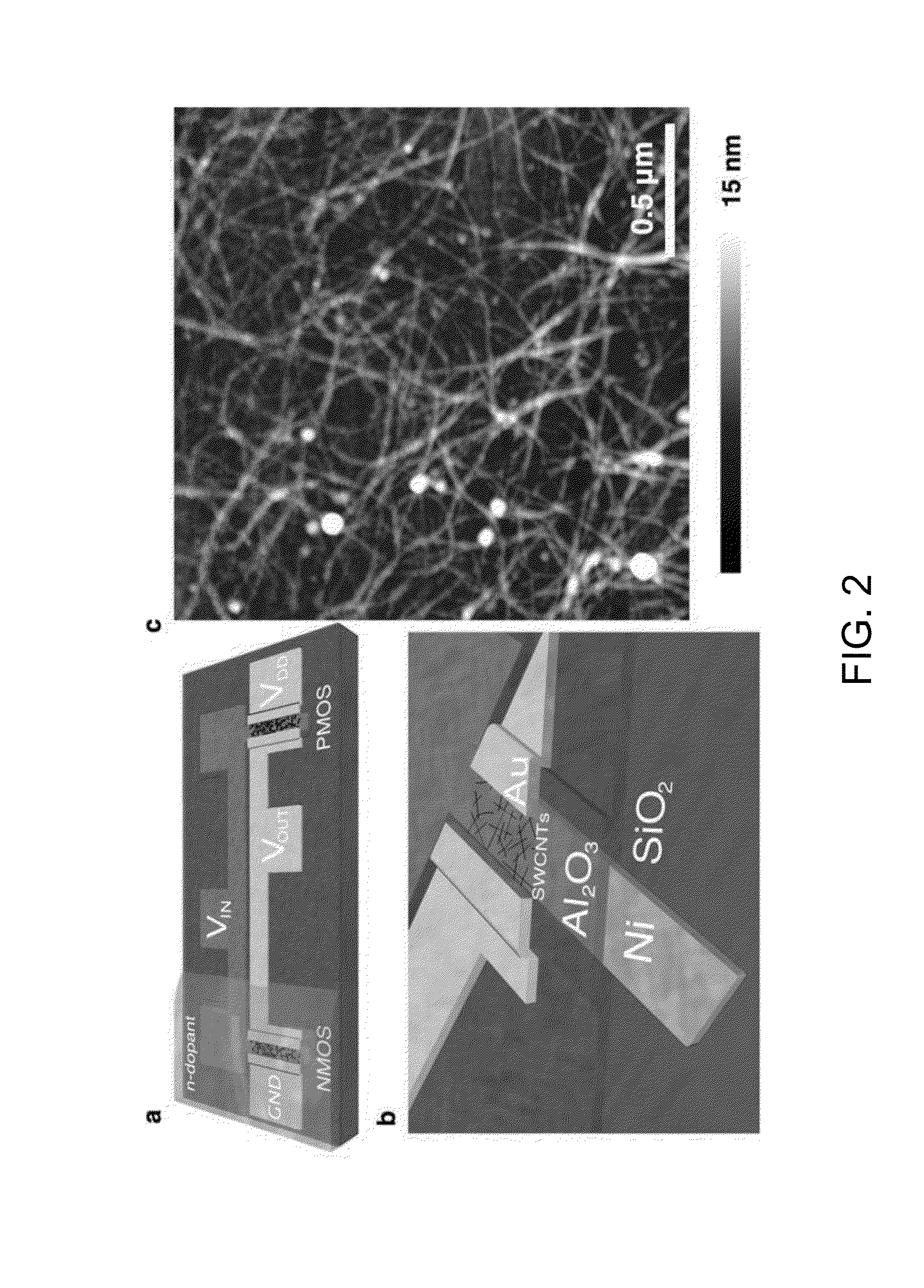
[0076]In one embodiment, threshold voltage control is demonstrated for both p-type and n-type SWCNT TFTs via a local Ni gate structure, which enables ultralow power complementary device operation. For example, a high-performance SWCNT CMOS inverter (logic NOT gate) is provided with reference to FIG. 1 as an initial illustration of this device architecture.
[0077]FIG. 1 shows schematically a circuit diagram of a CMOS logic inverter according to certain embodiments of the disclosure. As shown in FIG. 1, the CMOS logic inverter includes a p-type MOS (PMOS) transistor and an n-type MOS (NMOS) transistor. Each of the PMOS and NMOS transistors has a gate, a source and a drain. As shown in FIG. 1, the gate of the PMOS transistor and the gate of the NMOS transistor are respectively electrically connected to a common input voltage line for alternatively receiving a common input voltage VIN. The drain of the first PMOS transistor and the drain of the NMOS transistor are respectively electrical...
example two
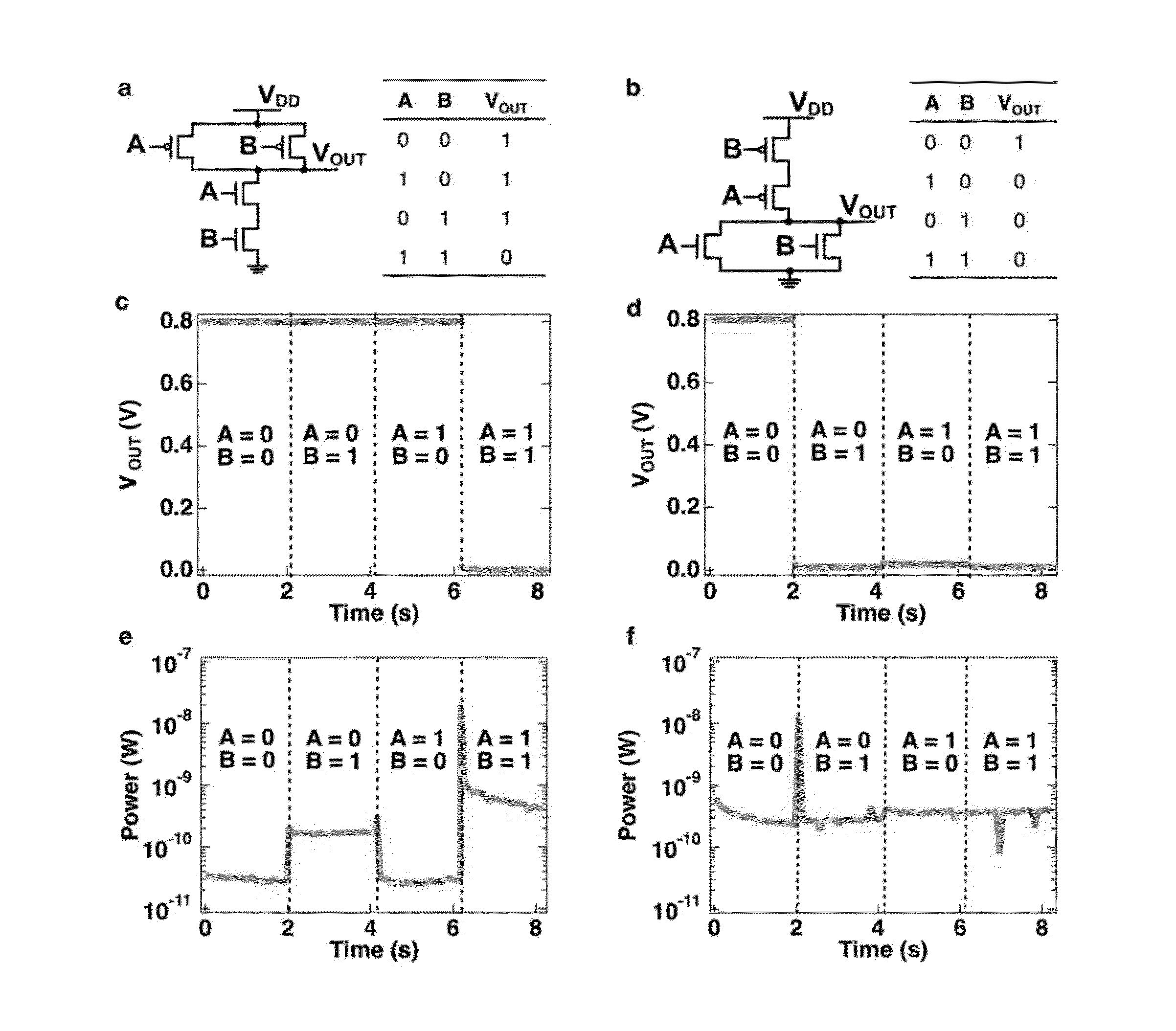
[0083]To demonstrate the next level of CMOS integration, NAND and NOR logic gates were fabricated. FIG. 9 shows the two-input CMOS NAND and NOR gate electrical characteristics according to certain embodiments of the disclosure, where (a) shows a CMOS logic NAND circuit diagram and associated truth table; (b) shows a CMOS logic NOR circuit diagram and associated truth table; (c) shows the output voltages (VOUT) for each possible two input state for the NAND circuit; (d) shows the output voltages (VOUT) for each possible two input state for the NOR circuit; (e) shows NAND power consumption for each possible two input state; and (f) shows NOR power consumption for each possible two input state. The supply voltage (VDD) for the circuits is 0.8 V. Input voltages of 0 V (GND) and 0.8 V (VDD) are treated as logic “0” and “1”, respectively.
[0084]As shown in FIG. 9(a), a logic NAND gate is realized by connecting two n-type TFTs in series and two p-type TFTs in parallel. Specifically, the NAN...
example three
1. Preparation of Benzyl Viologen Solution for n-Type Single-Walled Carbon Nanotube Transistors
[0088]In certain embodiments, benzyl viologen dichloride (0.1 g; 97%, Aldrich) was dissolved in 5 mL of deionized water, after which 2 mL of toluene (>99.5%, Sigma Aldrich) was added on top of the water solution, creating a biphasic solution. Next, 1 mL of sodium borohydride (>98% Aldrich) in water (200 mM) was added as a catalytic reducing agent, causing the benzyl viologen solution to turn purple and evolve H2 gas. The biphasic solution was left standing overnight, and the toluene containing ˜10 mM benzyl viologen was decanted (as shown in FIG. 3) and used for n-type doping for all n-type transistors.
2. Dispersion and Separation of SWCNTs
[0089]In certain embodiments, 45 mg of single-walled carbon nanotubes (SWCNTs) synthesized by the arc discharge method (P2, Carbon Solutions) were added to 6.6 mL of 1% w / v aqueous sodium cholate (SC) solution. This mixture was then sonicated for 60 min ...
PUM
 Login to View More
 Abstract
Description
Claims
Application Information
 Login to View More
 - R&D
- Intellectual Property
- Life Sciences
- Materials
- Tech Scout
- Unparalleled Data Quality
- Higher Quality Content
- 60% Fewer Hallucinations
Browse by: Latest US Patents, China's latest patents, Technical Efficacy Thesaurus, Application Domain, Technology Topic, Popular Technical Reports.
© 2025 PatSnap. All rights reserved.Legal|Privacy policy|Modern Slavery Act Transparency Statement|Sitemap|About US| Contact US: help@patsnap.com