Unlock instant, AI-driven research and patent intelligence for your innovation.

Rapid discovery and screening of enzyme activity using mass spectrometry

a mass spectrometry and enzyme activity technology, applied in the field of microorganisms, molecular biology, biofuel technology, etc., can solve the problems of reducing experimental throughput and few generally applicable technologies currently availabl

Pending Publication Date: 2015-11-19
THE UNITED STATES AS REPRESENTED BY THE DEPARTMENT OF ENERGY +1
View PDF6 Cites 4 Cited by
  • Summary
  • Abstract
  • Description
  • Claims
  • Application Information

AI Technical Summary

Benefits of technology

The present patent provides methods, compositions, and systems for detecting enzymatic activities. The technical effects include detecting the activity of an enzyme sample by incubating a substrate sample with an enzyme sample to form a reaction mixture, coupling the reaction products with a mass probe to form tagged reaction products, and detecting the enzymatic activity by analyzing at least one of the reaction products. Additionally, the patent also describes a method for monitoring enzymatic degradation of a substrate sample by repeating the steps (b) and (c) one or more times to determine the process of enzymatic degradation of the substrate sample and adjusting the composition of the enzyme sample before repeating the steps (b) and (c). Finally, the patent also describes a method for detecting the activities of a plurality of enzymes in a multiplexed assay by providing a substrate sample containing substrates for a plurality of enzyme, incubating the substrate sample with the plurality of enzyme to form a reaction mixture, coupling the reaction products with a mass probe to form tagged reaction products, and detecting the activities of the plurality of enzymes by analyzing the reaction products.

Problems solved by technology

High-throughput enzyme activity assays can help alleviate experimental bottlenecks, but few generally-applicable technologies are currently available.
On the other hand, liquid chromatographic-mass spectrometry-based assays are more universal, but require lengthy chromatographic separations to avoid spectral complexity and ionization suppression, drastically reducing experimental throughput.
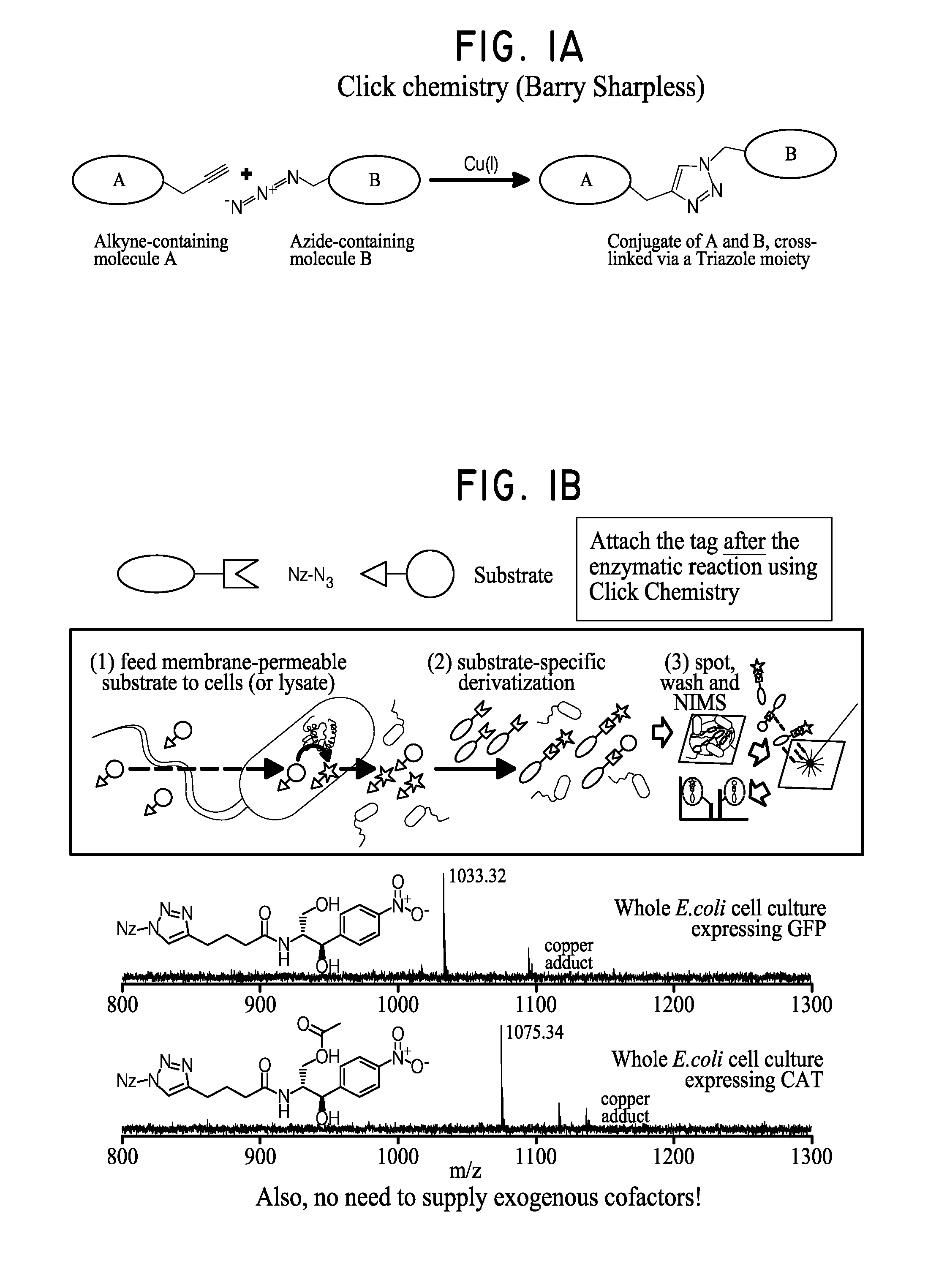
Nimzyme technology allows high-throughput assay for enzyme activity, but requires chemical synthesis of custom substrate analogs as substrate probes and is limited by the solubility of the substrate.

Method used

the structure of the environmentally friendly knitted fabric provided by the present invention; figure 2 Flow chart of the yarn wrapping machine for environmentally friendly knitted fabrics and storage devices; image 3 Is the parameter map of the yarn covering machine
View more

Image

Smart Image Click on the blue labels to locate them in the text.
Viewing Examples
Smart Image
  • Rapid discovery and screening of enzyme activity using mass spectrometry
  • Rapid discovery and screening of enzyme activity using mass spectrometry
  • Rapid discovery and screening of enzyme activity using mass spectrometry

Examples

Experimental program
Comparison scheme
Effect test

example 1

Screening Glycoside Hydrolases for Thermo-Stability and Substrate Specificity (NIMS-Cellobiose, Maltose, Lactose, Xylobiose)

[0097]Glycoside hydrolases (GHs) are a critical class of enzymes for the conversion of plant biomass (cellulose and hemicellulose) into fermentable sugars and therefore central to the development of lignocellulosic biofuels. High throughput activity assays for GHs are needed to support enzyme discovery, engineering and cocktail development. Enzyme assays using nanostructure-initiator mass spectrometry have been developed by using tagged model substrates to enable rapid detection and characterization of GHs activities from complex environmental samples and crude cell lysates. Integration of this approach with nanoliter-scale acoustic sample deposition enables rapid profiling of targeted GH activities. Using this approach over 60,000 assays were performed to characterize the specificity, temperature and pH optima from a set of 200 uncharacterized beta-glucosidase...

example 2

Time-Resolved Catalysis by Mass Spectrometry (MS)

[0098]FIGS. 5A-C show the mass spectra of the reaction products by various enzymes with pre-treated switchgrass.

[0099]MS methods allow direct detection of the cascades of solubilized products produced by a single enzyme or by enzyme cocktail. FIG. 5A shows distribution (glucose, cellobiose, cellotriose) of reaction products from the reaction of IL-SG switchgrass with enzyme CelD. Analysis of the reaction products of the reaction of switchgrass AFEX-SG with enzyme Cel D also shows C5 sugars: xylose, xylobiose, xylotriose and xylotetraose (FIG. 5B). And FIG. 5C shows that the reaction of IL-SG switchgrass with enzyme XynZ produced xylose, xylobiose and xylotriose.

[0100]FIG. 6 shows time-resolved catalysis by MS with a diagnostic probe (NIMS-Cellotetraose). Enzymes tested show different reaction time-courses.

example 3

Real Time Monitoring of Biomass Deconstruction Using Oxime-NIMS Method

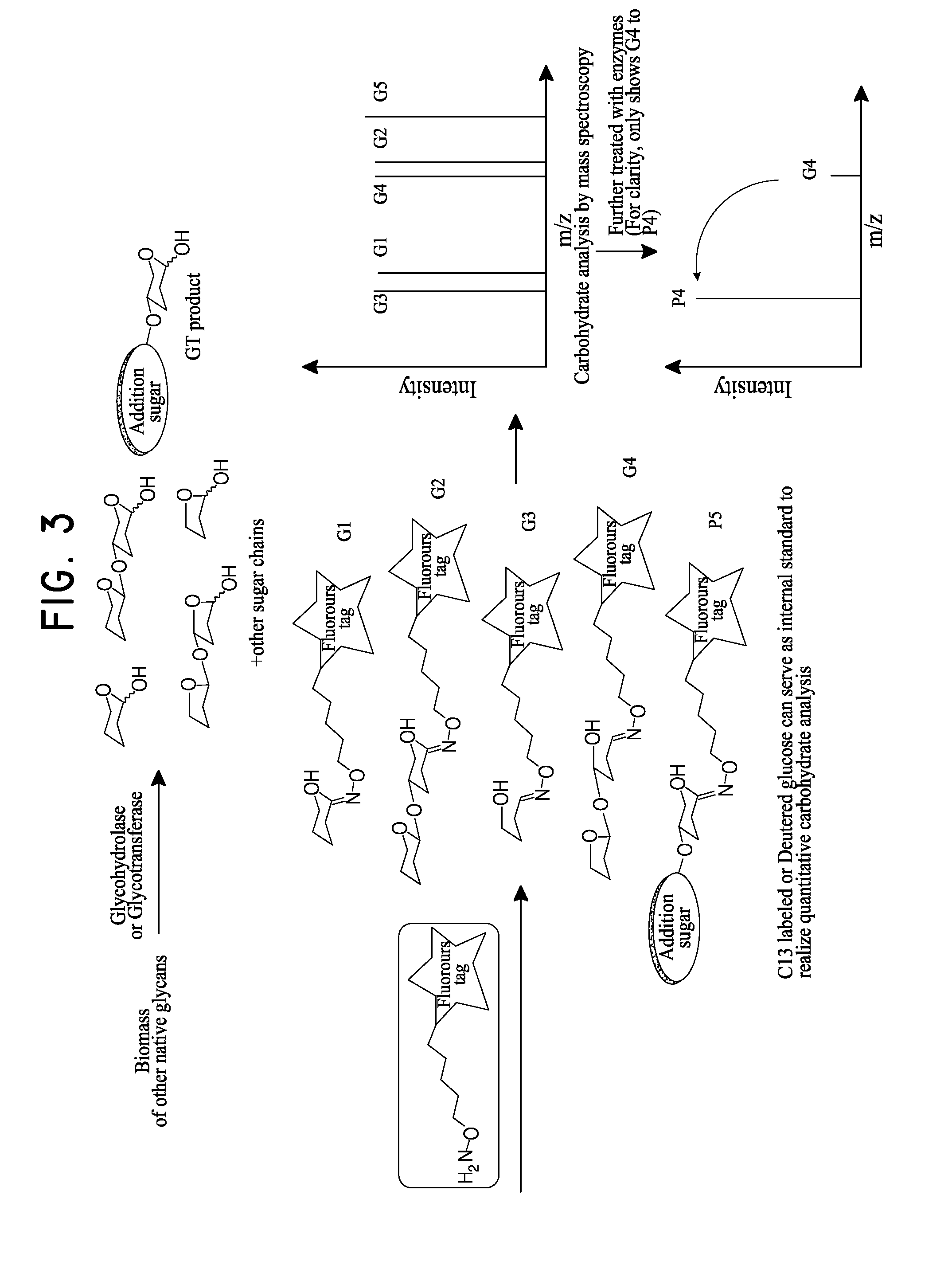
[0101]This example describes a high throughput Oxime-NIMS method to rapidly characterize activities of glycoside hydrolases (GHs) against a range of glycan substrates by combining NIMS analysis. The NIMS analysis was accomplished by using a mass probe that efficiently forms an oxime linkage with the reducing ends of soluble sugars. This probe was added after enzyme hydrolysis, affording both highly efficient modification with the mass-diagnostic tag and subsequent high sensitivity analysis of oligosaccharide mixtures.

[0102]These requirements are being overcome using oxime chemistry to attach the substrate directly to native glycans. Here an aminooxy-alkyl functional group, is used to react with the reducing ends of various oligosaccharides from the enzymatic reactions to form oxime. This assay is being used to characterize in vitro expressed C. thermocellum cellulosomal proteins from GLBRC. AFEX and IL pretreated ...

the structure of the environmentally friendly knitted fabric provided by the present invention; figure 2 Flow chart of the yarn wrapping machine for environmentally friendly knitted fabrics and storage devices; image 3 Is the parameter map of the yarn covering machine
Login to View More

PUM

No PUM Login to View More

Abstract

Described herein are methods, systems, and compositions for detecting enzyme activity. In some embodiments, the reaction product(s) are coupled with a mass tag, and the enzyme activity is determiner by analyzing the reaction product(s). The enzyme assays can be performed using mass spectrometry, for example nanostructure-initiator mass spectrometry (NIMS). Also described are methods, systems, and compositions for monitoring enzymatic degradation process of a substrate sample, for example a biomass.

Description

RELATED APPLICATIONS[0001]The present application claims priority under 35 U.S.C. §119(e) to U.S. Provisional Patent Application No. 61 / 736,409, filed on Dec. 12, 2012, U.S. Provisional Patent Application No. 61 / 738,929, filed on Dec. 18, 2012, and U.S. Provisional Patent Application No. 61 / 777,617, filed on Mar. 12, 2013. The content of each of these related applications is hereby incorporated by reference in its entirety.STATEMENT GOVERNMENT RIGHTS[0002]This invention was made with governmental support awarded by the National Institutes of Health under Grant No. 1RC1GM090980-01, and by the U.S. Department of Energy under Contract Nos. DE-AC02-05CH11231, DE-FC02-07ER64494, and DE-AC04-94AL85000. The government has certain rights in the invention. This work is also a collaboration between inventors at Lawrence Berkeley National Laboratory and Sandia National Laboratories for the Joint BioEnergy Institute.REFERENCE TO SEQUENCE LISTING[0003]The present application is being filed along...

Claims

the structure of the environmentally friendly knitted fabric provided by the present invention; figure 2 Flow chart of the yarn wrapping machine for environmentally friendly knitted fabrics and storage devices; image 3 Is the parameter map of the yarn covering machine
Login to View More

Application Information

Patent Timeline
no application Login to View More
IPC IPC(8): G01N33/68
CPCG01N2333/90G01N33/6848
Inventor NORTHEN, TRENT RDENG, KAIDE ROND, TRISTAN PPERALTA-YAHYA, PAMELA PCHENG, XIAOLIANGKEASLING, JAY D
Owner THE UNITED STATES AS REPRESENTED BY THE DEPARTMENT OF ENERGY