Unlock instant, AI-driven research and patent intelligence for your innovation.

Anode-free rechargeable battery

a rechargeable battery, anode-free technology, applied in the direction of electrochemical generators, cell components, transportation and packaging, etc., can solve the problems of low ce, high reactivity, and the inability to commercialize rechargeable batteries based on li metal anodes in large scal

Active Publication Date: 2016-09-08
BATTELLE MEMORIAL INST
View PDF5 Cites 40 Cited by
  • Summary
  • Abstract
  • Description
  • Claims
  • Application Information

AI Technical Summary

Benefits of technology

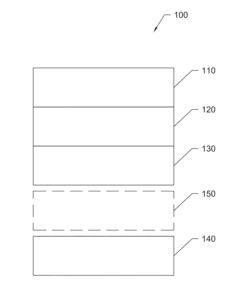
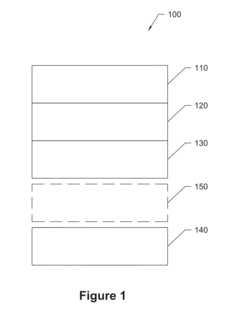
The present invention is about anode-free rechargeable batteries and methods of making them. These batteries do not require an anode current collector and have a high Coulombic Efficiency. The method involves using a copper anode current collector and a cathode with or without a cathode current collector. The cathode active material can be in a liquid phase as a catholyte. The electrolyte consists of one or more lithium salts dissolved in a non-aqueous solvent or polymers. The anode is formed in situ on the surface of the anode current collector during the charging process of the battery. The anode-free rechargeable battery has a Coulombic Efficiency of at least 95% after the first cycle.

Problems solved by technology

Unfortunately, rechargeable batteries based on Li metal anode have not yet been commercialized in large scale.
There are two main barriers to the development of Li metal batteries: one is the growth of Li dendrites during repeated charge / discharge processes, and another is the low CE of these processes.
These two barriers consequently lead to two critical problems for the Li anode: one is safety hazards because of potential internal short circuits and the high surface area of the active material resulting in high reactivity; another is the short cycle life of such batteries.
Although low CE can be partially compensated by the inclusion of an excess amount of Li metal, for example, a 300% excess of Li was a common feature in the early development of Li metal batteries—but the dendrite-growth related battery failure (sometimes dramatic failure that leads to fire and other hazards), and the emergence of Li-ion batteries have largely diminished industry's efforts devoted to the development of rechargeable Li metal batteries since the early 1990s.

Method used

the structure of the environmentally friendly knitted fabric provided by the present invention; figure 2 Flow chart of the yarn wrapping machine for environmentally friendly knitted fabrics and storage devices; image 3 Is the parameter map of the yarn covering machine
View more

Image

Smart Image Click on the blue labels to locate them in the text.
Viewing Examples
Smart Image
  • Anode-free rechargeable battery
  • Anode-free rechargeable battery
  • Anode-free rechargeable battery

Examples

Experimental program
Comparison scheme
Effect test

example 1

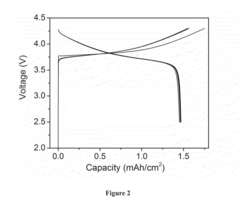
[0044]A coin cell type anode-free Li rechargeable battery was assembled using copper (Cu) foil as the anode current collector, a LiNi1 / 3Co1 / 3Mn1 / 3O2 (NMC) thick film coated on an Al substrate as the cathode, Celgard™ 2045 as the separator, and 4 M LiFSI in DME as the liquid electrolyte. The Cu foil substrate was washed by immersing it in 1 M hydrochloric acid for 10 min, and rinsed by distilled water and acetone three times, respectively, followed by a quick drying in a vacuum chamber. The NMC electrode was provided by Argonne National Laboratory with a nominal capacity of ˜1.5 mAh / cm2. The cell was cycled between 2.5 and 4.2 V at a constant current density of 0.5 mA / cm2. FIG. 2 shows the charge-discharge profiles of the Cu|NMC type battery. This cell delivers an initial charge / discharge capacity of 1.75 / 1.47 mAh / cm2, giving a high initial Coulombic Efficiency of 84%. The reversible capacity is identical to its nominal capacity and keeps stable without distinct capacity degradation ...

example 2

[0045]A coin cell type anode-free Li rechargeable battery was assembled using copper foil as the anode current collector, LiFePO4 film as the cathode, Celgard™ 2045 as the separator, and 4 M LiFSI in DME as the liquid electrolyte. A LiFePO4 cathode is a free standing film (no substrate) composed of LiFePO4, conductive carbon (Super P™) and Polytetrafluoroethylene (PTFE) binder in a ratio of 70:20:10. The cell was cycled between 3 and 3.8 V at a current density of 0.2 mA / cm2. FIG. 3 shows the voltage as a function of capacity of the cells during 100 cycles. The cell exhibits an initial discharge capacity of 2.2 mAh / cm2. FIG. 4 shows the Coulombic efficiency of this Cu|LiFePO4 battery as a function of cycle number. The average Coulombic Efficiency of the cell was 99.1% over 100 cycles (excluding the first cycles which exhibit relatively large capacity loss of 9.5%).

example 3

[0046]A sample with a structure similar to the one described in Example 2 was cycled at a low current rate of 0.2 mA / cm2 for the first four cycles then cycled at 0.5 mA / cm2 for further cycles. A coin cell type anode-free Li rechargeable battery was assembled using copper foil as the anode current collector, a free standing LiFePO4 film (LiFePO4:Super P™:PTFE=70:20:10) as the cathode, Celgard™ 2045 as the separator, and 4 M LiFSI in DME as the liquid electrolyte. The cell was initially cycled between 3 and 3.8 V at a current density of 0.2 mA / cm2 for the first 4 cycles, then cycled at a current density of 0.5 mA / cm2. FIG. 5 shows the voltage profiles of the battery as a function of capacity in the first five cycles. The cell exhibits an initial discharge capacity of 1.8 mAh / cm2. FIG. 6 shows the Coulombic efficiency of a Cu|LiFePO4 battery as a functional of cycle number. The initial Coulombic efficiency of the cell is more than 92%. The average Coulombic efficiency of the cell is ˜9...

the structure of the environmentally friendly knitted fabric provided by the present invention; figure 2 Flow chart of the yarn wrapping machine for environmentally friendly knitted fabrics and storage devices; image 3 Is the parameter map of the yarn covering machine
Login to View More

PUM

PropertyMeasurementUnit
Coulombic Efficiencyaaaaaaaaaa
Coulombic efficiencyaaaaaaaaaa
current densityaaaaaaaaaa
Login to View More

Abstract

An anode-free rechargeable battery is disclosed. The battery includes an anode current collector and a cathode containing an active cation Mn+, where n=1, 2, or 3. The anode-free rechargeable battery further includes a separator placed between the anode current collector and the cathode. The anode-free rechargeable battery also includes an electrolyte including a salt or salt mixture containing an active cation Mn+ dissolved in a solvent or solvent mixture.

Description

STATEMENT REGARDING FEDERALLY SPONSORED RESEARCH OR DEVELOPMENT[0001]The invention was made with Government support under Contract DE-AC05-76RL01830, awarded by the U.S. Department of Energy. The Government has certain rights in the invention.TECHNICAL FIELD[0002]This invention relates to anode-free rechargeable batteries. More specifically, this invention relates to anode-free rechargeable batteries including a liquid or polymer electrolyte with high Coulombic Efficiency (CE).BACKGROUND OF THE INVENTION[0003]Energy storage devices such as batteries with high energy density and power density, long cycle life and calendar life, good safety and low cost are in high demand to supply power for electronic devices, electric vehicles (EVs) and Smart Grid. To date, lithium (Li)-ion batteries have been one of the most widely used energy storage systems for portable electronics and EVs. A typical Li-ion battery consists of a multiple stack of anode current collector / anode / separator / cathode / ca...

Claims

the structure of the environmentally friendly knitted fabric provided by the present invention; figure 2 Flow chart of the yarn wrapping machine for environmentally friendly knitted fabrics and storage devices; image 3 Is the parameter map of the yarn covering machine
Login to View More

Application Information

Patent Timeline
no application Login to View More
Patent Type & Authority Applications(United States)
IPC IPC(8): H01M10/0525H01M4/525H01M4/04H01M10/0568H01M10/0569H01M10/0565H01M4/66H01M4/505
CPCH01M10/0525H01M4/661H01M4/525H01M4/505H01M2004/028H01M10/0569H01M10/0565H01M4/0445H01M10/0568H01M4/40H01M4/405H01M10/052Y02E60/10Y02T10/70
Inventor ZHANG, JI-GUANGQIAN, JIANGFENGXU, WUHENDERSON, WESLEY A.
Owner BATTELLE MEMORIAL INST