Unlock instant, AI-driven research and patent intelligence for your innovation.

Monoazo-based dye for acid detection

a monoazo dye and acid detection technology, applied in monoazo dyes, organic dyes, textiles and papermaking, etc., can solve the problems of not being dyed into fibers, not being able to detect the changes in the working environment according to the use of toxic chemicals, and the amount of toxic chemicals being used is on the increase, so as to prevent secondary contamination, not discoloring and fade, and high color fastness

Active Publication Date: 2016-11-10
KYUNGPOOK NAT UNIV IND ACADEMIC COOP FOUND
View PDF1 Cites 3 Cited by
  • Summary
  • Abstract
  • Description
  • Claims
  • Application Information

AI Technical Summary

Benefits of technology

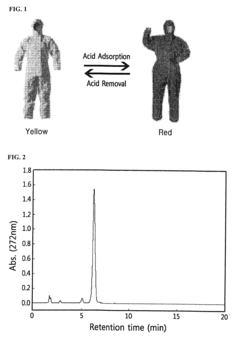
The present invention is a special dye that changes color quickly when exposed to strong acid. It is very durable and can resist fading from laundering or sunlight. Additionally, it can help prevent secondary contamination when used in protective or working clothes. This allows workers to recognize an exposure to acid in real-time, in case of an accident or exposure to an acid-contaminated environment.

Problems solved by technology

With the recent changes in industrial structure and working environment, the amount of toxic chemicals being used is on the increase.
Nevertheless, the development of protective clothes which can detect the changes in working environment according to the use of toxic chemicals is far from satisfaction.
As such, attempts were made to prepare protective clothes by applying pH-detecting chromic dyes, however, the conventional pH-detecting chromic dyes had problems in that they could not be dyed into fibers, and that, even they were dyed, the chromic action of colors according to pH change disappeared in the dyed state.
Additionally, the chromic dyes had a problem in that they were discolored and faded by laundering, sunlight, etc., thus are not usable.
However, these structures only describe the color changes by the binding with a particular acidic compound, and they cannot be considered to have characteristics for pH-detection.
Meanwhile, hydrofluoric acid is an aqueous solution of hydrofluoride (HF) and a colorless pungent liquid, which fumes in the air, is toxic and has small surface tension and strong penetration ability, and thus can strongly penetrate into the skin or the mucus.
However, the gas leak alarm device does not alarm until the gases reach a certain concentration or higher, and thus the gas leak alarm device was not sufficient for immediate response for on-site workers.
Furthermore, the gas leak alarm device also becomes a cause for serious accidents due to its malfunction.

Method used

the structure of the environmentally friendly knitted fabric provided by the present invention; figure 2 Flow chart of the yarn wrapping machine for environmentally friendly knitted fabrics and storage devices; image 3 Is the parameter map of the yarn covering machine
View more

Image

Smart Image Click on the blue labels to locate them in the text.
Viewing Examples
Smart Image
  • Monoazo-based dye for acid detection
  • Monoazo-based dye for acid detection
  • Monoazo-based dye for acid detection

Examples

Experimental program
Comparison scheme
Effect test

example 1

Preparation of (E)-N,N-dihexyl-4-(phenyldiazenyl)benzenamine Compound (General Name: N,N-dihexylanilineazobenzene) Dye

[0049]Aniline (0.01 mole) was added into water (5 mL), added with hydrochloric acid (35%; 2.19 g) and dissolved. Sodium nitrite (0.01 mole) was dissolved in water (5 mL) and slowed added into the dissolved aniline while maintaining the temperature at 0° C. to 5° C. to proceed with a diazotization reaction. The resulting diazotized solution was added with propionic acid (1.5 mL) and acetic acid (8.5 mL).

[0050]N,N-dihexylaniline (0.01 mole) as a coupler was dissolved / emulsified in ethanol (40 mL) and the coupler solution was added to the diazotized solution and reacted.

[0051]In about 2 hours thereafter, the reaction was completed, added with distilled water (200 mL), and allowed to stand for 24 hours for the phase separation of the synthesized dye. The separated distilled water in the lower layer was removed by release and placed thereat using an excess amount of disti...

example 2

Preparation of (E)-N,N-dipropyl-4-(phenyldiazenyl)benzenamine Compound (General Name: N,N-dipropylanilineazobenzene) Dye

[0055]The dye of the title compound represented by Formula 3 below was obtained in the same manner as described in Example 1, except that N,N-dipropylaniline was used as the coupler.

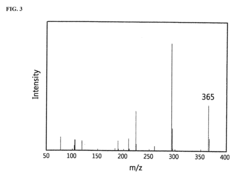
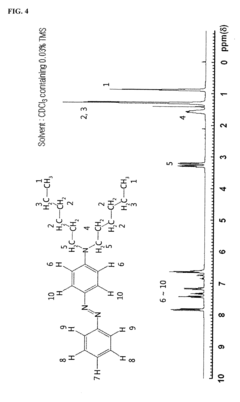
[0056]In order to confirm whether the above compound of the present invention was prepared, GC-MS analysis was performed. As a result of the GC-MS analysis, it was confirmed that the predicted molecular weight of the title compound was 281 and also confirmed that the title compound was obtained exactly at 281 as a result of the GC-MS analysis. The peaks which appeared below 281 were confirmed to be peaks occurring due to fragmentation.

example 3

Preparation of (E)-N,N-dibutyl-4-(phenyldiazenyl)benzenamine Compound (General Name: N,N-dibutylanilineazobenzene) Dye

[0057]The dye of the title compound represented by Formula 4 below was obtained in the same manner as described in Example 1, except that N,N-dibutylaniline was used as the coupler.

[0058]In order to confirm whether the above compound of the present invention was prepared, GC-MS analysis was performed. As a result of the GC-MS analysis, it was confirmed that the predicted molecular weight of the title compound was 309 and also confirmed that the title compound was obtained exactly at 309 as a result of the GC-MS analysis. The peaks which appeared below 309 were confirmed to be peaks occurring due to fragmentationdivision.

the structure of the environmentally friendly knitted fabric provided by the present invention; figure 2 Flow chart of the yarn wrapping machine for environmentally friendly knitted fabrics and storage devices; image 3 Is the parameter map of the yarn covering machine
Login to View More

PUM

PropertyMeasurementUnit
Timeaaaaaaaaaa
Timeaaaaaaaaaa
Fractionaaaaaaaaaa
Login to View More

Abstract

The present invention relates to a monoazo-based dye for acid detection, which changes color upon addition of or exposure to acid and, more specifically, to a dye which changes color within a few seconds upon exposure to a trace amount of a strong acidic material, and a fiber product using the same. The monoazo-based dye for acid detection according to the present invention has an effect of reacting with a trace amount of strong acid to change color, and returning to the original color when the acid is removed. Also, a fiber dyed with the dye of the present invention exhibits high color fastness and thus is not discolored and faded by laundering or sunlight. In addition, there is an effect of preventing secondary contamination at an accident scene and serious accidents from harmful environmental factors, when protective or working clothes are manufactured applying the effect, thereby providing a function enabling workers to recognize an exposure to acid in real time in the case of an exposure to an acid-contaminated environment.

Description

TECHNICAL FIELD[0001]The present invention relates to a monoazo-based dye for acid detection, which changes color upon addition of or exposure to acid, and more specifically, to a dye which changes color within a few seconds upon exposure to a trace amount of a strong acidic material, and a fiber product using the same.BACKGROUND ART[0002]With the recent changes in industrial structure and working environment, the amount of toxic chemicals being used is on the increase. Accordingly, the issues on the manufacture, use, and treatment of waste chemicals have been raised, and human bodies are now exposed to environments where chemicals are present not only in the working sites but also via various routes. Nevertheless, the development of protective clothes which can detect the changes in working environment according to the use of toxic chemicals is far from satisfaction.[0003]As such, attempts were made to prepare protective clothes by applying pH-detecting chromic dyes, however, the c...

Claims

the structure of the environmentally friendly knitted fabric provided by the present invention; figure 2 Flow chart of the yarn wrapping machine for environmentally friendly knitted fabrics and storage devices; image 3 Is the parameter map of the yarn covering machine
Login to View More

Application Information

Patent Timeline
no application Login to View More
IPC IPC(8): G01N31/22D06P1/00C09B29/08
CPCG01N31/224D06P1/004C09B29/081C09B29/0003G01N31/221C09B29/08G01N31/22
Inventor KIM, TAE KYEONG
Owner KYUNGPOOK NAT UNIV IND ACADEMIC COOP FOUND