

Molecules having pesticidal utility, and intermediates, compositions, and processes, related thereto
a technology of pesticidal utility and molecules, applied in the field of molecules having pesticidal utility, can solve the problems of destroying more than 40% of all food production, prone to loss, and often one of the most insidious and costly problems
- Summary
- Abstract
- Description
- Claims
- Application Information
AI Technical Summary
Benefits of technology
Problems solved by technology
Method used
Image

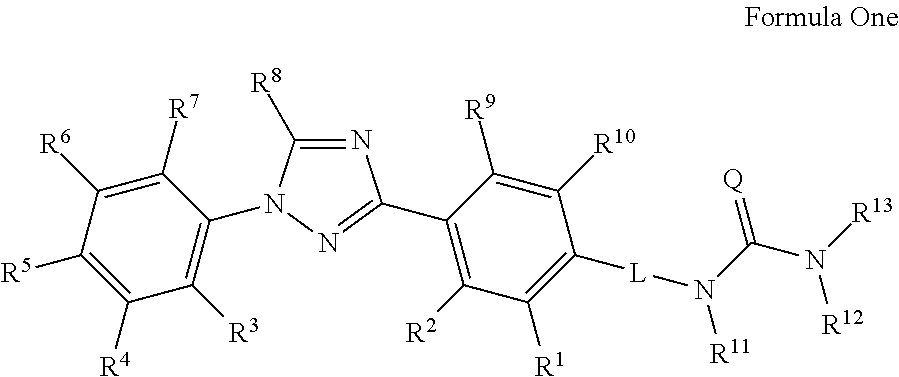
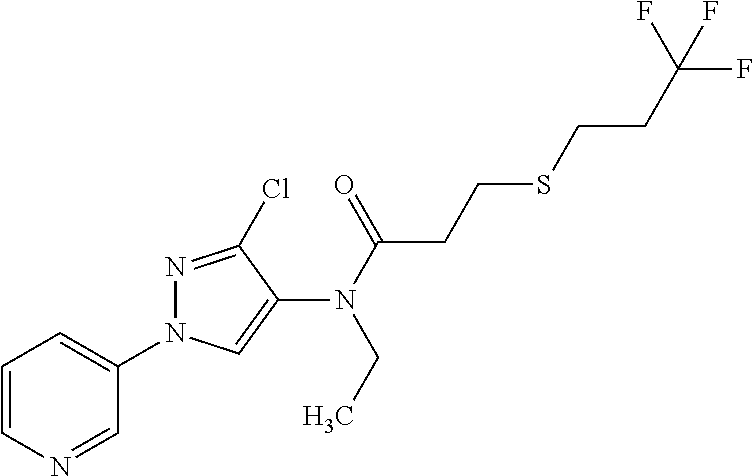
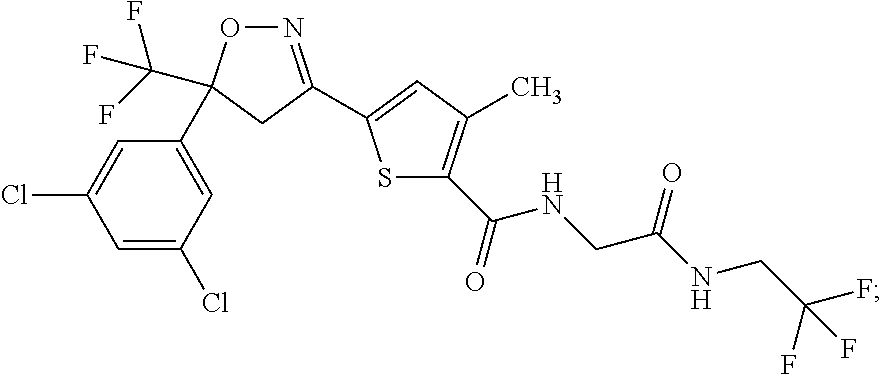
Examples
example 1
Preparation of ethyl 4-methyl-2-(3-(4-(1-(4-(trifluoromethoxy)phenyl)-1H-1,2,4-triazol-3-yl)phenyl)ureido)thiophene-3-carboxylate (F1)
[0184]
[0185]To 4-(1-(4-(trifluoromethoxy)phenyl)-1H-1,2,4-triazol-3-yl)benzoyl azide (0.50 g, 1.3 mmol) in a 25 mL vial equipped with a stir bar and vigreux column was added 1,2-dichloroethane (6.7 mL). The reaction was heated to 85° C. After several hours the reaction was cooled to room temperature. Ethyl 2-amino-4-methylthiophene-3-carboxylate (0.25 g, 1.3 mmol) was added in one portion. The reaction was heated to reflux overnight. The reaction was cooled to room temperature. The reaction mixture was diluted with ethyl acetate and washed with water. The water layer was extracted with ethyl acetate. The combined organic layer was washed with water (3×). The organic layers were poured through a phase separator and dry packed onto Celite®. Purification by flash column chromatography using 5-50% ethyl acetate / (1:1 dichloromethane / hexanes) provided a whi...
example 2
Preparation of ethyl 5-amino-1-(4-chloro-2-methylphenyl)-1H-pyrazole-4-carboxylate (C1)
[0243]
[0244]To (4-chloro-2-methylphenyl)hydrazine hydrochloride (1.00 g, 5.18 mmol) and (Z)-ethyl 2-cyano-3-ethoxyacrylate (0.964 g, 5.70 mmol) in a 25 mL vial equipped with a stir bar and a vigreux column was added ethanol (6.47 mL) followed by triethylamine (0.794 mL, 5.70 mmol). The reaction was heated to reflux overnight. The reaction was cooled. The solution was diluted with ethyl acetate and washed with water. The aqueous layer was extracted with ethyl acetate. The combined organic layers were dried over magnesium sulfate, filtered, and concentrated. Purification by flash column chromatography using 0-20% ethyl acetate / hexanes as eluent provided the title molecule as a tan solid (1.08 g, 75%): mp 82-84° C.; 1H NMR (400 MHz, CDCl3) δ 7.79 (s, 1H), 7.37 (d, J=2.3 Hz, 1H), 7.34-7.29 (m, 1H), 7.26-7.24 (m, 1H), 4.99 (s, 2H), 4.31 (q, J=7.1 Hz, 2H), 2.15 (s, 3H), 1.37 (t, J=7.1 Hz, 3H); ESIMS m / z...
example 3
Preparation of 1-(4-chloro-2-methylphenyl)-1H-pyrazol-5-amine (C10)
[0262]
[0263]To ethyl 5-amino-1-(4-chloro-2-methylphenyl)-1H-pyrazole-4-carboxylate (C1) (0.750 g, 2.68 mmol) in a 25 mL vial equipped with a stir bar, vigreux column and tube to vent hydrochloric acid gas into a sodium hydroxide (1N) trap was added concentrated hydrochloric acid (8.04 mL, 97.0 mmol). The reaction was heated to reflux. Upon completion, the reaction was cooled and the mixture was transferred to a beaker and diluted with water (100 mL). The solution was treated with solid sodium bicarbonate until the acid was neutralized. The aqueous layer was extracted with dichloromethane (2×). The organic layers were poured through a phase separator and concentrated. The resultant oil was dried under house vacuum overnight providing the title molecule as an amber oil (0.532 g, 96%): 1H NMR (400 MHz, CDCl3) δ 7.44 (d, J=1.9 Hz, 1H), 7.34 (dt, J=1.6, 0.7 Hz, 1H), 7.31-7.23 (m, 2H), 5.60 (d, J=1.9 Hz, 1H), 3.55 (s, 2H),...
PUM
| Property | Measurement | Unit |
|---|---|---|
| temperatures | aaaaa | aaaaa |
| temperature | aaaaa | aaaaa |
| temperature | aaaaa | aaaaa |
Abstract
Description
Claims
Application Information
 Login to View More