Tensile Contact Etch Stop Layer (CESL) For Radio Frequency (RF) Silicon-On-Insulator (SOI) Switch Technology

US20180069035A1Inactive Publication Date: 2018-03-08NEWPORT FAB
5 Cites 0 Cited by

Patent Information

Authority / Receiving Office
US · United States
Current Assignee / Owner
Publication Date
2018-03-08
Estimated Expiration
Not applicable · inactive patent

Smart Images

  • Figure 1
    Figure 1
  • Figure 2
    Figure 2
  • Figure 3
    Figure 3
Patent Text Reader

Abstract

A radio frequency switch includes a plurality of n-channel SOI CMOS transistors connected in series, wherein each of these transistors has a gate width of at least about 0.13 microns. A contact etch stop layer (CESL) structure having a relatively large thickness of at least about 1000 Angstroms is formed on silicide regions of the n-channel SOI CMOS transistors, wherein the CESL structure places a tensile stress on channel regions of the n-channel SOI CMOS transistors, thereby reducing the on-resistances of the n-channel SOI CMOS transistors. The CESL structure is also formed over p-channel SOI CMOS transistors fabricated on the same substrate as the n-channel SOI CMOS transistors. While the CESL structure also places a tensile stress on channel regions of the p-channel SOI CMOS transistors (increasing the on-resistances of these transistors), the on-resistances of the p-channel SOI CMOS transistors are non-critical in the RF switch application.
Need to check novelty before this filing date? Find Prior Art

Description

FIELD OF THE INVENTION

[0001] The present invention relates to the use of a contact etch stop layer (CESL) to introduce tensile stress to the channel regions of silicon-on-insulator (SOI) CMOS transistors used in high power applications such as radio frequency (RF) switching.RELATED ART

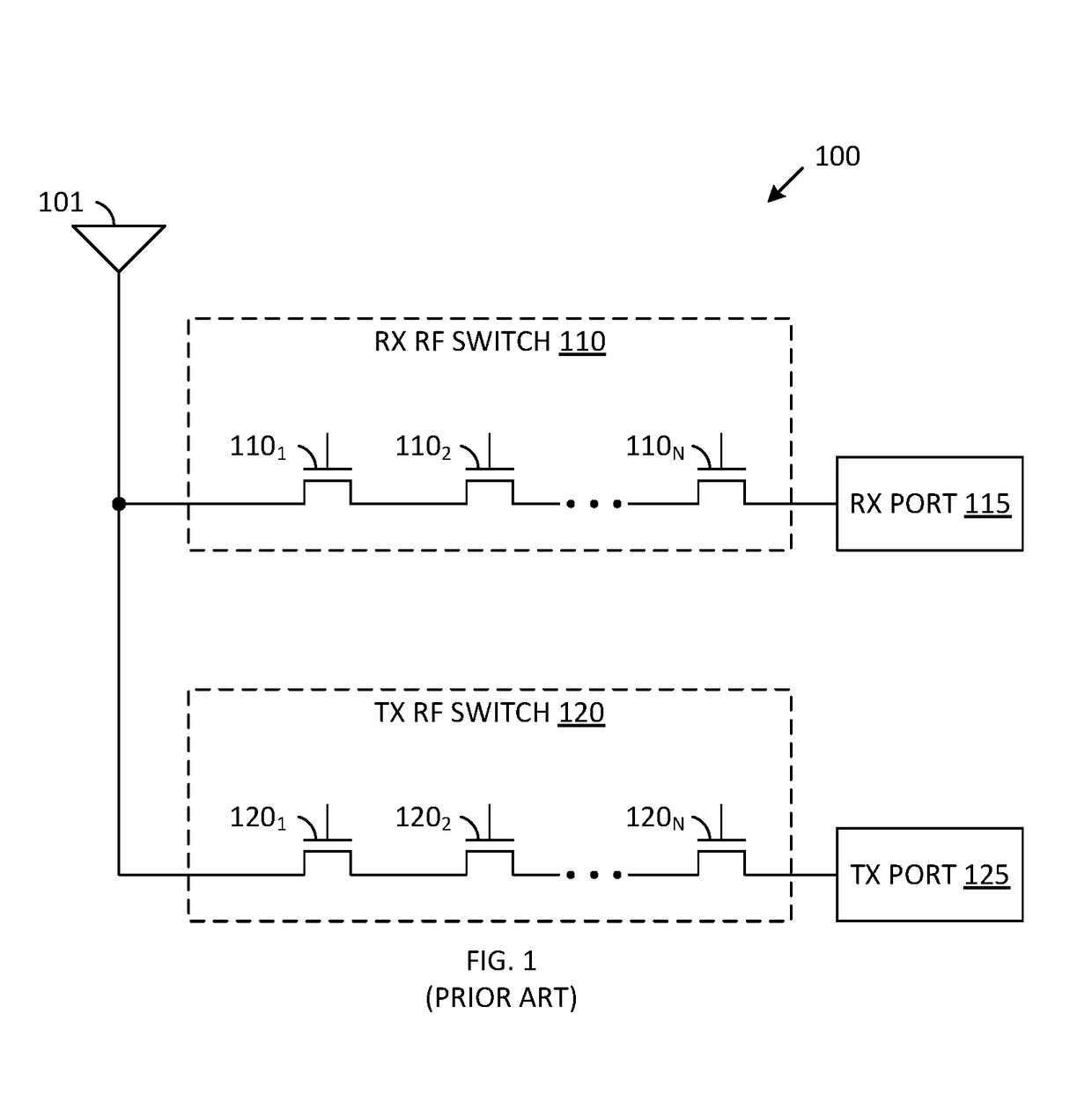
[0002] FIG. 1 is a circuit diagram of a conventional radio frequency (RF) circuit 100, including an antenna 101, an RF receiver switch 110, an RF receiver port 115, an RF transmitter switch 120 and an RF transmitter port 125. RF receiver switch 110 includes a plurality of high-voltage field effect transistors (FETs) 1101-110N, which are connected in series (in a stack). The stack of high voltage FETs 1101-110N is controlled to route RF signals from antenna 101 to receive port 115. Similarly, RF transmitter switch 120 includes a stack of high-voltage FETs 1201-120N, which are controlled to route RF signals from transmit port 125 to antenna 101. As used herein, an RF signal is defined as a signal having a ...

Examples

Embodiment Construction

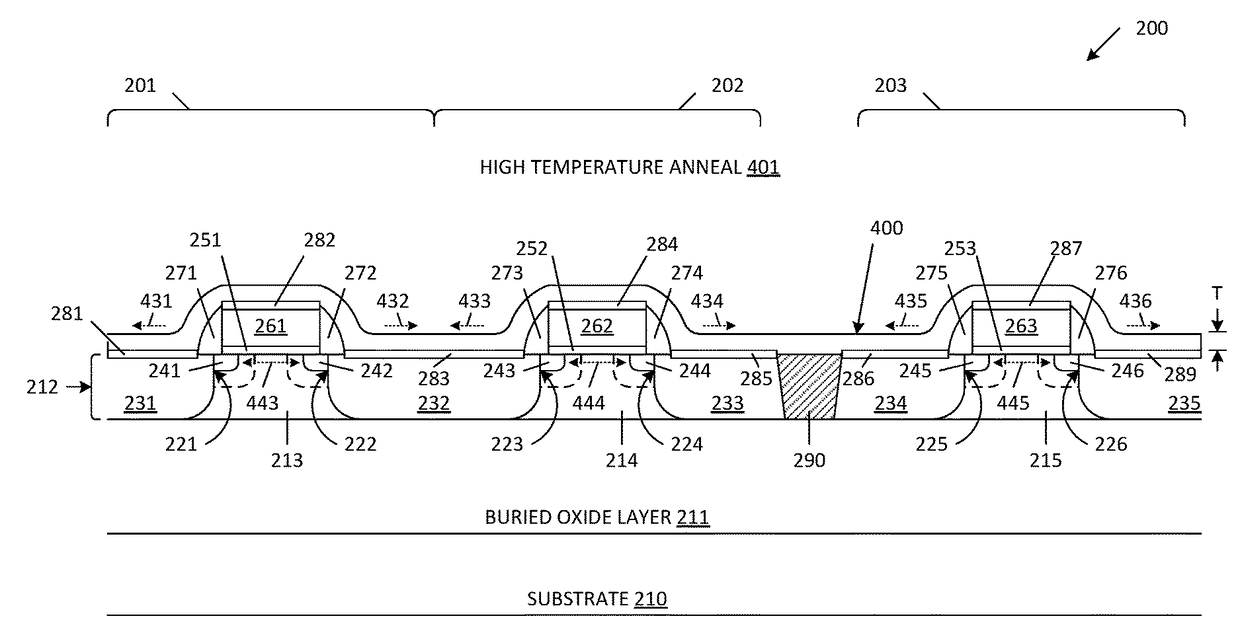
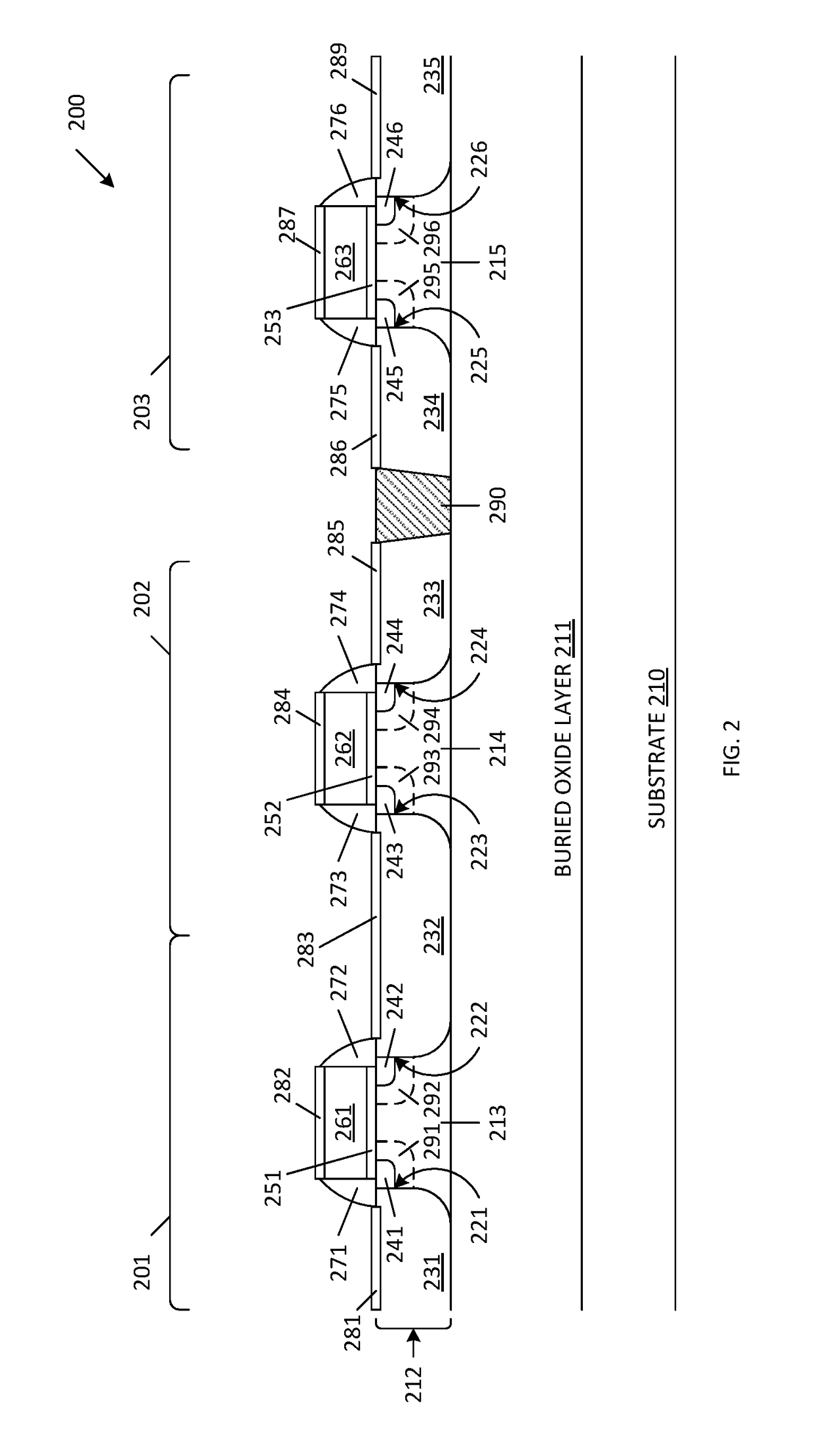
[0017]FIG. 2 is a cross-sectional view of an SOI CMOS structure 200, which includes n-channel SOI CMOS transistors 201-202 and p-channel SOI CMOS transistor 203. In accordance with one embodiment, transistors 201-202 may represent series-connected transistors of an RF switch. For example, transistors such as transistors 201-202 may be used to replace the series-connected transistors 1101-110N of the receiver RF switch 110 (and the series-connected transistors 1201-120N of the transmitter RF switch 120) in one embodiment of the present invention. In this embodiment, transistors having the construction of transistors 201-203 are also used to implement non-critical logic and analog circuitry that supports these RF switches (e.g., logic and circuitry in the RF receiver port 115 and the RF transmit port 125). SOI CMOS transistors 201-203 are fabricated on a thin silicon layer 212, which is located on a buried insulator layer 211 (e.g., silicon oxide), which in turn, is located on a subst...