
Deep convolutional network heterogeneous architecture
a convolutional network and heterogeneous architecture technology, applied in the field of deep convolutional neural networks, can solve the problems of high power, other computing resource costs, and high bandwidth requirements for additional features, and achieve the effects of reducing power consumption, fast data throughput, and efficient mathematical operation
- Summary
- Abstract
- Description
- Claims
- Application Information
AI Technical Summary
Benefits of technology
Problems solved by technology
Method used
Image

Examples
Embodiment Construction
[0120]It has been recognized by the inventors that known deep conventional neural network (DCNN) systems are large and require significant amounts of power to implement. For these reasons, conventional DCNN systems are not found in mobile devices, and in cases where DCNN mobile systems are attempted, the systems have many shortcomings.
[0121]In order to deploy these technologies in everyday life, making them pervasive in mobile and wearable devices, the inventors have further recognized that hardware acceleration plays an important role. When so implemented as described herein, hardware acceleration provides a mobile DCNN with the ability to work in real time with reduced power consumption and with embedded memory, thereby overcoming limitations of conventional fully programmable solutions.
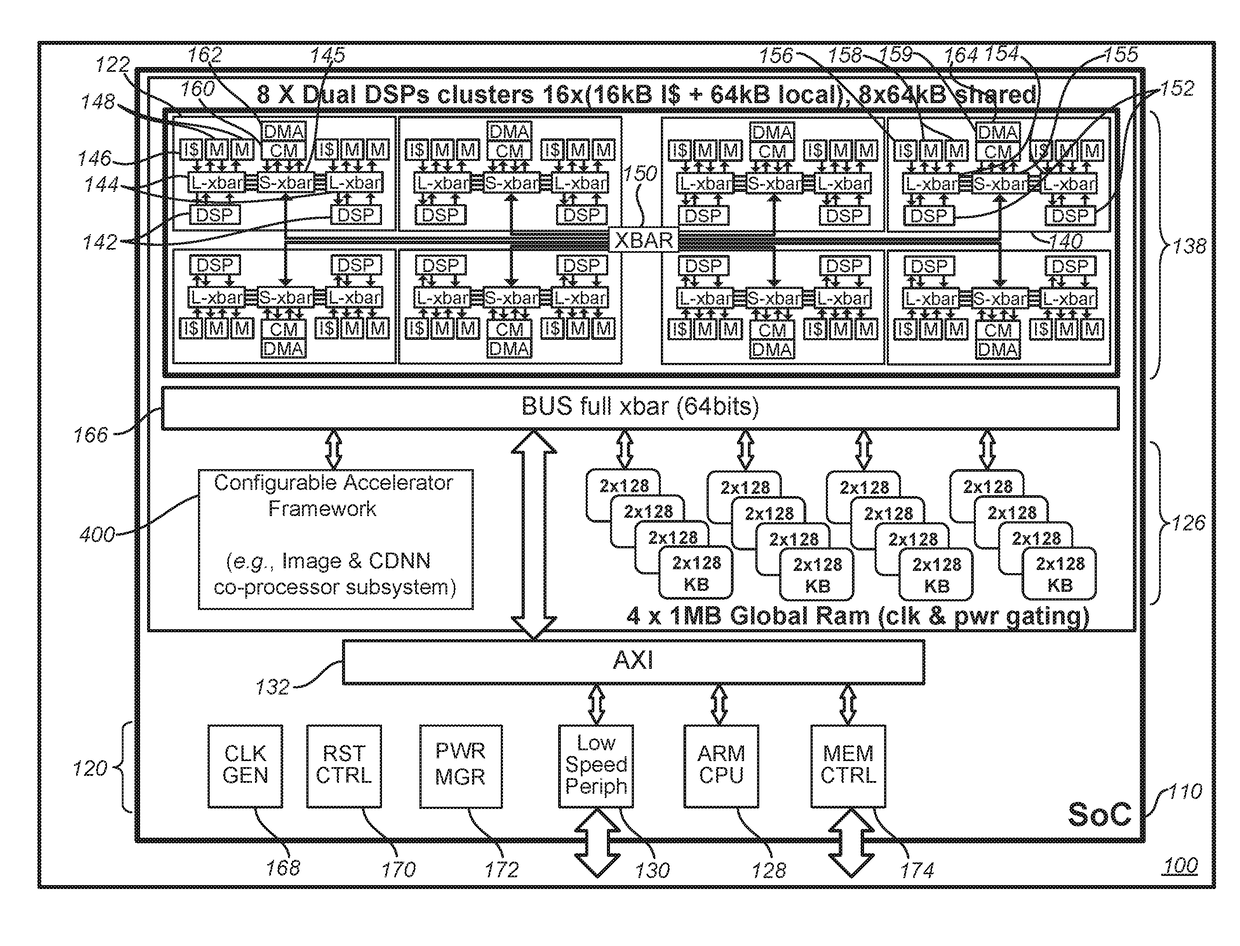
[0122]The high-performance, energy efficient hardware accelerated DCNN processor described herein includes an energy efficient set of DCNN hardware convolution accelerators that support kernel deco...
PUM
 Login to View More
 Abstract
Description
Claims
Application Information
 Login to View More