This helps you quickly interpret patents by identifying the three key elements:
Problems solved by technology
Method used
Benefits of technology
Benefits of technology
This patent describes a new material that can prevent adhesions and help with healing wounds. It can be applied easily and reapplied for adjustment. It is efficient to produce and can be mass-produced. Overall, this material has several advantages and can be used for various surgeries and procedures.
Problems solved by technology
Since the PTFE film among them is not biodegradable, it has a problem of remaining in the body.
On the other hand, the sheet containing HA and CMC as well as the oxidized regenerated cellulose sheet are biodegradable but they are unable to completely prevent serious adhesions such as an adhesion caused after hepatic resection, and thus they require further improvement to be effective in adhesion prevention.
Method used
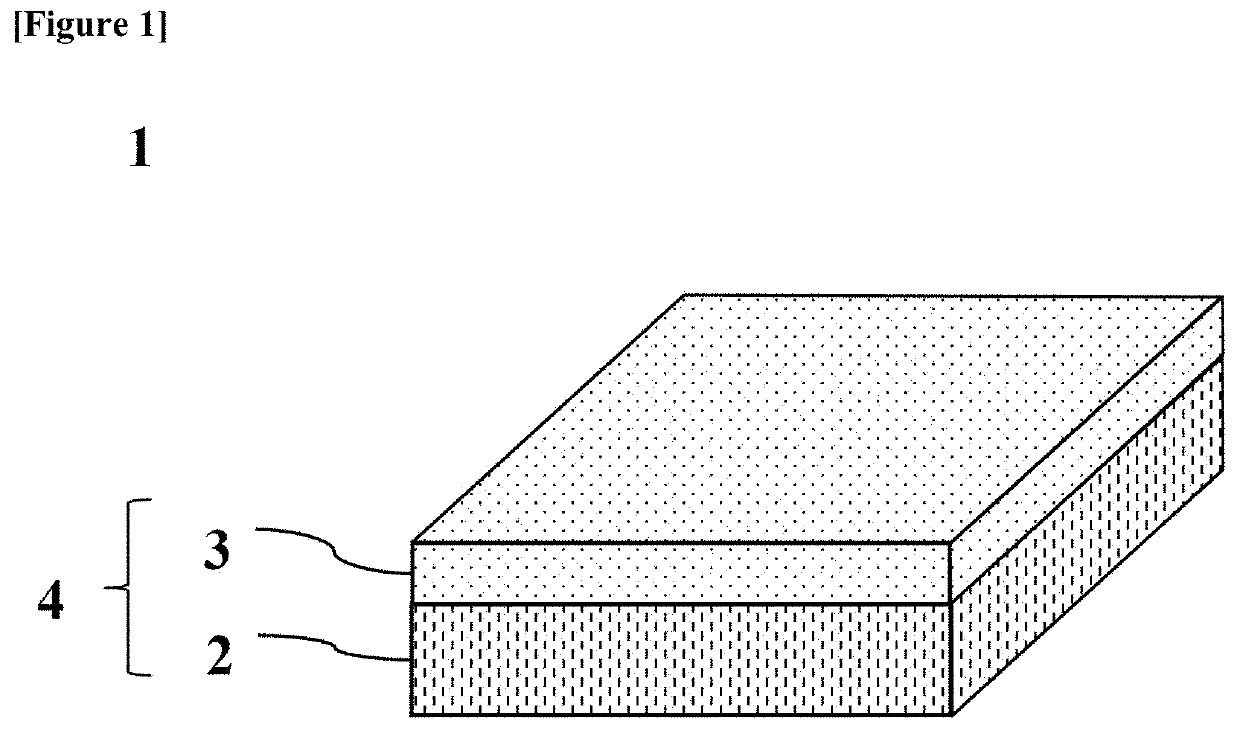
the structure of the environmentally friendly knitted fabric provided by the present invention; figure 2 Flow chart of the yarn wrapping machine for environmentally friendly knitted fabrics and storage devices; image 3 Is the parameter map of the yarn covering machine
View more
Image
Smart Image Click on the blue labels to locate them in the text.
Viewing Examples
Smart Image
Click on the blue label to locate the original text in one second.
Reading with bidirectional positioning of images and text.
[0254]Using the alginic acids listed in [Reagents] below, i.e., AL100 or AL500 as a feedstock of the lower layer and AL10 or AL20 as a feedstock of the upper layer, alginic acid-layered sponges were prepared in combinations of AL10 (upper layer)-AL100 (lower layer), AL20 (upper layer)-AL100 (lower layer) and AL20 (upper layer)-AL500 (lower layer), respectively, according to the method described in Example 1.
[0255]Herein, a combination of an upper layer and a lower layer may also be referred to as “lower layer / upper layer” for the sake of convenience. For example, according to this representation, a combination of AL10 (upper layer)-AL100 (lower layer) may be referred to as “AL100 / AL10”, and a combination of AL20 (upper layer)-AL500 (lower layer) may be referred to as “AL500 / AL20”.
[0256][Reagents][0257]AL10: Same as Example 1[0258]AL20: (Lot NO. BL150713-20), endotoxin level 13 EU / g[0259]AL100: (Lot NO. 5G17201), endotoxin ...
[0274]An alginic acid-layered sponge was prepared according to the method of Example 1 except that 10 mM calcium gluconate (from Wako Pure Chemical Industries, Ltd.) was used instead of 10 mM calciumchloride upon gelation of the AL500 layer. The prepared sponge was used in Experimental group 1 of Example 3-3 below.
the structure of the environmentally friendly knitted fabric provided by the present invention; figure 2 Flow chart of the yarn wrapping machine for environmentally friendly knitted fabrics and storage devices; image 3 Is the parameter map of the yarn covering machine
Login to View More
PUM
Property
Measurement
Unit
Fraction
aaaaa
aaaaa
Fraction
aaaaa
aaaaa
Time
aaaaa
aaaaa
Login to View More
Abstract
The purpose of the present invention is to provide an anti-adhesion material having a high anti-adhesion effect. The present invention pertains to an anti-adhesion material comprising a biocompatible sponge-like layered body having a sponge-like first layer and a sponge-like second layer both being at least partially crosslinked with a curing agent and comprising a low endotoxin monovalent metal salt of alginic acid. The monovalent metal salt of alginic acid in the first layer has a weight average molecular weight of 30000 to 300000. The monovalent metal salt of alginic acid in the second layer has a weight average molecular weight of 1000 to 200000. The weight average molecular weights are determined by GPC-MALS after a de-crosslinking treatment. The weight average molecular weight of the monovalent metal salt of alginic acid in the first layer is higher than the weight average molecular weight of the monovalent metal salt of alginic acid in the second layer.
Description
FIELD OF THE INVENTION[0001]The present invention relates to an anti-adhesion material, a method for producing the same and a sponge-like laminate.BACKGROUND ART[0002]Adhesions refer to a state where surfaces of tissues that should be separated from each other are connected or fused to each other via fibrous tissue. Adhesions occur in association with injury or inflammation upon which an exudate containing fibrin is emitted on the surface of the tissue, where this exudate is organized such that the tissue surfaces are connected or fused. Adhesions are caused by an injury generated on a surface of a tissue upon a surgical operation, inflammation caused by an injury, and inflammation caused by drying of a tissue surface upon a surgical operation.[0003]Adhesions sometimes cause infertility, bowel passing disorder and chronic pelvic pain. Moreover, in order to separate adhesions that were generated after a surgical operation, another surgical operation may be required. For example, whil...
Claims
the structure of the environmentally friendly knitted fabric provided by the present invention; figure 2 Flow chart of the yarn wrapping machine for environmentally friendly knitted fabrics and storage devices; image 3 Is the parameter map of the yarn covering machine
Login to View More
Application Information
Patent Timeline
Application Date:The date an application was filed.
Publication Date:The date a patent or application was officially published.
First Publication Date:The earliest publication date of a patent with the same application number.
Issue Date:Publication date of the patent grant document.
PCT Entry Date:The Entry date of PCT National Phase.
Estimated Expiry Date:The statutory expiry date of a patent right according to the Patent Law, and it is the longest term of protection that the patent right can achieve without the termination of the patent right due to other reasons(Term extension factor has been taken into account ).
Invalid Date:Actual expiry date is based on effective date or publication date of legal transaction data of invalid patent.



 Login to View More