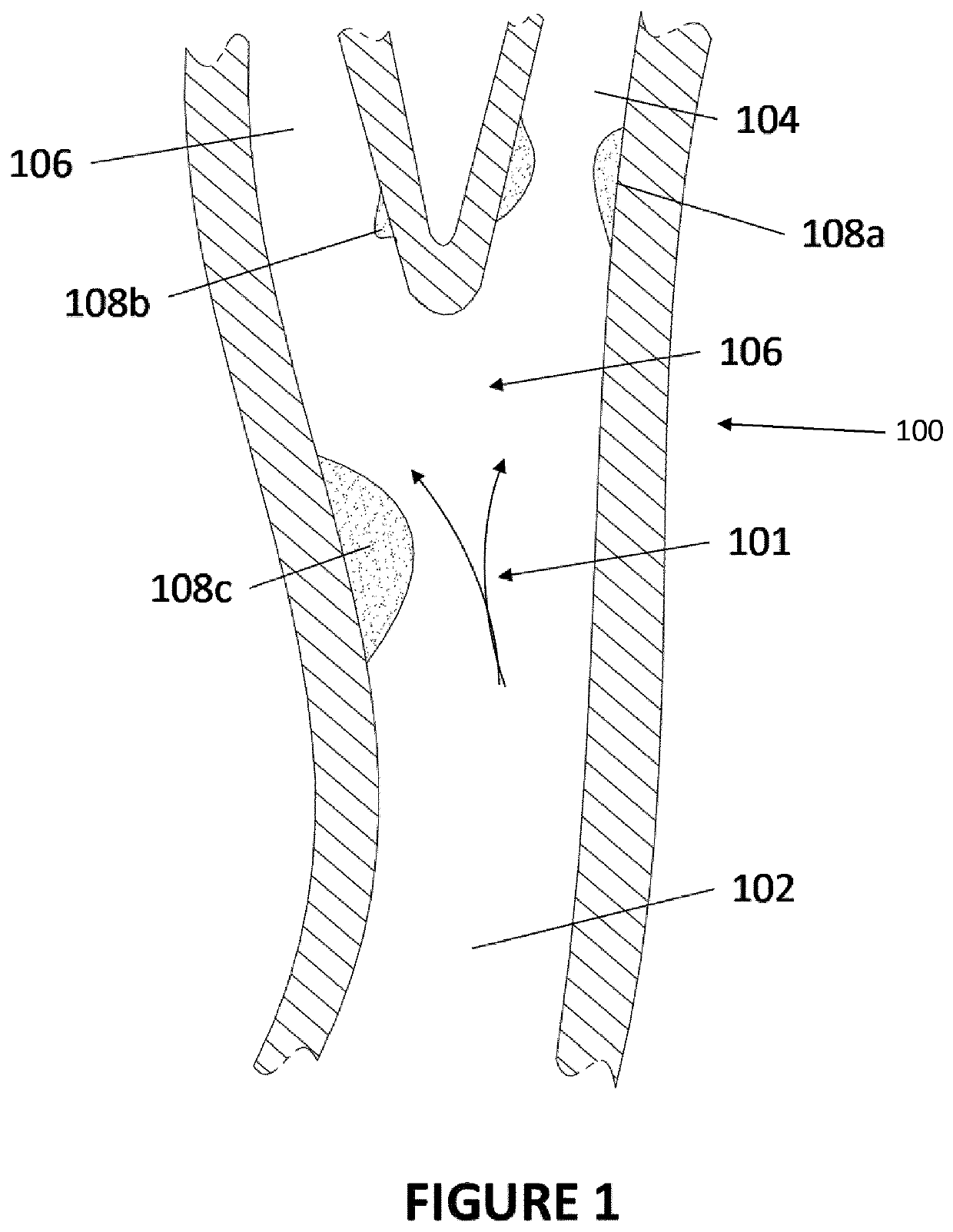
As atherosclerotic plaque grows within an
artery, it will increasingly cause a narrowing or
stenosis of the
artery and hence a restriction to
blood flow.
As stenosis increases, a patient may become symptomatic as the decreased
blood supply affects tissues distal to the obstruction.
In addition, emboli may break off the plaque.
Permanent placement of a
metal carotid stent can provide positive benefits of opening a vessel and thus improving
blood flow whilst reducing the risk of the plaque breaking free but it can also result in long-term complications such as in-stent stenosis.
If a longer term complication does arise, there are then fewer options available.
As noted above, when a patient has exhibited symptoms, and upon diagnosis, the plaque / thrombus shows relatively low stenosis (<50%), the plaque may also have an unstable appearance where a physician may consider that the risk of the plaque / thrombus breaking free within a relatively short
time frame is reasonably high.
It has been shown that plaques may get inflamed and become unstable (such plaques may show enhancement of high-resolution contrast enhanced
MR imaging).
Hemorrhage into the plaque may also lead to unstable plaque.
However, in a significant number of cases, an unstable plaque may “settle down” wherein, over a period of time, the risk of it breaking free becomes lower.
Aneurysms can occur in any
blood vessel but can be particularly problematic when they occur in a cerebral
artery.
Known as an intracranial or cerebral or
brain aneurysm, if a
brain aneurysm ruptures, it can lead to a hemorrhagic
stroke and potentially cause death or severe disability.
The risk of rupture increases with the size of the
aneurysm.
Ruptured aneurysms have a
high likelihood of re-rupture which can have devastating consequences.
One of the risks associated with this type of procedure is that the microcatheter may be too rigid because of the pressure from the
balloon and hence may cause the
aneurysm to rupture.
Other risks are the presence of an inflated
balloon in the
parent vessel that can lead to thrombus formation.
Rarely the vessel may rupture because of over-inflation of the
balloon.
Most importantly, there is a chance that the coils may prolapse out of the
aneurysm once the balloon has been deflated.
It has some of the disadvantages of balloon assisted coiling but in addition, the other problem is that stents are quite thrombogenic and hence, patients need to be placed on blood-thinners in preparation for
stent placement.
Of note, some patients have resistance to different blood thinners further adding to the complexity.
In addition, generally speaking it is difficult to use stent assisted coiling in acutely ruptured aneurysms as there isn't
sufficient time for the blood thinners to act and in addition blood thinners may not be safe in the presence of SAH.
When deployed and detached, like the coiled wire, the mesh ball seals and / or prevents or slows the flow of blood into the aneurysm, causing a thrombus to form in the aneurysm.
However, as shown in FIG. 5B, if the neck is wide and the mesh ball is substantially spherical, regions of the aneurysm may not be completely filled which can result in unfilled pockets 10a, 10b such that if
turbulent blood flow is created in those regions, it can result in growth of the aneurysm.
In addition, there is also a possibility of aneurysm rupture and thrombus formation that can subsequently break away and cause
stroke.
Often the aneurysm will shrink over time after the stent is in place.
The disadvantages of a stent are that it creates a large area of metal within the artery which increases the chance of thrombi forming on the stent.
While stents can work well for certain types of aneurysms, particularly ones that are located in straight arterial passageways, they are not ideal for all aneurysms.
In addition, once one of these flow diverters are placed across the neck of the aneurysm, it practically obviates any future option for an
alternative treatment into the sac of the aneurysm as the pores of the
flow diverter are so small that no device can be introduced through it.



 Login to View More