Unlock instant, AI-driven research and patent intelligence for your innovation.
Fermented cereal
Pending Publication Date: 2022-07-07
SOC DES PROD NESTLE SA
View PDF0 Cites 0 Cited by
Summary
Abstract
Description
Claims
Application Information

AI Technical Summary
This helps you quickly interpret patents by identifying the three key elements:
Problems solved by technology
Method used
Benefits of technology
The patent text describes a binder / clustering agent that has strong adhesive properties, but is not too sticky. This agent is important for ensuring the right clustering and keeping bars safe during transport and shelf life. It also helps prevent equipment from getting dirty during processing of granolas, bars, and cereals.
Problems solved by technology
As sugars remain necessary for organoleptic purposes, such as sweetness and texture, substituting refined sugars (or high intensive sweeteners) by some natural equivalent food material is not an easy task.
Method used
the structure of the environmentally friendly knitted fabric provided by the present invention; figure 2 Flow chart of the yarn wrapping machine for environmentally friendly knitted fabrics and storage devices; image 3 Is the parameter map of the yarn covering machine
View more
Image
Smart Image Click on the blue labels to locate them in the text.
Viewing Examples
Smart Image
Click on the blue label to locate the original text in one second.
Reading with bidirectional positioning of images and text.
Smart Image
Examples
Experimental program
Comparison scheme
Effect test
example 1
[0082]Aim of Study
[0083]To develop a process for preparing a concentrated fermented cereal slurry made from rice koji (Amazake).
[0084]Materials and Methods
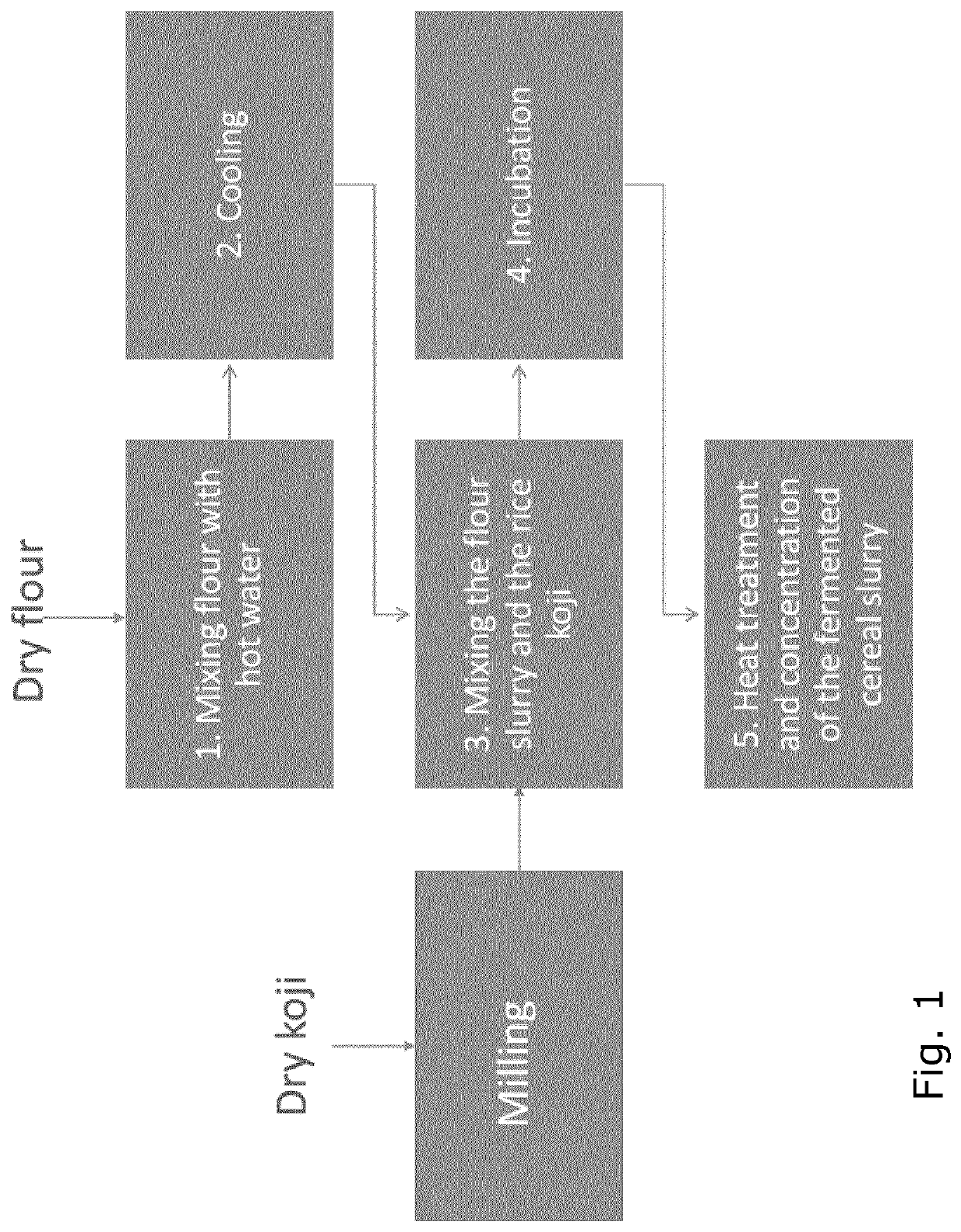
[0085]FIG. 1 outlines a process for preparing a concentrated fermented cereal slurry made from rice koji (Amazake).
[0086]Dry koji can be manufactured from rice, as refined grain.
[0087]Rice Koji is manufactured by adding Aspergillus Oryzae onto polished rice through solid state fermentation.
[0088]Rice koji is purchased from (Horaiya Honten Co., LTD.)
[0089]Flour can be a refined flour or whole grain flour. Flour can be sourced from wheat, rice, oat, barley, and rye but preferably from rice. Polished rice is preferred over whole grain rice as it is more neutral in taste.
[0090]Step 1: Flour paste is preferably in the range of 20-25% total solids. Hot water at a temperature between 90° and 98° C. is added into the vessel.
[0091]Step 2: The flour paste is cooled down to 60° C.
[0099]To develop a process for preparing granolas made with the concentrated fermented cereal slurry made from rice koji (Amazake) (example 1).
[0100]Materials and Methods
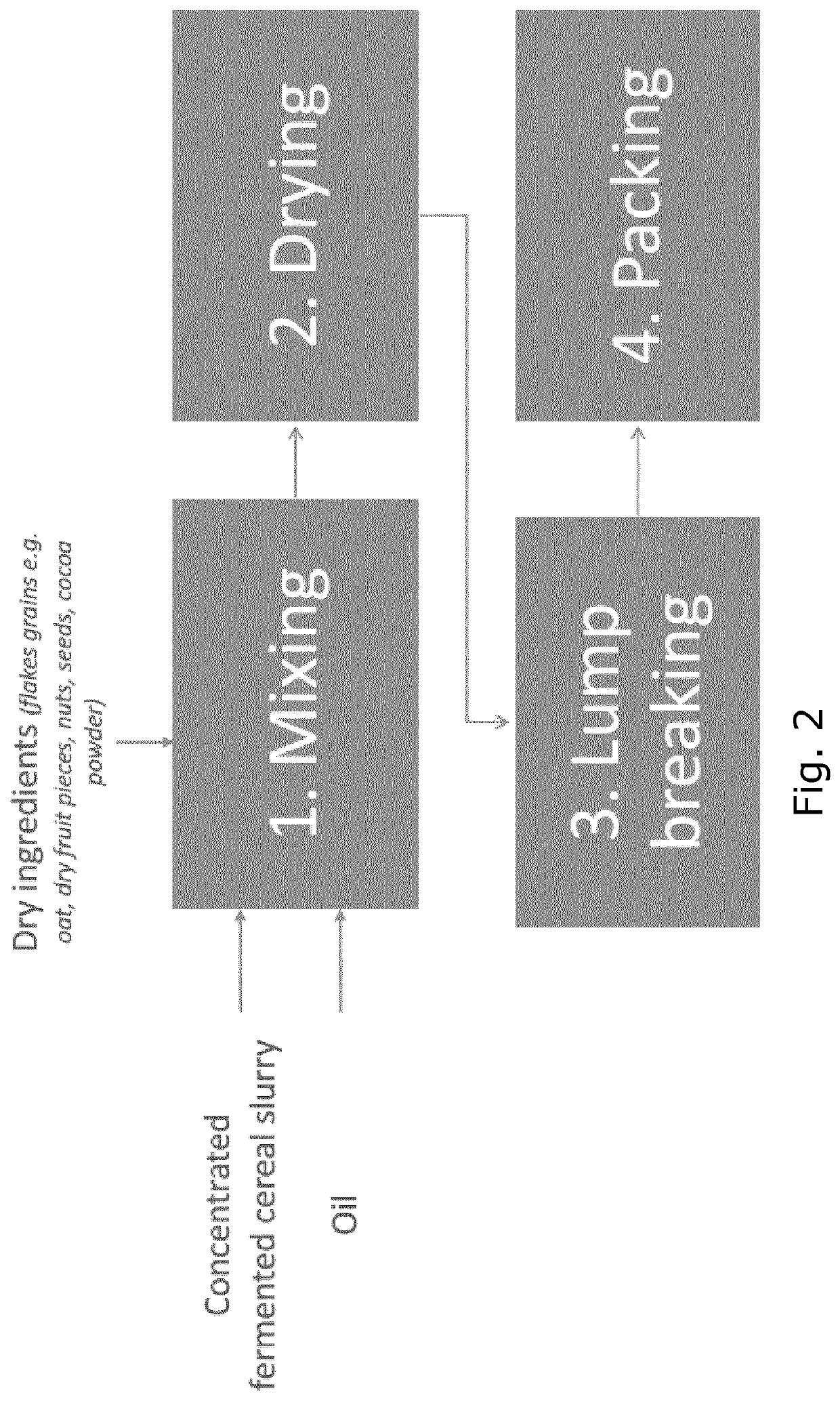
[0101]FIG. 2 outlines a process for preparing granolas made with the concentrated fermented cereal slurry made from rice koji (Amazake).
[0102]Step 1: ratio (w / w) oil / slurry (see example 1) / dry mix: 0-10 / 20-50 / 40-80. Examples of oil are but not limited to: Sunflower oil, canola oil, coconut oil, palm oil.
[0103]The dry mix may comprise flake grains e.g. oat, dry fruit pieces, nuts, seeds, and / or cocoa powder.
[0106]Step 4: packaging in individual pouch / multi-portion pouch.
[0107]Conclusion
[0108]A process for preparing granolas made with the concentrated fermented cereal slurry made from rice koji (Amazake) has been developed.
example 3
[0109]Aim of Study
[0110]To develop process for preparing “ready to eat” cereals coated with the concentrated fermented cereal slurry made from rice koji (Amazake).
[0111]Materials and Methods
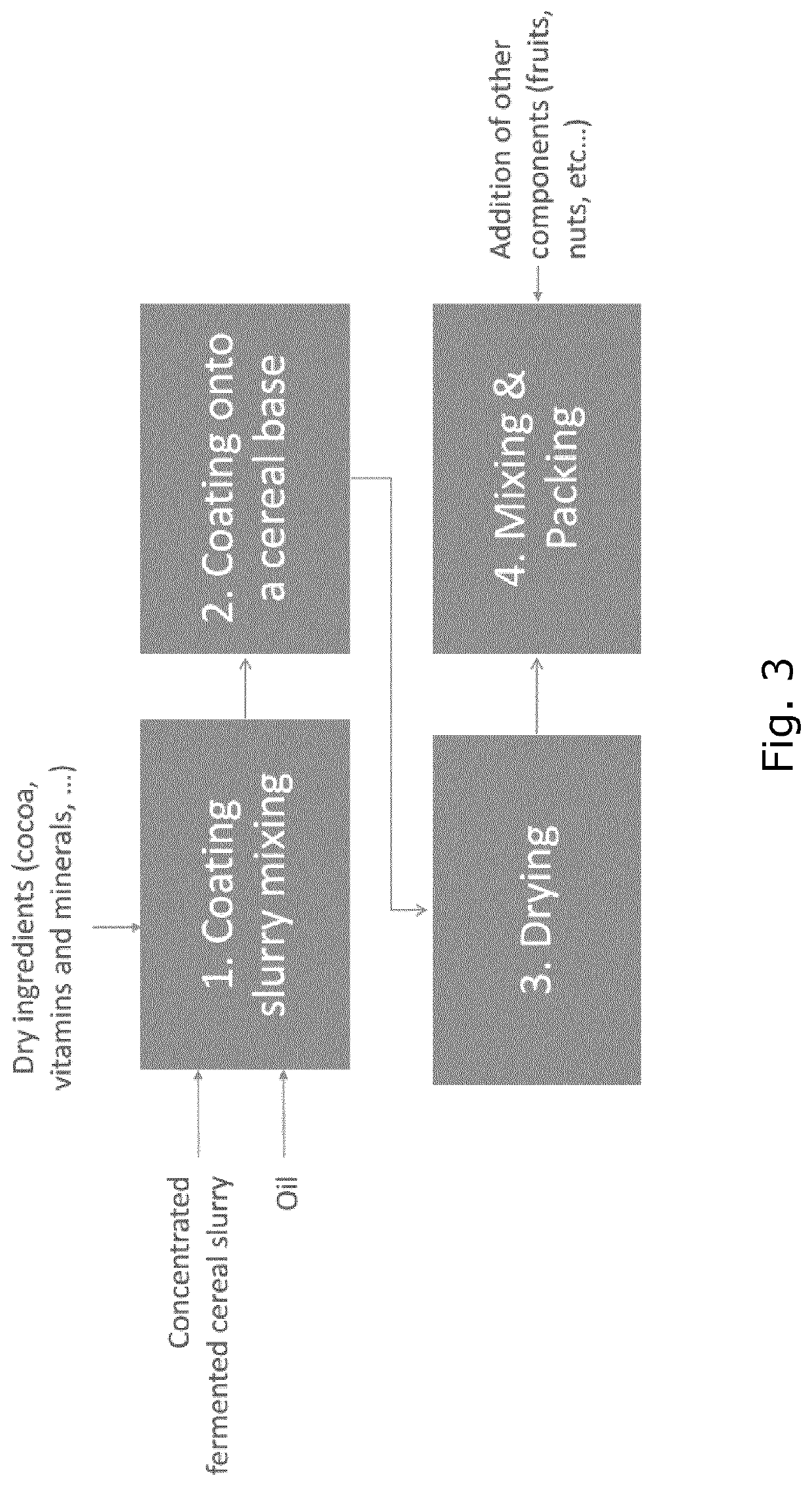
[0112]FIG. 3 outlines a process for preparing “ready to eat” cereals coated with the concentrated fermented cereal slurry made from rice koji (Amazake).
[0113]Step 1: Concentrated fermented cereal slurry: total solids from 50% to 70% (w / w)
[0114]Step 2: Coating slurry / cereal base ratio (w / w) 10 / 90 up to 50 / 50.
the structure of the environmentally friendly knitted fabric provided by the present invention; figure 2 Flow chart of the yarn wrapping machine for environmentally friendly knitted fabrics and storage devices; image 3 Is the parameter map of the yarn covering machine
Login to View More
PUM
Login to View More
Abstract
The present invention relates to a cereal product comprising a fermented slurry of rice flour made from koji rice (fermented rice). The fermented rice flour provides a natural and mild sweetness and glue for binding but is not too sticky during coating. The use of the slurry allows for a reduction / removal of added (refined) sugar in the final product because the fermented cereal slurry brings natural sweetness.
Description
TECHNICAL FIELD OF THE INVENTION[0001]The present invention relates to a cereal product comprising a fermented slurry of rice flour made from koji rice (fermented rice). The fermented rice flour provides a natural and mild sweetness and glue for binding but is not too sticky during coating. The use of the slurry allows for a reduction / removal of added (refined) sugar in the final product because the fermented cereal slurry brings natural sweetness.BACKGROUND OF THE INVENTION[0002]There is a continued wish to try to reduce as much as possible of consumer's daily diet in terms of refined sugars as well as to bring non-refined sources of sweetness. As sugars remain necessary for organoleptic purposes, such as sweetness and texture, substituting refined sugars (or high intensive sweeteners) by some natural equivalent food material is not an easy task. Such replacement food materials must prove to be stable and compatible with the other co-ingredients, as well as it must keep an acceptab...
Claims
the structure of the environmentally friendly knitted fabric provided by the present invention; figure 2 Flow chart of the yarn wrapping machine for environmentally friendly knitted fabrics and storage devices; image 3 Is the parameter map of the yarn covering machine
Login to View More
Application Information
Patent Timeline
Application Date:The date an application was filed.
Publication Date:The date a patent or application was officially published.
First Publication Date:The earliest publication date of a patent with the same application number.
Issue Date:Publication date of the patent grant document.
PCT Entry Date:The Entry date of PCT National Phase.
Estimated Expiry Date:The statutory expiry date of a patent right according to the Patent Law, and it is the longest term of protection that the patent right can achieve without the termination of the patent right due to other reasons(Term extension factor has been taken into account ).
Invalid Date:Actual expiry date is based on effective date or publication date of legal transaction data of invalid patent.