
Valeraldehyde and process for its preparation
a technology of valeraldehyde and process, applied in the field of linear aldehydes, can solve the problems of low stability of phosphite ligands compared with phosphine ligands, disadvantage of industrial implementation, etc., and achieve the effect of high selectivity
- Summary
- Abstract
- Description
- Claims
- Application Information
AI Technical Summary
Benefits of technology
Problems solved by technology
Method used
Image

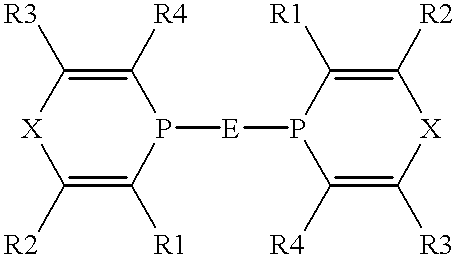
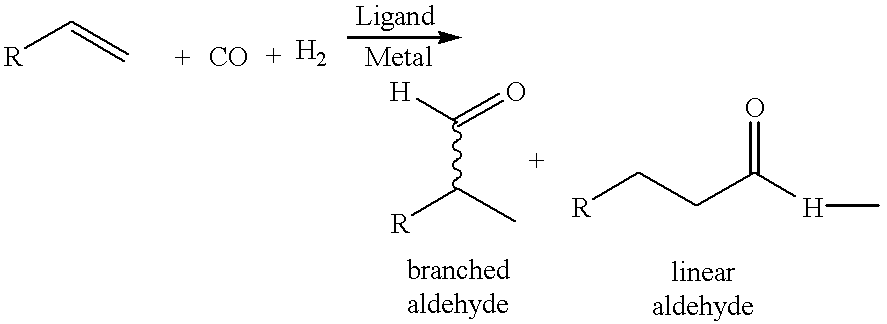
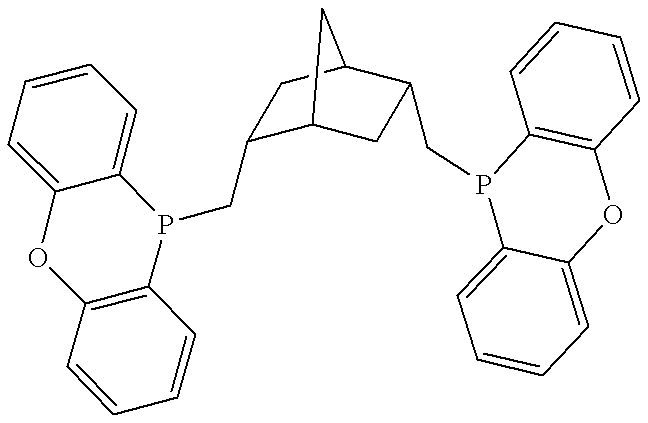
Examples
Embodiment Construction
General Synthesis Method
All experiments are carried out using standard Schlenk techniques under an argon atmosphere. The chemical were obtained from Acros Chimica and Aldrich Chemical Company. Rh(CO).sub.2 (dipivaloyl methanoate) was prepared by the processes described in the literature (H. T. Teunissen, F. Bickelhaupt "Phosphor, Sulfur" 1996 118, pp. 309-312; H. K. A. C. Coolen, P. W. N. M. van Leeuwen, R. J. M. Nolte "J. Org. Chem." 1966, 61, pp. 4739-4747). The NMR measurements were carried out using a Bruker AMX 300 spectrometer.
Preparation of the Diphosphine Ligands 2a-2c: ##STR12##
3.7 ml of a solution of N-butyllithium in hexane (2.5 mol, 9.3 mmol) were added to a mixture of 2.00 g of 4,5-dibromo-2,7-di-t-butyl-9,9-dimethylxanthene (compound 3) (4.16 mmol) in 50 ml of THF at -60.degree. C. After the resultant white suspension had been stirred for 2 hours, 2.2 equivalents of chlorophosphine in 25 ml of toluene were added. The reaction mixture was slowly heated to ambient temper...
PUM
| Property | Measurement | Unit |
|---|---|---|
| pressure | aaaaa | aaaaa |
| pressure | aaaaa | aaaaa |
| pressure | aaaaa | aaaaa |
Abstract
Description
Claims
Application Information
 Login to View More