This helps you quickly interpret patents by identifying the three key elements:
Problems solved by technology
Method used
Benefits of technology
Problems solved by technology
No agent has been developed to inhibit nerve cell death in neurodegenerative diseases such as Alzeheimer's disease and Parkinson's disease and prevent these diseases from progressing.
Method used
the structure of the environmentally friendly knitted fabric provided by the present invention; figure 2 Flow chart of the yarn wrapping machine for environmentally friendly knitted fabrics and storage devices; image 3 Is the parameter map of the yarn covering machine
View more
Image
Smart Image Click on the blue labels to locate them in the text.
Viewing Examples
Smart Image
Click on the blue label to locate the original text in one second.
Reading with bidirectional positioning of images and text.
[0369]2-Methyl 2,3-dihydro-4(1H)-quinolone (1.19 g, 7.38 mmol) was synthesized in the published manner (Bioorganic and Medicinal Chemistry Letters 9 1009 (1999)) and dissolved in pyridine (15 ml). To this solution, 3,4-dimethoxybenzoyl chloride (1.63 g, 8.12 mmol) was added and stirred at room temperature for 16 hours. The reaction mixture was concentrated and extracted by addition of ethyl acetate and water. After the organic layer was dried and concentrated, the residue was applied to silica gelcolumn chromatography (developing solvent: ethyl acetate / hexane=1 / 2) and the resulting eluate was recrystallized from ethyl acetate-hexane to give the product of interest, i.e., cis-1-(3,4-dimethoxybenzoyl)-2-methyl-2,3-dihydro-4(1H)-quinolinone (1.57 g, yield: 65%) as a white crystal.
[0370]Elementary Analysis for C19H19NO4: Calculated: C, 70.14; H, 5...
[0374]Starting with 2,3-dihydro-4(1H)-quinolone (2.60 g, 16.54 mmol), the same procedure as shown in Reference Example 1-1) was repeated to give 1-(3,4-dimethoxybenzoyl)-2,3-dihydro-4(1H)-quinolinone (4.42 g, yield: 86%) as a white crystal.
[0376]Starting with 1-(3,4-dimethoxybenzoyl)-2,3-dihydro-4(1H)-quinolinone (2.00 g, 14.3 mmol) prepared in 1) above, the same procedure as shown in Reference Example 1-2) was repeated to give 1-(3,4-dimethoxybenzoyl)-1,2,3,4-tetrahydro-4-quinolinol (1.54 g, yield: 77%) as a white crystal.
[0377]1H-NMR (CDCl3) δ: 2.05-2.13 (1H, m), 2.21-2.27 (1H, m), 3.76 (3H, s), 3.76-3.84 (1H, ...
[0379]1-(3,4-Dimethoxybenzoyl)-1,2,3,4-tetrahydro-4-quinolinol (400 mg, 1.28 mmol) prepared in Reference Example 2 was dissolved in chloroform (10 ml), to which iodotrimethylsilane (638 mg, 3.19 mmol) was then added on ice and stirred for 2 hours. After the reaction mixture was concentrated, the residue was dissolved in THF (10 ml) and mixed with 1,2,3,4-tetrahydroquinoline (511 mg, 3.84 mmol) and bariumcarbonate (505 mg, 2.56 mmol), followed by stirring at room temperature for 48 hours. After the reaction mixture was filtered to remove insoluble products and concentrated, the residue was applied to silica gelcolumn chromatography (developing solvent: ethyl acetate / hexane=1 / 3) and the resulting eluate was recrystallized from diethyl ether-hexane to give the product of interest, i.e., 4-(tetrahydroquinolin-1-yl)-1-(3,4-dimethoxybenzoyl)-1,2,3,4-tetrahydro-quinoline (202 mg, yield: 37%) as a white ...
the structure of the environmentally friendly knitted fabric provided by the present invention; figure 2 Flow chart of the yarn wrapping machine for environmentally friendly knitted fabrics and storage devices; image 3 Is the parameter map of the yarn covering machine
Login to View More
PUM
Property
Measurement
Unit
Composition
aaaaa
aaaaa
Login to View More
Abstract
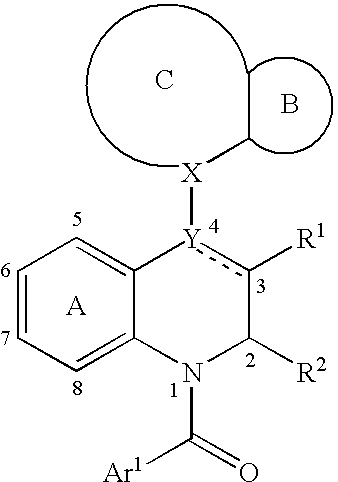
The object of the present invention is to provide soluble β-amyloid precursor protein secretory stimulators, which are effective in treating neurodegenerative diseases as well as cerebrovascular disorder-induced neuronopathy. More specifically, the present invention provides a novel compound of the following Formula (I) or a salt or prodrug thereof: [wherein R1 and R2 each represent a hydrogen atom or a lower alkyl group, etc., Ar1 and the ring B each represent an optionally substituted aromatic group, the ring A represents an optionally substituted benzene ring, the ring C represents an optionally substituted 4- to 8-membered ring which may further be condensed with an optionally substituted ring, X represents CH or N, and Y represents CH or N].
Description
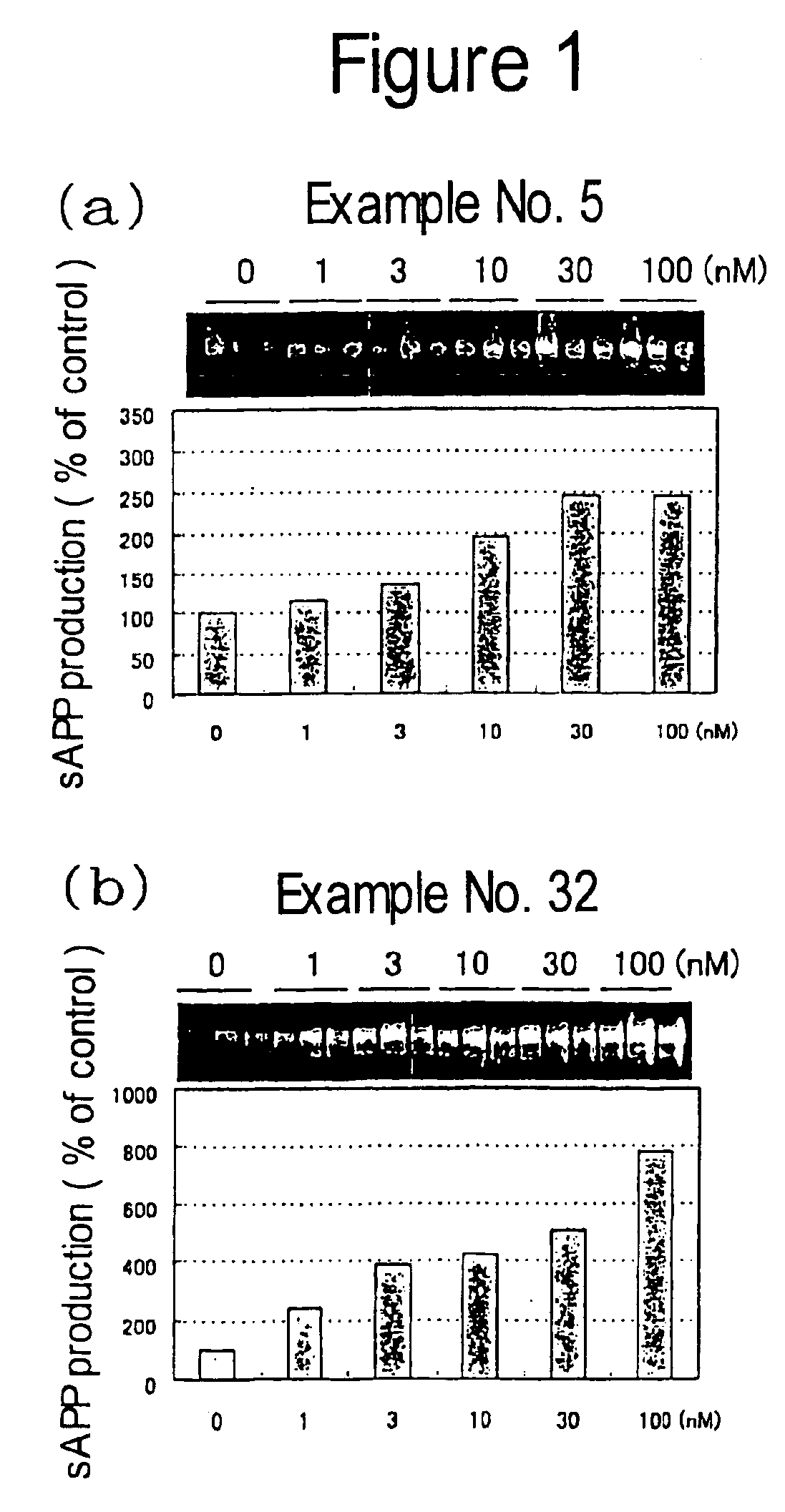
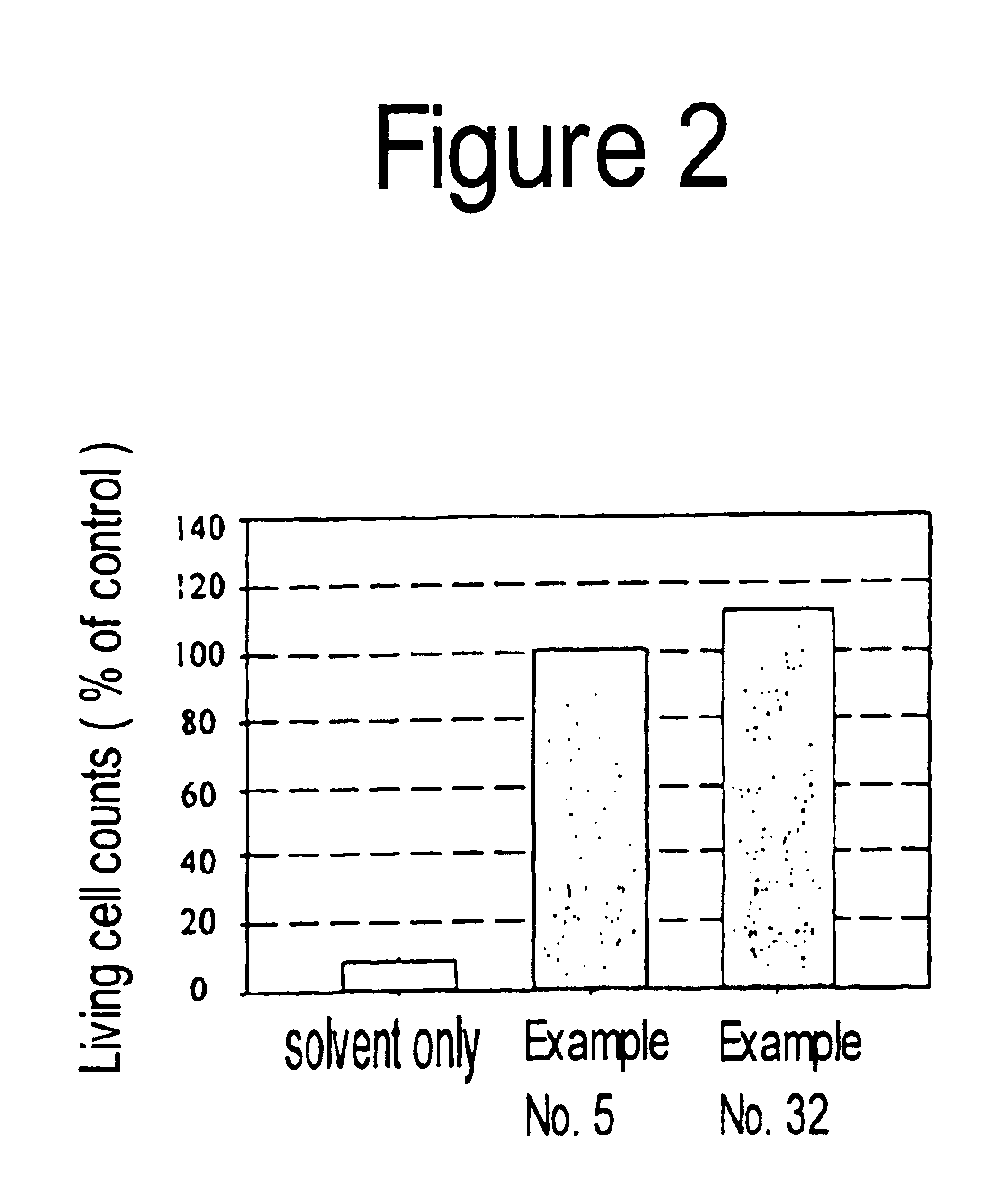
[0001]This application is the National Phase filing of International Patent Application No. PCT / JP02 / 04148, filed 25 Apr. 2002.TECHNICAL FIELD[0002]The present invention relates to medicaments, more particularly soluble β-amyloid precursor protein secretory stimulators and apoptosis inhibitors, which are effective in treating neurodegenerative diseases such as Alzeheimer's disease, Parkinson's disease, Down's syndrome, amyotrophic lateral sclerosis, prion disease (Creutzfeldt-Jakob disease), Huntington's chorea and neuropathy (preferably, e.g., diabetic neuropathy), as well as effective in treating cerebrovascular disorder-induced neuronopathy.BACKGROUND ART[0003]No agent has been developed to inhibit nerve cell death in neurodegenerative diseases such as Alzeheimer's disease and Parkinson's disease and prevent these diseases from progressing.[0004]Alzeheimer's disease is characterized by senile plaque formation and neurofibrillary degeneration along with neuronal degeneration and d...
Claims
the structure of the environmentally friendly knitted fabric provided by the present invention; figure 2 Flow chart of the yarn wrapping machine for environmentally friendly knitted fabrics and storage devices; image 3 Is the parameter map of the yarn covering machine
Login to View More
Application Information
Patent Timeline
Application Date:The date an application was filed.
Publication Date:The date a patent or application was officially published.
First Publication Date:The earliest publication date of a patent with the same application number.
Issue Date:Publication date of the patent grant document.
PCT Entry Date:The Entry date of PCT National Phase.
Estimated Expiry Date:The statutory expiry date of a patent right according to the Patent Law, and it is the longest term of protection that the patent right can achieve without the termination of the patent right due to other reasons(Term extension factor has been taken into account ).
Invalid Date:Actual expiry date is based on effective date or publication date of legal transaction data of invalid patent.



 Login to View More