
Method of achieving jet separation of an un-separated flow in a divergent nozzle body of a rocket engine
a rocket engine and jet separation technology, applied in the direction of machines/engines, vessel construction, marine propulsion, etc., can solve the problems of jet separation, difficult to implement active secondary injection, and unstable position, and achieve the effect of avoiding such instability
- Summary
- Abstract
- Description
- Claims
- Application Information
AI Technical Summary
Benefits of technology
Problems solved by technology
Method used
Image

Examples
Embodiment Construction
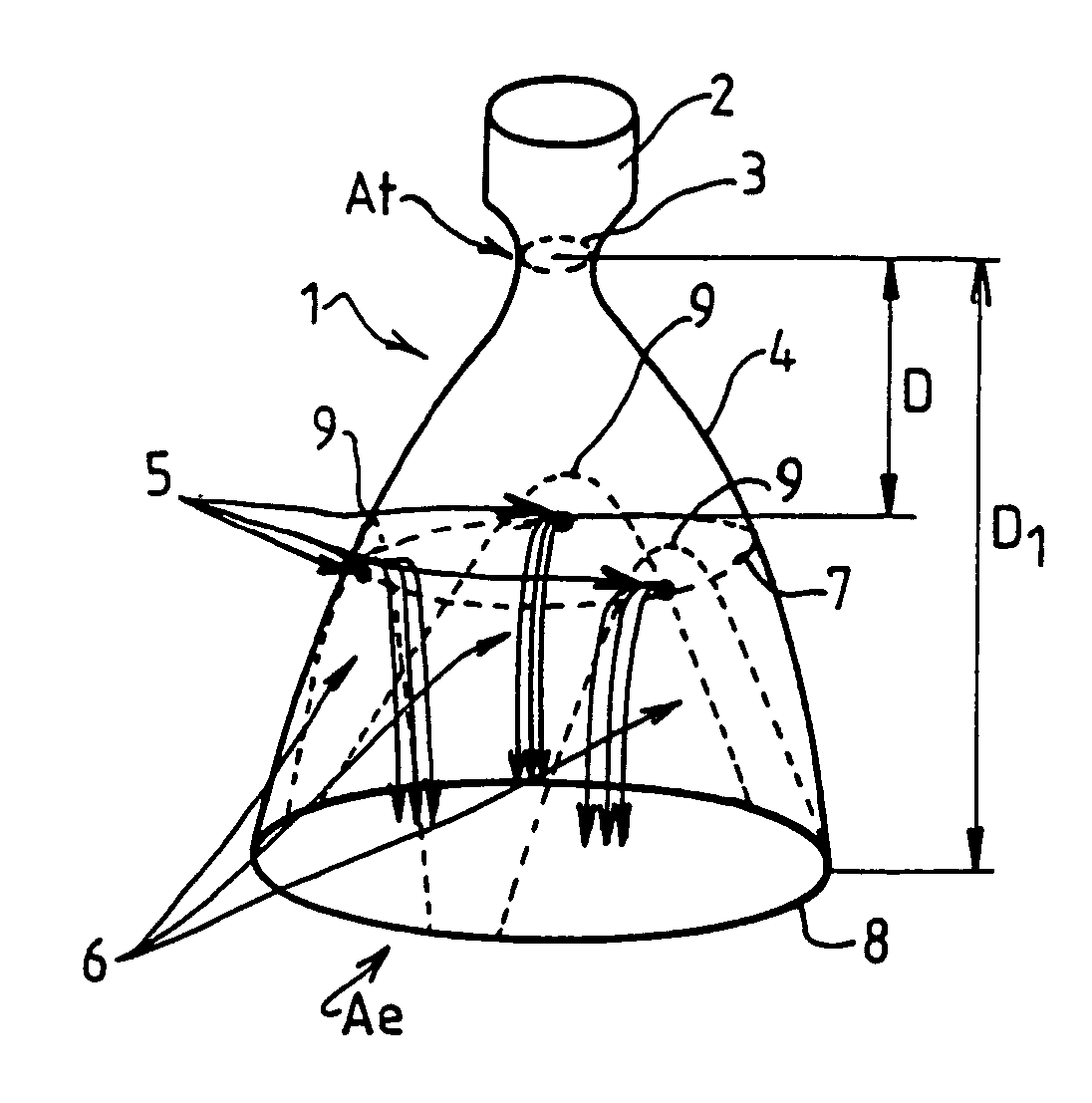
[0044]As shown in FIG. 1, a nozzle, designated by the general label 1, exhibits a combustion chamber 2, a throat 3, and a divergent nozzle body 4 which terminates in an exit cross section 8.
[0045]Over the perimeter of the divergent portion 4 of the nozzle, and in a cross section 7 situated in a plane, perpendicular to the axis of the nozzle, where the static pressure P of the jet is substantially greater than the nozzle separation pressure Psep, are arranged injection orifices 5 able to direct radially inward a jet of a fluid, for example the combustion gases originating from the turbopumps of the engine.
[0046]The flow separation which is generated by these orifices 5, does not exhibit axial symmetry, but on the contrary it is three-dimensional. This is because each of the injection points 5, represented here as three in number and distributed uniformly at 120° around the contour of the body 4 of the nozzle, induces a region of separation 6 of the stream exiting the nozzle. Owing to...
PUM
 Login to View More
 Abstract
Description
Claims
Application Information
 Login to View More