Check patentability & draft patents in minutes with Patsnap Eureka AI!

Segmented polymers and their conjugates

a technology of segmented polymers and conjugates, which is applied in the direction of depsipeptides, peptide sources, peptide/protein ingredients, etc., can solve the problems of complex synthesis of such compounds, hampered clinical usefulness of potentially therapeutic biomolecules, and rapid proteolytic degradation

Inactive Publication Date: 2006-05-30
NEKTAR THERAPEUTICS INC
View PDF12 Cites 99 Cited by
  • Summary
  • Abstract
  • Description
  • Claims
  • Application Information

AI Technical Summary

Benefits of technology

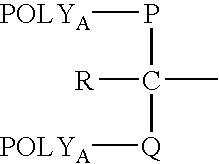
[0049]In selected embodiments of structure (IV), q is 1 or 2; that is, each “arm” represents a linear polymer (q=1) or a “forked” polymer (q=2). In further embodiments, x is 3 to 20, or 3 to 10. Generally, q is 1, such that each POLYA is linked to a single POLYB. However, q can be greater than 1, and POLYB can include more than one Y or a polyfunctional Y, as noted above. Where q is >1 or POLYB includes more than one Y, branched spacer groups, as represented by L above, are incorporated as appropriate. Generally, POLYB includes a single group Y.
[0050]The multiarmed polymer may also include some POLYA segments which are not further substituted. Accordingly, structure (IV) can represent a branched or dendritic polymer segment in which each of a plurality of POLYA polymer arms (where the plurality is equal to or less than q) is covalently attached to a POLYB-Y segment via a covalent linkage, X.

Problems solved by technology

Scientists and clinicians face a number of challenges in development of therapeutically active agents into forms suitable for delivery to a patient.
For example, pharmaceutically useful biomolecules, including antibodies and antibody fragments, can now be prepared on a useful scale, due to advances in biotechnology, but the clinical usefulness of potentially therapeutic biomolecules is often hampered by their rapid proteolytic degradation, their instability upon manufacture, storage or administration, and / or their immunogenicity.
However, the synthesis of such compounds is often complicated by the difficulty in removing polymeric impurities that accumulate during multi-step preparations.
The diol impurity, and especially its reaction products when carried through a series of synthetic transformations, can be extremely difficult to analyze and remove.
Higher molecular weight polymeric side-products, in particular, are generally quite difficult to remove and require time-consuming and expensive chromatographic techniques.

Method used

the structure of the environmentally friendly knitted fabric provided by the present invention; figure 2 Flow chart of the yarn wrapping machine for environmentally friendly knitted fabrics and storage devices; image 3 Is the parameter map of the yarn covering machine
View more

Image

Smart Image Click on the blue labels to locate them in the text.
Viewing Examples
Smart Image
  • Segmented polymers and their conjugates
  • Segmented polymers and their conjugates
  • Segmented polymers and their conjugates

Examples

Experimental program
Comparison scheme
Effect test

example 1

Synthesis of α-t-Boc amino-ω-methanesulfonate PEG(3400)

[0253]

BocNH-PEG3.4 kD-OMS

[0254]α-N-t-Boc amino-ω-hydroxy PEG(3400) (MW 3318 Da, 4.0 g, 0.0012 mol) (Shearwater Corp.) was azeotroped in chloroform (80 ml) on a rotary evaporator at 35° C. to dryness, and chloroform (50 ml) was added to the residual syrup. The solution was cooled to 4° C. under argon, and triethylamine (0.31 ml, 0.0022 mol) was injected, followed by slow injection of methanesulfonyl chloride (0.15 ml, 0.0019 mol). The reaction mixture was stirred overnight under argon while the bath was allowed to rise to ambient temperature. Anhydrous sodium carbonate (4.0 gm) was added to the reaction mixture, and the resulting solution was stirred at room temperature for one hour. The mixture was then filtered, and the filtrate was concentrated to dryness. Isopropanol (40 ml) was added, and the precipitated product was collected by filtration and dried under vacuum to yield 3.7 g α-t-Boc amino-ω-methanesulfonate PEG(3400). NMR...

example 2

Synthesis of α-t-Boc amino-ω-p-toluenethiosulfonate PEG(3400)

[0255]

BocNH-PEG3.4 kD-STs

[0256]α-t-Boc amino-ω-methanesulfonate PEG(3400) (the product of Example 1) (1.0 g, 0.30 mmol) was azeotroped to dryness in chloroform (30 ml) on a rotary evaporator at 35° C., and anhydrous ethanol (15 ml) was added to the residual syrup. Potassium p-toluenethiosulfonate (292 mg, 1.25 mmol) was added, and the mixture was refluxed under argon overnight. The solvent was removed on a rotary evaporator at 40° C., and the residue was dried under vacuum for 30 minutes. The crude product was dissolved in 100 ml 1M NaH2PO4—Na2HPO4 buffer solution (contain 10 wt % NaCl) at pH 5.8, and the resulting solution was extracted with dichloromethane (100 ml×3). The dichloromethane phase was dried over anhydrous sodium sulfate, filtered, and the filtrate concentrated to near dryness on a rotary evaporator. The product was precipitated by addition of isopropanol / ether (40 ml / 20 ml), collected by filtration, and drie...

example 3

Synthesis of α-NH2-ω-p-toluenethiosulfonate PEG(3400)

[0258]

H2N-PEG3.4 kD-STs

[0259]α-t-Boc amino-ω-p-toluenethiosulfonate PEG(3400) (the product of Example 2) (0.7 g) was dissolved in anhydrous dichloromethane (3.5 ml) and trifluroacetic acid (3.5 ml) under argon. The solution was stirred at room temperature for one hour and concentrated to dryness. Isopropanol (20 mL) was added, and the precipitated product was collected by filtration and dried under vacuum. Yield: 0.6 g α-NH2-ω-p-toluenethiosulfonate PEG(3400). NMR (DMSO-d6): 2.43 ppm (s, CH3—CH2═CH2 / Ar), 2.95 ppm (t, —OCH2CH2NH2), 3.51 ppm (s, PEG backbone), 7.49 ppm (dd, CH3—CH2═CH2 / Ar), 7.82 ppm (dd, CH3—CH2═CH2 / Ar).

[0260]Example 4 demonstrates the linking of a high molecular weight (“POLYA”) and low molecular weight (“POLYB”) polymer, by reaction of an amine on POLYB with a benzotriazole carbonate on POLYA, to form a functionalized, segmented carbamate-linked polymer. The segmented polymer product has a p-toluenethiosulfonate f...

the structure of the environmentally friendly knitted fabric provided by the present invention; figure 2 Flow chart of the yarn wrapping machine for environmentally friendly knitted fabrics and storage devices; image 3 Is the parameter map of the yarn covering machine
Login to View More

PUM

PropertyMeasurementUnit
molecular weightsaaaaaaaaaa
Login to View More

Abstract

Segmented water soluble polymers, containing a higher molecular weight segment linked to a lower molecular weight segment, are described. In one embodiment, the polymer segments are poly(ethylene glycol) segments. The segmented polymers are functionalized and are useful for conjugation to various moieties such as pharmacologically active substances. Also described are conjugates of such polymers and methods of their preparation.

Description

[0001]This application is a continuation-in-part of U.S. Ser. No. 10 / 024,357, filed Dec. 18, 2001, now U.S. Pat. No. 6,774,180, which claims the benefit of Provisional Application Ser. No. 60 / 256,801, filed Dec. 18, 2000, both of which are hereby incorporated by reference in their entirety.FIELD OF THE INVENTION[0002]The invention relates to medium to high molecular weight, functionalized, water soluble polymers useful for conjugation to various moieties, including pharmacologically active substances. In particular, the invention relates to functionalized water soluble polymers, such as poly(ethylene glycols), containing a higher molecular weight segment linked to a lower molecular weight segment, and methods of their preparation.REFERENCES[0003]Brinkley, M. A brief survey of methods for preparing protein conjugates with dyes, haptens, and cross-linking reagents. Bioconjug. Chem. 3:2–13 (1992).[0004]Carlsson, J., Drevin, H., and Axen, R. Protein thiolation and reversible protein-pro...

Claims

the structure of the environmentally friendly knitted fabric provided by the present invention; figure 2 Flow chart of the yarn wrapping machine for environmentally friendly knitted fabrics and storage devices; image 3 Is the parameter map of the yarn covering machine
Login to View More

Application Information

Patent Timeline
no application Login to View More
Patent Type & Authority Patents(United States)
IPC IPC(8): C08G63/48C08G63/91A61K47/48C08G65/329
CPCA61K47/48169C08G65/329A61K47/48215Y10S530/815A61K47/56A61K47/60A61P11/00
Inventor KOZLOWSKI, ANTONISHEN, XIAOMINGBENTLEY, MICHAEL D.FANG, ZHIHAOSANDER, TONY L.
Owner NEKTAR THERAPEUTICS INC
Features
  • R&D
  • Intellectual Property
  • Life Sciences
  • Materials
  • Tech Scout
Why Patsnap Eureka
  • Unparalleled Data Quality
  • Higher Quality Content
  • 60% Fewer Hallucinations
Social media
Patsnap Eureka Blog
Learn More