Check patentability & draft patents in minutes with Patsnap Eureka AI!

Process and apparatus for oxygen enrichment in fuel conveying gases

a technology of fuel conveying gas and process, which is applied in the direction of lighting and heating apparatus, combustion regulation, combustion types, etc., can solve the problems of preventing the adaptability of known techniques already used or described for secondary or tertiary air enrichment, adversely affecting the characteristics of the fuel-carrying gas stream, and nox discharge low, the effect of reducing nox

Active Publication Date: 2006-06-27
AIR LIQUIDE AMERICA INC
View PDF63 Cites 12 Cited by
  • Summary
  • Abstract
  • Description
  • Claims
  • Application Information

AI Technical Summary

Benefits of technology

This approach effectively reduces NOx production, enhances combustion efficiency, and meets environmental guidelines by ensuring safe oxygen enrichment without compromising the conveying gas flow, thereby improving the operational safety and effectiveness of pulverized coal-fired burners.

Problems solved by technology

To date, none of these oxygen-enrichment schemes has been successfully adapted to solid-fuel applications, such as pulverized coal-fired boilers, due to problems associated therewith that are unique to solid-fuel media and their transportation, as described below.
While it appears then theoretically desirable to enrich the primary air to increase the temperature in the fuel-rich ignition zone, two problems have in the past prevented adaptability of known techniques already used or described for secondary or tertiary air enrichment.
Second, oxygen-enrichment of the primary air by replacing a portion of it (the function of which includes transporting the pulverized fuel) with the stoichiometric equivalent of oxygen would reduce the volume of the conveying gas and may adversely affect the characteristics of the fuel-carrying gas stream.
Thus, a problem associated with coal-fired burners and other pulverized solid-fuel, air-fired combustion systems that precede the present invention is that they produce an level of NOx emission that is unacceptable in view of existing environmental regulations.
Yet another problem associated with pulverized coal-fired burners and other pulverized solid-fuel burners that precede the present invention is that they are not susceptible to traditional oxygen enrichment techniques upstream from the point of ignition, as they would then bear an unacceptably high risk of premature ignition, explosion, or other detrimental effects.
Still another problem associated with pulverized coal-fired burners and other pulverized solid-fuel burners that precede the present invention is that they have not been successively modified to provide adequate combustion characteristics resulting in adequate reduction of NOx formation sufficient to meet environmental guidelines without expensive and complex NOx treatment apparatus.
Another problem associated with pulverized coal-fired burners and other pulverized solid-fuel burners that precede the present invention is that they have not been adaptable to oxygen enrichment that facilitates NOx reduction while at the same time permits a maintained flow of a conveying gas to facilitate flow of the pulverized fuel from storage to the burner.
An even further problem associated with pulverized coal-fired burners and other pulverized solid-fuel burners that precede the present invention is that they have not been provided with a multiplicity of oxygen enrichment tools that permit substantial reduction of NOx with the least amount of oxygen necessary.
Another problem associated with pulverized coal-fired burners and other pulverized solid-fuel burners that precede the present invention is that they have not been provided with a multiplicity of oxygen distribution variables so as to be retrofittable to provide optimal reduction of NOx with the least amount of oxygen.

Method used

the structure of the environmentally friendly knitted fabric provided by the present invention; figure 2 Flow chart of the yarn wrapping machine for environmentally friendly knitted fabrics and storage devices; image 3 Is the parameter map of the yarn covering machine
View more

Image

Smart Image Click on the blue labels to locate them in the text.
Viewing Examples
Smart Image
  • Process and apparatus for oxygen enrichment in fuel conveying gases
  • Process and apparatus for oxygen enrichment in fuel conveying gases
  • Process and apparatus for oxygen enrichment in fuel conveying gases

Examples

Experimental program
Comparison scheme
Effect test

Embodiment Construction

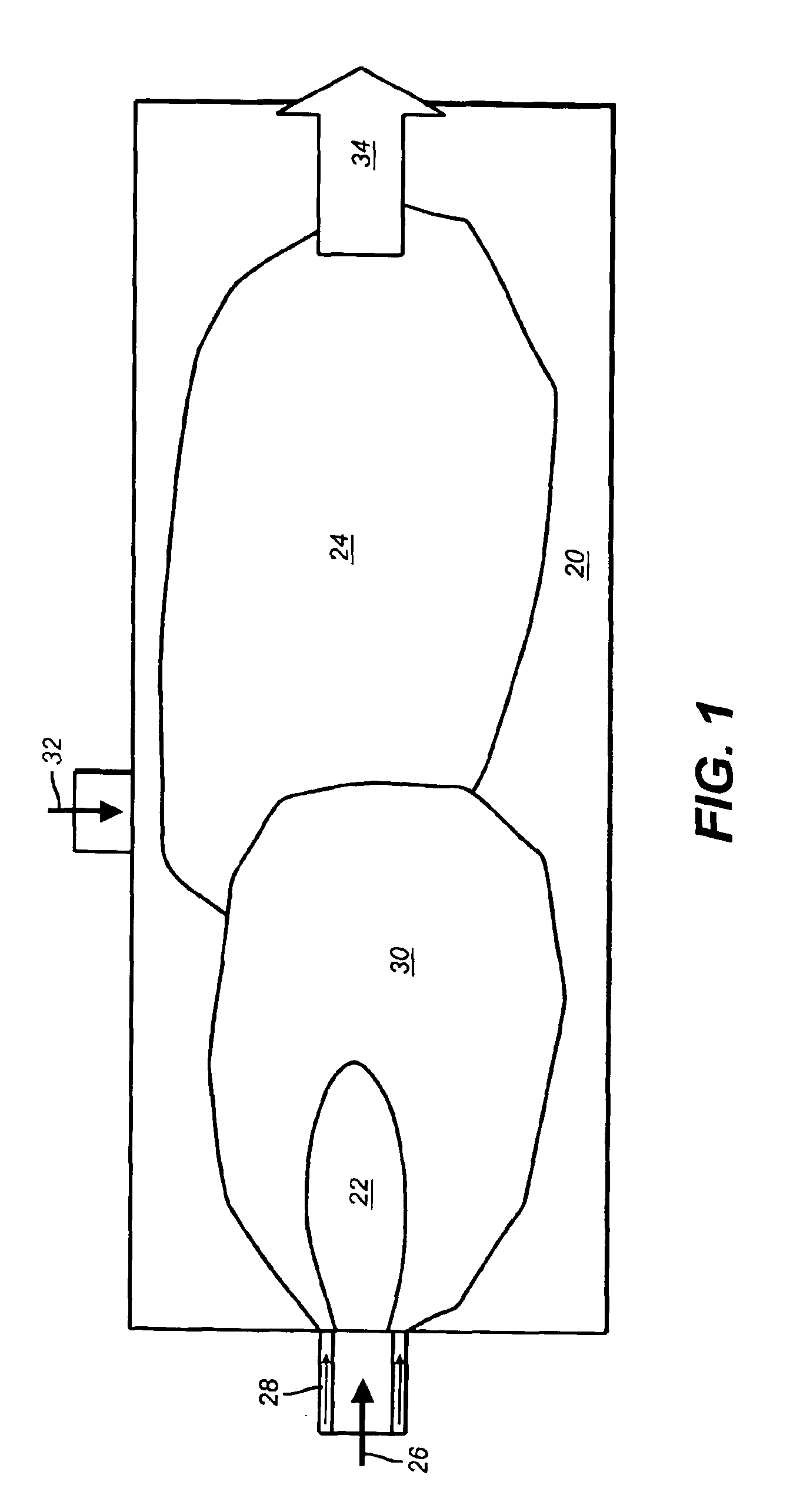
[0039]Conventional, pulverized coal-fired boilers use at least two, and sometimes three, types of air streams. As shown schematically in FIG. 1, a combustion chamber 20 is shown having a first combustion zone 22 and a second combustion zone 24. The first of the three inlet stream types, the primary stream 26, comprises primary air and fuel, and conveys the pulverized solid fuel. The second type, or secondary stream 28, is the “secondary air” injected into the burner, around or near the primary air / fuel mixture 26. The third type, or tertiary stream 32, is injected, if necessary, outside the burner ignition zone 30, in the second combustion zone 24, to complete combustion. It is understood that in these apparatus, multiple air streams of each type thus described (primary, secondary and tertiary) can be utilized—indeed multiple burners can be used; the following description will refer to each in the singular for simplicity). Flue gas 34 is formed and exhausted from the combustion cham...

the structure of the environmentally friendly knitted fabric provided by the present invention; figure 2 Flow chart of the yarn wrapping machine for environmentally friendly knitted fabrics and storage devices; image 3 Is the parameter map of the yarn covering machine
Login to View More

PUM

No PUM Login to View More

Abstract

An improved process for burning solid fuel particles in a combustion chamber and creating a flue gas is disclosed. The method comprises creating a fuel gas stream by mixing the solid fuel particles with a conveying gas, transporting the fuel gas stream through a fuel duct terminating at the combustion chamber at a fuel exit plane and injecting an oxygen stream through an injection device into said fuel gas at an oxygen injection location selected to create a mixing zone to mix the oxygen stream and the fuel gas stream immediately prior to or coincident with combustion of the fuel. Operating parameters of the process can be varied to optimally reduce NOx emissions.

Description

CROSS REFERENCE TO RELATED APPLICATION[0001]This application claims the benefit of U.S. Provisional Application No. 60 / 441,508, filed Jan. 21, 2003.BACKGROUND OF THE INVENTION[0002]1. Field of the Invention[0003]This invention relates to the field of oxygen enrichment in fuel conveying gases for use in combustion.[0004]2. Related Art[0005]Oxygen enrichment in all kinds of combustion systems is a well known and growing method already implemented in many industrial processes to improve combustion characteristics, both in terms of efficiency, product quality and pollutant emission levels. These include glass furnaces, cement and lime kilns, and aluminum or steel processes. For example, oxygen enrichment in lime kilns has been described in Garrido G. F., Perkins A. S., Ayton J. R., UPGRADING LIME RECOVERY WITH O2 ENRICHMENT, CPPA Conference, Montreal, January 1981. Pure or substantially pure oxygen may be used as the only oxidant for some specific applications, often referred to as “ful...

Claims

the structure of the environmentally friendly knitted fabric provided by the present invention; figure 2 Flow chart of the yarn wrapping machine for environmentally friendly knitted fabrics and storage devices; image 3 Is the parameter map of the yarn covering machine
Login to View More

Application Information

Patent Timeline
no application Login to View More
Patent Type & Authority Patents(United States)
IPC IPC(8): F23M3/00F23D1/00F23L7/00F23N5/00
CPCF23D1/00F23N5/006F23L7/007F23C2900/07021Y02E20/344Y02E20/322Y02E20/32Y02E20/34
Inventor CHATEL-PELAGE, FABIENNEMARIN, OVIDIUMACADAM, SCOTTPENFORNIS, ERWIN
Owner AIR LIQUIDE AMERICA INC
Features
  • R&D
  • Intellectual Property
  • Life Sciences
  • Materials
  • Tech Scout
Why Patsnap Eureka
  • Unparalleled Data Quality
  • Higher Quality Content
  • 60% Fewer Hallucinations
Social media
Patsnap Eureka Blog
Learn More