Autocatalysis/yeast two-hybrid assay
a technology of autocatalysis and hybridization, applied in the field of improved assay system, can solve the problems of not being able to screen for such interactions, cellular toxicity, and not having a method that enables researchers to identify protein interactions, and achieves the effect of fast identification of protein interactions
- Summary
- Abstract
- Description
- Claims
- Application Information
AI Technical Summary
Benefits of technology
Problems solved by technology
Method used
Image



Examples
example 1
Evidence of Autocatalysis in Two Different Two-Hybrid Systems and Two Different Organisms.
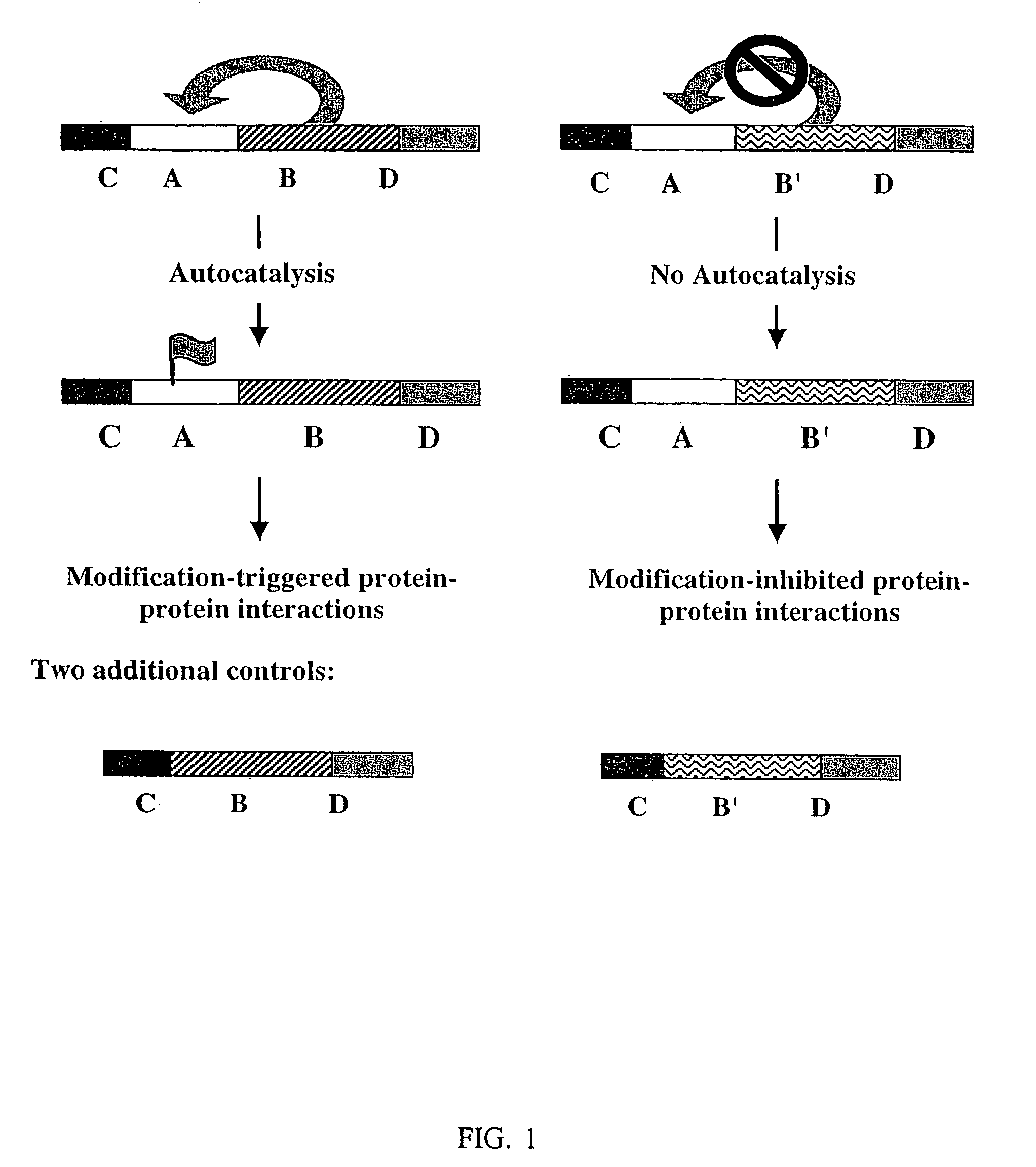
[0214]The concept and feasibility of Autocatalysis was tested using an array of fusion proteins composed of histones H3, H4 (as the substrates) and the prototypic histone acetyltransferase, Gcn5. The detailed overview of this system is shown in FIG. 4.
[0215]To first test if the autocatalysis actually is feasible, histone H3 (amino acids 2 to 60) was fused to Gcn5 (the catalytic domain, amino acids 1 to 252). In the first setting, H3 was fused to the glutathione S-transferase (GST), followed by the Gcn5 catalytic domain, and by the Ras protein. The Ras protein is a part of the bait used in the Ras Recruitment System, an alternative to Stanley Fields' Yeast Two-Hybrid system (Aronheim, A., Methods Enzymol 332:260-70, 2001) (U.S. Pat. No. 5,776,689). The GST is an epitope tag allowing efficient purification of the fusion protein. In addition, a point mutation of Gcn5, F221A (Kuo, M.-H., et al., “H...
example 2
Confirmation of An Interaction between Acetylated Histones and the Bromodomain of the PCAF Protein.
[0219]This Example is to show that AC / Y2H recapitulates bromodomain-acetylated histone interaction in vivo.
[0220]To further confirm that the AC / 2H can identify protein-protein interactions that require specific PTMs, the GDBD-H3-Gcn5-HA constructs were used in the Yeast Two-Hybrid genetic tests. In the Y2H system, the expression of one of the three reporter genes reveals the protein-protein interactions (James, et al., Genetics 144:1425-1436, 1996). The first reporter is the bacterial lacZ gene under the control of GAL7 promoter. Positive interactions are indicated by elevated β-galactosidase activity. The second reporter is the HIS3 gene under the control of the GAL1 promoter. When HIS3 gene is upregulated by positive protein-protein interactions, yeast cells display significant resistance to the chemical 3-amino-1,2,4-triazole (3-AT) and survive in the absence of histidine (His). The...
example 3
Identification of Novel Acetylated Histone Binding Proteins Using the AC / Y2H Methodology.
[0222]This Example shows that AC / Y2H using a modified chromatin component (e.g., acetylated histone H3) identifies three chromatin-related proteins Cac1, Rmt1, and Rpm2.
[0223]To definitively test whether the AC / 2H system is suitable for genetic screening, the GDBD-H3-Gcn5-HA (pDG1) was tested in two different formats of Y2H. The first approach uses a high-throughput screening method (Uetz, P., et al., “A comprehensive analysis of protein-protein interactions in Saccharomyces cerevisiae” Nature 403:623-7, 2000). In this approach, protein-protein interactions were tested in about 6,000 yeast strains simultaneously. Each of these 6,000 strains expresses a unique chimeric protein that contains the Gal4 activation domain (AD) and one of the about 6,000 open reading frames (ORFs). The high-throughput Y2H approach uses a robot to cross each of these AD-fusion yeast haploid strains to the one that conta...
PUM
| Property | Measurement | Unit |
|---|---|---|
| Time | aaaaa | aaaaa |
Abstract
Description
Claims
Application Information
 Login to View More
 - R&D
- Intellectual Property
- Life Sciences
- Materials
- Tech Scout
- Unparalleled Data Quality
- Higher Quality Content
- 60% Fewer Hallucinations
Browse by: Latest US Patents, China's latest patents, Technical Efficacy Thesaurus, Application Domain, Technology Topic, Popular Technical Reports.
© 2025 PatSnap. All rights reserved.Legal|Privacy policy|Modern Slavery Act Transparency Statement|Sitemap|About US| Contact US: help@patsnap.com