Self-calibrating position location using periodic codes in broadcast digital transmissions

a digital transmission and broadcast digital technology, applied in the field of radio geolocation, can solve the problems of bdt signals such as dtv signals being the clock bias and drift of signal timing sources, and the gps cannot function well, and achieve the effects of simple reprogramming, improved timing, and convenient adjustmen

a digital transmission and broadcast digital technology, applied in the field of radio geolocation, can solve the problems of bdt signals such as dtv signals being the clock bias and drift of signal timing sources, and the gps cannot function well, and achieve the effects of simple reprogramming, improved timing, and convenient adjustmen

US7388541B1Inactive Publication Date: 2008-06-17YANG CHUN

Image

Smart Image Click on the blue labels to locate them in the text.
Viewing Examples
Smart Image
  • Self-calibrating position location using periodic codes in broadcast digital transmissions
  • Self-calibrating position location using periodic codes in broadcast digital transmissions
  • Self-calibrating position location using periodic codes in broadcast digital transmissions

Examples

Experimental program
Comparison scheme
Effect test

exemplary embodiment 100

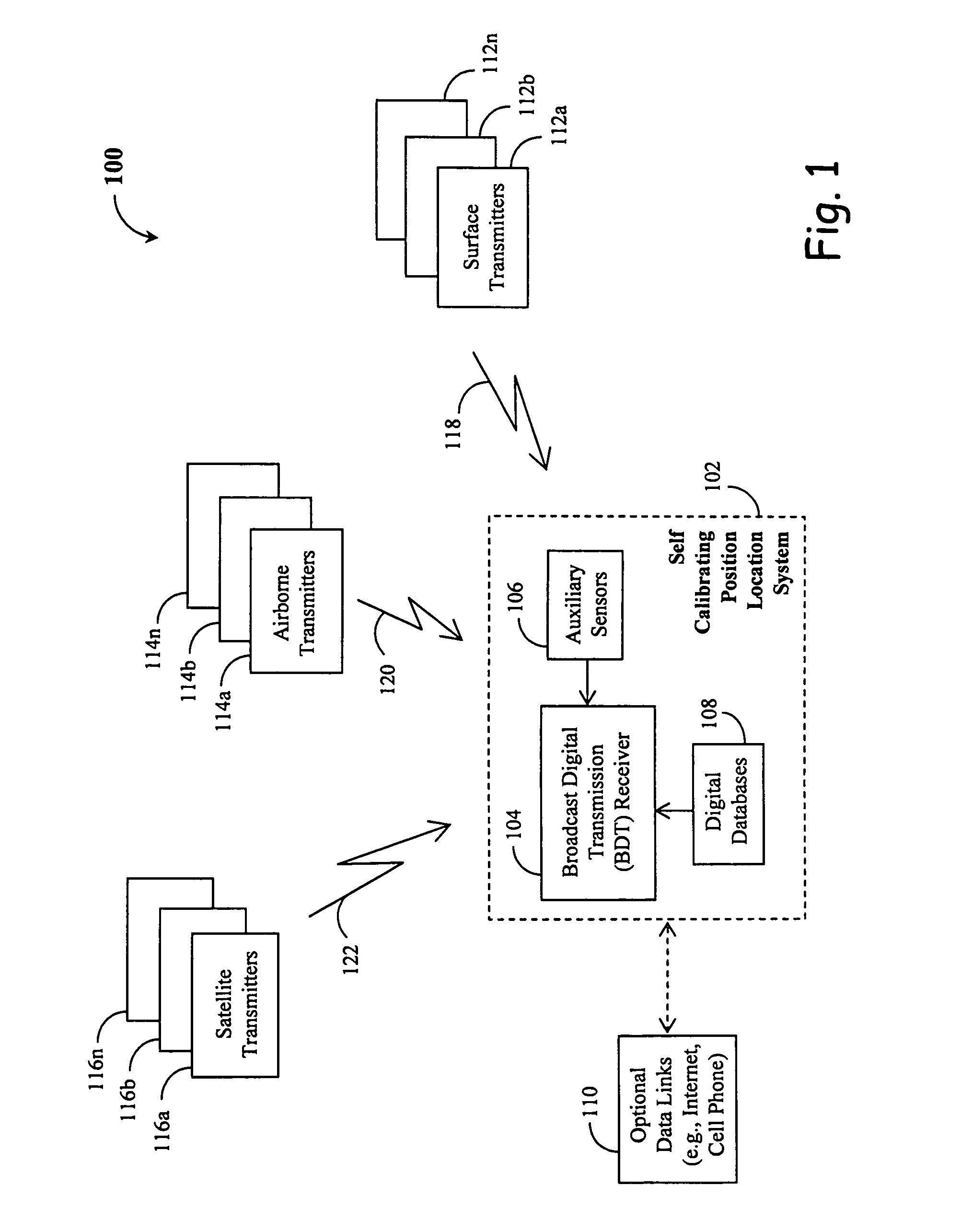
[0042]Referring to FIG. 1, an exemplary embodiment 100 of the present invention is sketched wherein a self-calibrating position location system 102 receives broadcast digital transmissions (BDT) 118, 120, and 122 from a plurality of transmitters. This includes surface transmitters 112a and 112b through 112n at known locations on the ground for instances. It may also include airborne transmitters 114a and 114b through 114n with their locations either embedded in digital transmissions or made available to a BDT receiver 104 by other means. Satellite transmitters 116a and 116b through 116n can be used in a similar manner. In a sense, GPS satellites fall into this category because a GPS satellite broadcasts its orbit and clock information within navigation messages modulated on the radio signal. More generally, surface transmitters do not need to be fixed on the ground for use in the present invention so long as their locations at time of broadcasting are precisely known to a BDT receiv...

exemplary embodiment 200

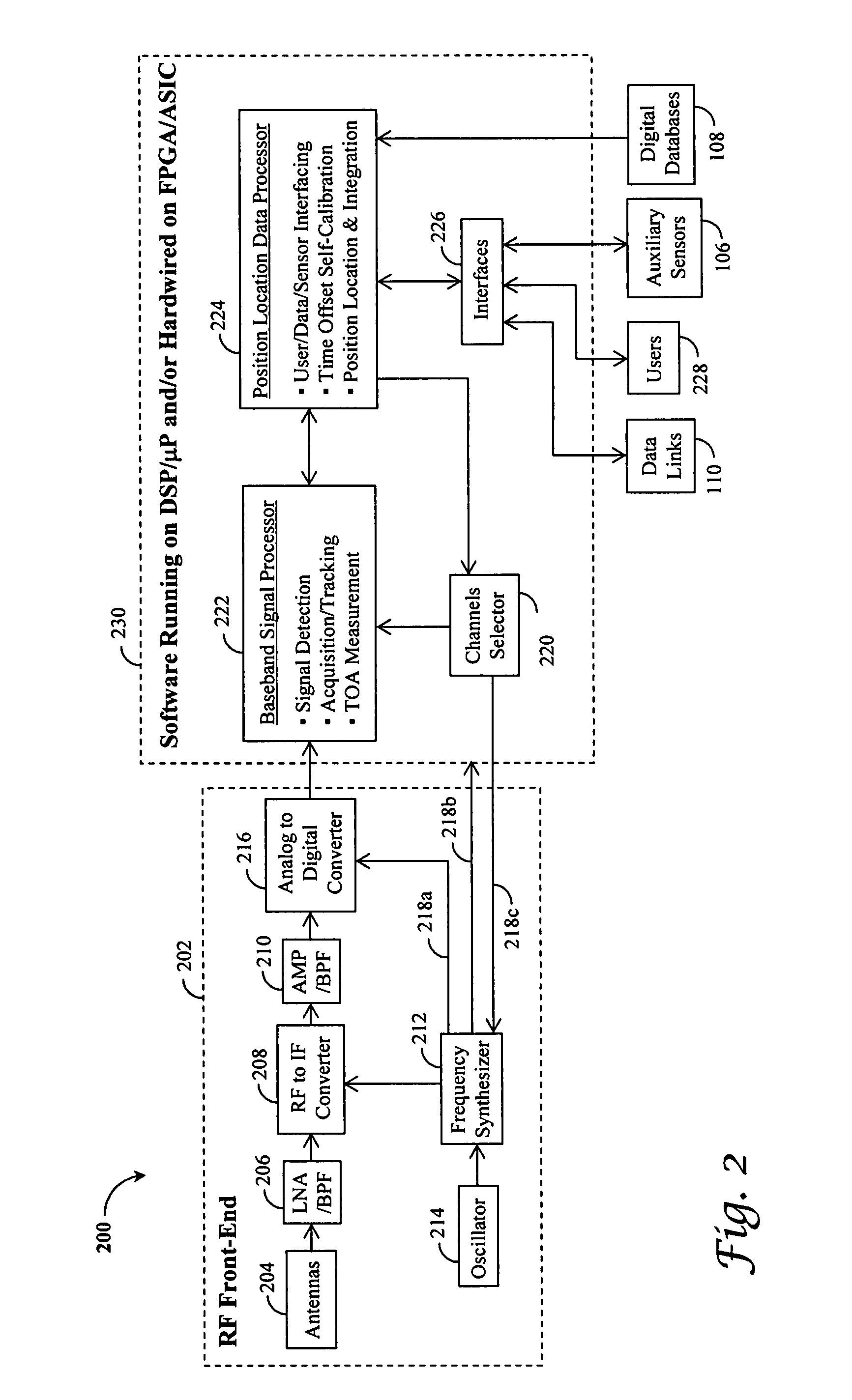
[0044]Referring to FIG. 2, an exemplary embodiment 200 of a broadcast digital transmission (BDT) receiver 104 is depicted with a radio frequency (RF) front-end 202 coupled to a receiver software 230 either running on a digital signal processor (DSP) / a microprocessor (μP) or hardwired on a field programmable gate array (FPGA) / an application-specific integrated circuit (ASIC) chip in accordance with the present invention. More specifically, antennas 204 intercept RF signals that come from a plurality of transmitters on the ground 112, in the air 114, and / or from the space 116. Captured signals are low-noise amplified (LNA) and bandpass-filtered (BPF) 206 and coupled to a RF to IF converter 208 with mixers. There may be several RF to IF conversion stages, each followed by an amplifier (AMP) / a bandpass filter (BPF) 210 in order to reach the desired gain and bandwidth while minimizing unwanted nonlinearity and interference effects. To drive a RF front-end 202, various frequency component...

the structure of the environmentally friendly knitted fabric provided by the present invention; figure 2 Flow chart of the yarn wrapping machine for environmentally friendly knitted fabrics and storage devices; image 3 Is the parameter map of the yarn covering machine
Login to View More

PUM

No PUM Login to View More

Abstract

A broadcast digital transmission (BDT) receiver, computer-readable media, and associated method for receiving and processing of BDT signals from a plurality of transmitters. A BDT receiver includes an antenna to intercept broadcast radio signals and an analog front-end to down-convert it to a suitable frequency for digitization. A baseband signal processor acquires and tracks designated codes in BDT signals using a generalized correlator to produce time of arrival measurements thereof. A data processor, coupled to the baseband signal processor and with input from an auxiliary sensor and a digital database, first calibrates time offsets of said transmitters relative to the BDT receiver's time base and then operates on offset-adjusted time of arrival measurements to produce a position solution.

Description

RELATED APPLICATIONS[0001]This application is a continuation-in-part of co-pending patent application Ser. No. 11 / 188,258, entitled, Global Navigation Satellite System (GNSS) Receivers Based On Satellite Signal Channel Impulse Response, filed Jul. 25, 2005.DOCUMENT DISCLOSURE REFERENCE[0002]This application claims priority of Disclosure Documents No. 583,936, filed Aug. 12, 2005, entitled, Generalized Frequency-Domain Correlator (GFDC) for Global Navigation Satellite System (GNSS) Receivers and No. 603,633, filed Jul. 17, 2006, entitled, Method and Device for Self Calibrated Relative Positioning with Synchronization Signals in Digital Wireless Transmissions.BACKGROUND OF THE INVENTION[0003]1. Field of the Invention[0004]The present invention relates generally to radio geolocation and particularly to self-calibrating receivers for position location using periodic codes in such broadcast digital transmissions as broadcast digital television (DTV) signals.[0005]2. Description of the Pr...

Claims

the structure of the environmentally friendly knitted fabric provided by the present invention; figure 2 Flow chart of the yarn wrapping machine for environmentally friendly knitted fabrics and storage devices; image 3 Is the parameter map of the yarn covering machine
Login to View More

Application Information

Patent Timeline
17 Jun 2008
Publication
US7388541B1
IPC
G01S3/02; G01S19/48; G01S5/02; G01S19/11
CPC
G01C21/206; G01S5/021; G01S5/0263
Inventors
YANG, CHUN