
Etchant, replenishment solution and method for producing copper wiring using the same
a replenishment solution and replenishment solution technology, applied in the field of etchant and replenishment solution for copper and copper alloys and a method for producing wirings, can solve the problem of dissolved copper beneath an etching resist and achieve the effect of reducing undercu
Active Publication Date: 2008-10-07
MEC CO LTD
View PDF22 Cites 8 Cited by
- Summary
- Abstract
- Description
- Claims
- Application Information
AI Technical Summary
Benefits of technology
The etchant effectively suppresses undercut, allowing for the formation of fine and dense wiring patterns with improved etching rates and stability, reducing the difference in widths between the top and base portions of the wiring, thus enhancing the yield of printed wiring boards.
Problems solved by technology
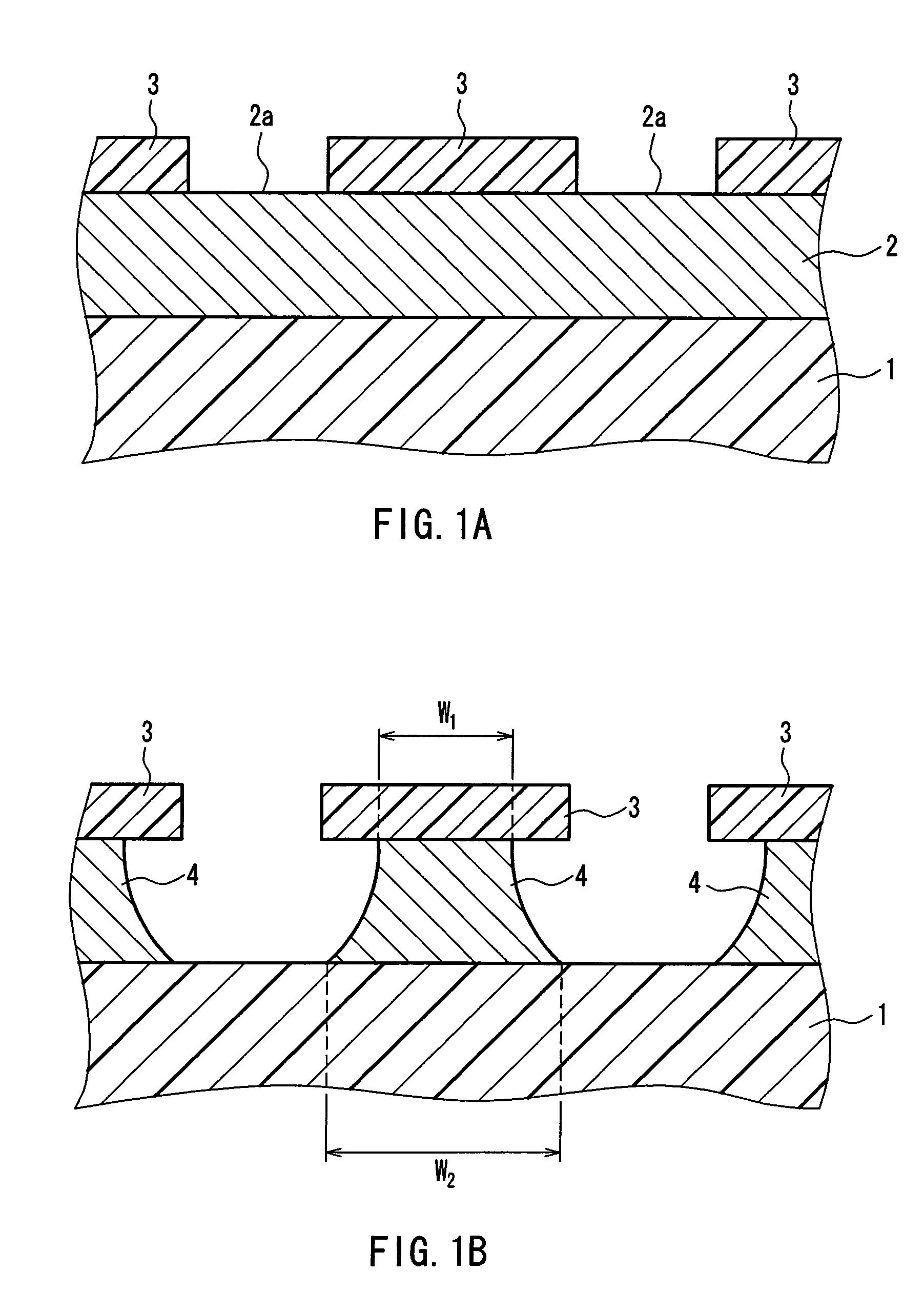
These etchants, however, have a problem called undercut in which copper beneath an etching resist is dissolved.
However, such a conventional etchant is insufficient for suppressing undercut in some cases, and therefore an etchant with an increased effect for suppressing undercut is required.
Method used
the structure of the environmentally friendly knitted fabric provided by the present invention; figure 2 Flow chart of the yarn wrapping machine for environmentally friendly knitted fabrics and storage devices; image 3 Is the parameter map of the yarn covering machine
View moreImage
Smart Image Click on the blue labels to locate them in the text.
Smart ImageViewing Examples

Examples
Experimental program
Comparison scheme
Effect test
examples
[0034]Hereinafter, the present invention will be described more specifically by way of examples. These examples are shown merely for illustrative purpose, and the present invention is not limited to these examples.
the structure of the environmentally friendly knitted fabric provided by the present invention; figure 2 Flow chart of the yarn wrapping machine for environmentally friendly knitted fabrics and storage devices; image 3 Is the parameter map of the yarn covering machine
Login to View More PUM
| Property | Measurement | Unit |
|---|---|---|
| concentration | aaaaa | aaaaa |
| concentration | aaaaa | aaaaa |
| concentration | aaaaa | aaaaa |
Login to View More
Abstract
An etchant for copper and copper alloys, includes an aqueous solution containing: 14 to 155 g / liter of cupric ion source in terms of a concentration of copper ions; 7 to 180 g / liter of hydrochloric acid; and 0.1 to 50 g / liter of azole, the azole including nitrogen atoms only as heteroatoms residing in a ring. A method for producing a wiring by etching of copper or copper alloys, includes the step of: etching a portion of a copper layer on an electrical insulative member that is not covered with an etching resist using the above-described etchant so as to form the wiring. Thereby, a fine and dense wiring pattern with reduced undercut can be formed.
Description
FIELD OF THE INVENTION[0001]The present invention relates to an etchant and a replenishment solution for copper and copper alloys and a method for producing wirings using the same.BACKGROUND OF THE INVENTION[0002]When a copper wiring is formed by photoetching in course of the manufacturing of a printed wiring board, iron chloride based etchants, copper chloride based etchants, alkaline etchants and the like are used for the etchant. These etchants, however, have a problem called undercut in which copper beneath an etching resist is dissolved. Particularly, in the case of a finer wiring pattern, the undercut should be minimized.[0003]Conventionally, an etchant for suppressing the undercut has been examined. For instance, JP 3387528 B proposes an aqueous solution containing: cupric chloride; hydrochloric acid; a 2-aminobenzothiazole based compound; polyethylene glycol and a polyamine compound.[0004]However, such a conventional etchant is insufficient for suppressing undercut in some c...
Claims
the structure of the environmentally friendly knitted fabric provided by the present invention; figure 2 Flow chart of the yarn wrapping machine for environmentally friendly knitted fabrics and storage devices; image 3 Is the parameter map of the yarn covering machine
Login to View More Application Information
Patent Timeline
 Login to View More
 Patent Type & AuthorityPatents(United States)
IPC IPC(8): C03C15/00C23F1/18H05K3/06
CPCC23F1/18H05K3/067H05K2203/124C09K13/04C23F1/02G03F7/00H05K3/0017
InventorTODA, KENJIMORINAGA, YUKARITESHIMA, TAKAHIROKURODA, AI
OwnerMEC CO LTD