Phosphite composition and method for producing the same
a technology of phosphite and composition, which is applied in the field of phosphite composition, can solve the problems of insufficient coloring resistance of thermoplastic resin composition, and achieve the effect of good coloring resistance to thermoplastic resin and easy dispersion
- Summary
- Abstract
- Description
- Claims
- Application Information
AI Technical Summary
Benefits of technology
Problems solved by technology
Method used
Image

Examples
example 1
Production Example of Granular Composition
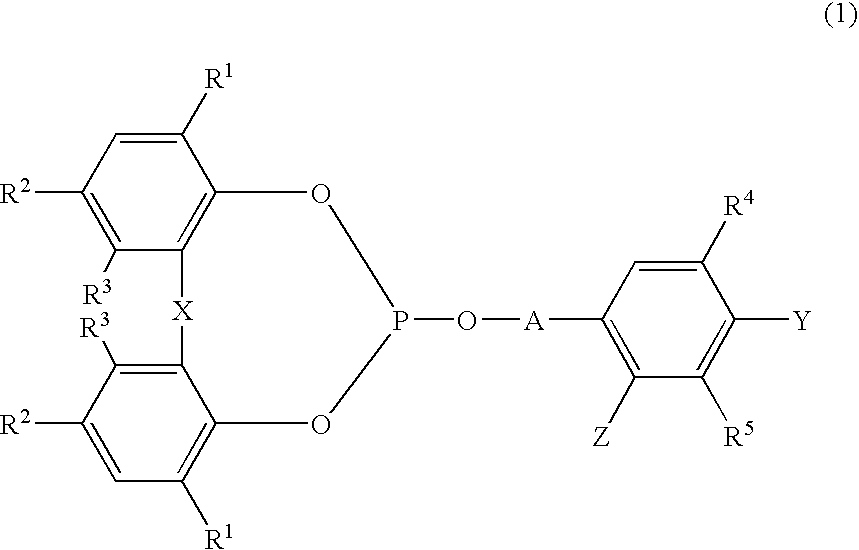
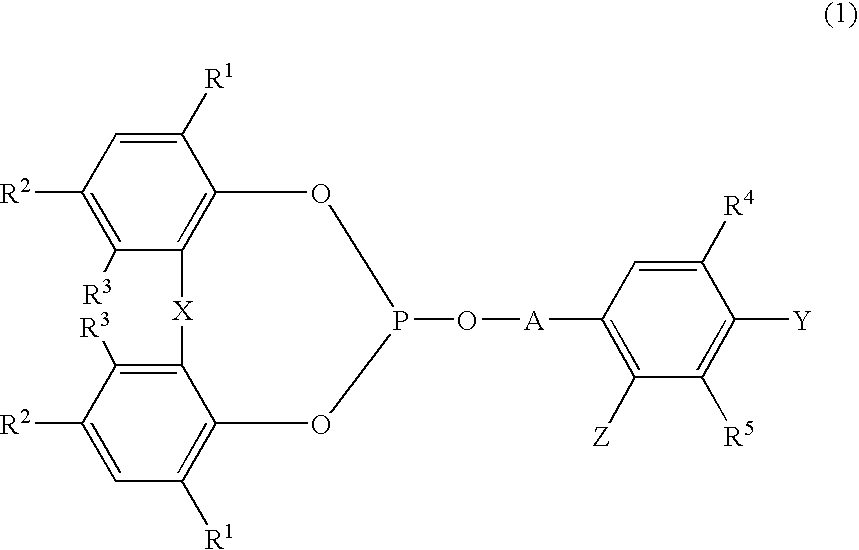
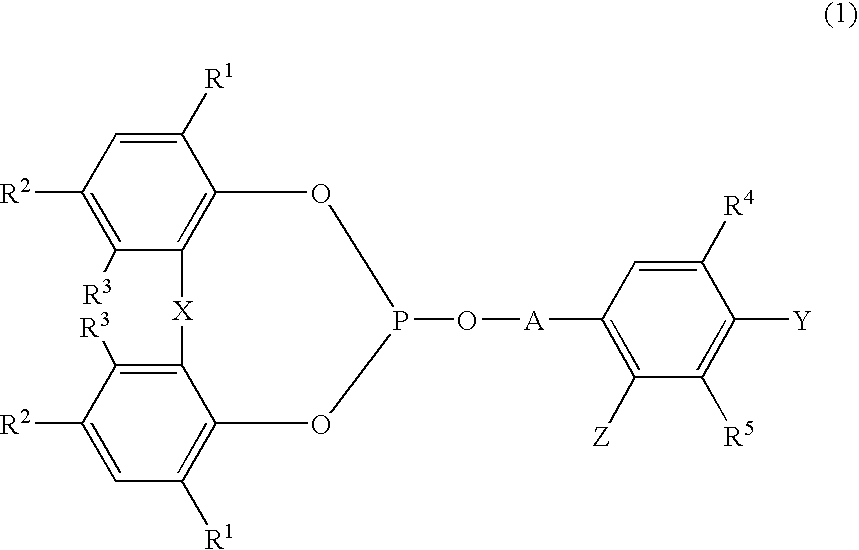
[0096]Into a mixing chamber of a Henschel mixer having a volume of 10 L which is equipped with a temperature sensor and a heated water jacket in the interior of the mixing chamber were placed 1 kg of the phosphite (1-1) and 50 g of the aliphatic hydrocarbon lubricant (2-1) as a binder. Subsequently, a liquid at 90° C. was passed through the heated water jacket, and high speed mixing was performed at a rotation number of 950 to conduct granulation. After 4 minutes and 20 seconds from the initiation of mixing, the temperature sensor in the interior of the mixing chamber indicated 84° C. (final temperature). Stirring was stopped, and 1 kg of a granular composition A was taken out from a discharge port.
example 5
Production of Polypropylene Composition and Coloring Resistance of Resulting Polypropylene Composition
[0102]One kilogram of polypropylene (MI: 3 g / 10 min), 0.5 g of calcium stearate and 1 g of the granular composition A were dry-blended, and extruded at an extrusion temperature of 230° C. with a 30 mmΦ uniaxial extruder to obtain a pellet. The pellet was injection-molded at 230° C. to obtain a sheet of polypropylene (40×60×1 mm). The coloring resistance (ΔYI) before and after exposure of the polypropylene sheet to 650 ppm of an NOx gas was 1.07.
Assessment Method of Coloring Resistance (ΔYI):
[0103]The polypropylene sheet was exposed to 650 ppm of an NOx gas at about 25° C. for 7 days. Yellowness indexes (YI) of the sheet before and after exposure were measured. The coloring resistance of the polypropylene composition was assessed by a difference (ΔYI) between YI after exposure and YI before exposure.
example 9
Production of Polyethylene Composition and Processing Stability of Resulting Polyethylene Composition
[0106]One kilogram of linear low density polyethylene (MI: 1 g / 10 min), 3 g of the granular composition A were dry-blended, and extruded at an extrusion temperature of 210° C. with a 30 mmΦ uniaxial extruder to obtain a pellet. The melt-mass flow rate (MFR) of the pellet was measured at 190° C. and under a load of 5 kg, and adopted as an initial MFR. The pellet was extruded repetitively three times at 250° C. Then, the MFR (190° C., 5 kg) of the pellet was measured to assess the processing stability of the polyethylene composition.
Assessment Method of Processing Stability (MFR (g / 10 min)):
[0107]JIS K 7210 (1976) (method A) was used at 190° C. and under a load of 5 kg.
PUM
| Property | Measurement | Unit |
|---|---|---|
| melting point | aaaaa | aaaaa |
| particle diameter | aaaaa | aaaaa |
| temperature | aaaaa | aaaaa |
Abstract
Description
Claims
Application Information
 Login to View More
 - R&D
- Intellectual Property
- Life Sciences
- Materials
- Tech Scout
- Unparalleled Data Quality
- Higher Quality Content
- 60% Fewer Hallucinations
Browse by: Latest US Patents, China's latest patents, Technical Efficacy Thesaurus, Application Domain, Technology Topic, Popular Technical Reports.
© 2025 PatSnap. All rights reserved.Legal|Privacy policy|Modern Slavery Act Transparency Statement|Sitemap|About US| Contact US: help@patsnap.com