Check patentability & draft patents in minutes with Patsnap Eureka AI!

Image deblurring using panchromatic pixels

a panchromatic pixel and image technology, applied in image enhancement, color signal processing circuits, instruments, etc., can solve the problems of insufficient light sensitivity of electronic image sensors, insufficient motion blur prevention of many image capture environments, and long exposure time, so as to achieve fewer ringing artifacts, reduce noise, and improve the effect of sharpness

Inactive Publication Date: 2012-06-19
MONUMENT PEAK VENTURES LLC
View PDF18 Cites 26 Cited by
  • Summary
  • Abstract
  • Description
  • Claims
  • Application Information

AI Technical Summary

Benefits of technology

[0034]This invention has the advantage that it produces deblurred images having a lower noise level than the sharp image, but having a higher sharpness level than the blurred image.
[0035]It has the additional advantage that it produces deblurred images having fewer ringing artifacts than prior art deblurring algorithms.
[0036]It has the further advantage that the sharp grayscale image will have a lower noise level than an image captured with the same exposure time using a conventional RGB image sensor due to the higher light sensitivity of the panchromatic pixels.

Problems solved by technology

This type of image blur is sometimes called “motion blur” or “smear.” Motion blur typically occurs when the light level in the image capture environment is dim, thus necessitating a long exposure time.
However, this is only effective when the subject is relatively close to the camera.
Additionally, many users find that flash photography provides a less satisfactory experience.
While much progress has been made in this area in recent years, the light sensitivity of currently available electronic image sensors is not high enough to prevent motion blur in many image capture environments.
One factor that reduces the light sensitivity of electronic image sensors is the use of color filters placed over the sensors to enable the formation of color images.
While this general approach is used today in most consumer digital cameras, the color filter array (CFA) has the undesirable effect of throwing away about ⅔ of the incident light, and therefore substantially reduces the photographic speed of the imaging system.
Although this system improves the light sensitivity over a single conventional image sensor, the overall complexity, size, and cost of the system is greater due to the need for two sensors and a beam splitter.
Furthermore, the beam splitter directs only half the light from the image to each sensor, limiting the improvement in photographic speed.
Blind deconvolution is an ill-posed problem, which is significantly more challenging.
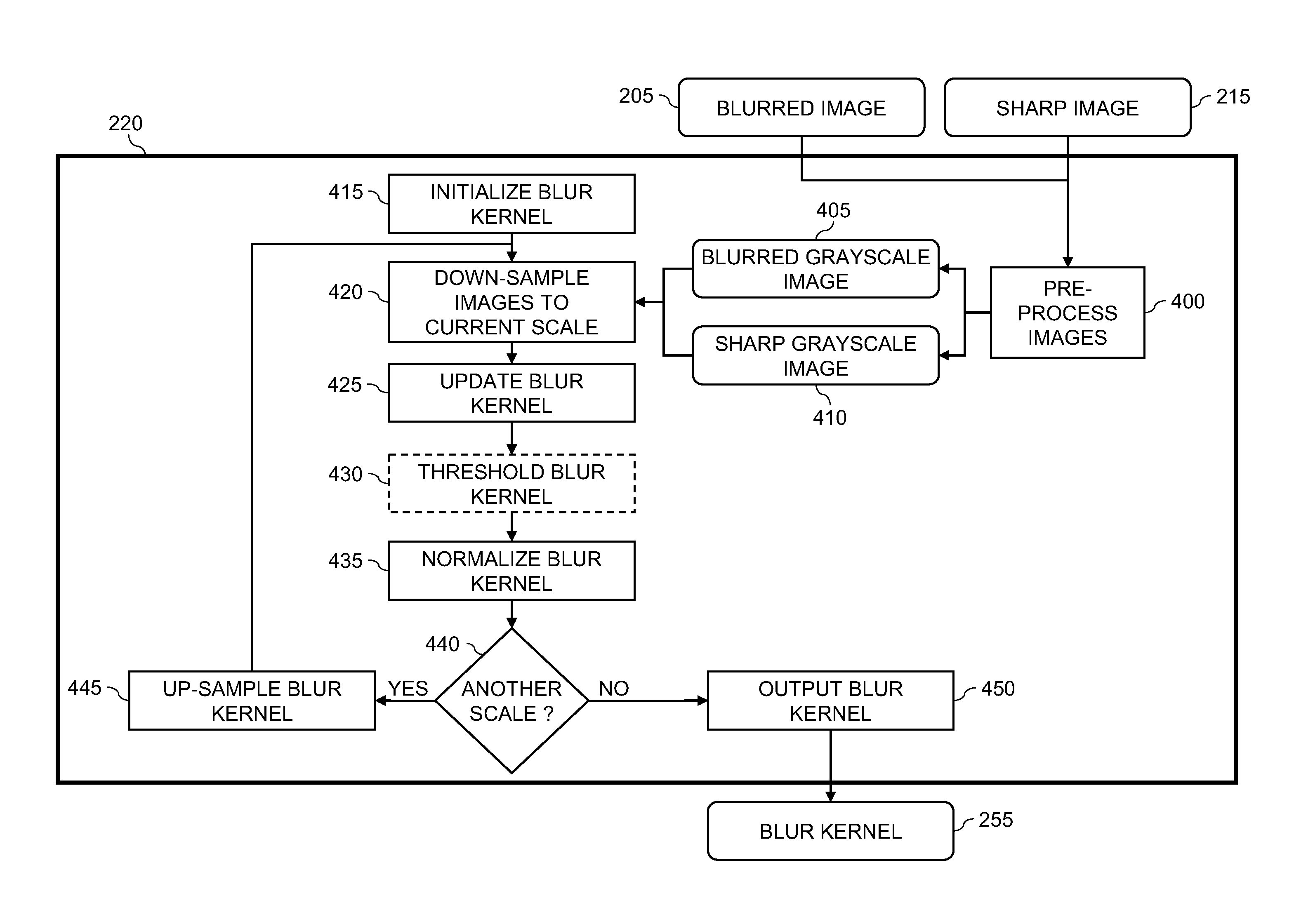
The most challenging problem is single-image blind deblurring, which requires the simultaneous estimation of the deblurred image and the Point Spread Function (PSF) associated with the image blur.
As a result, the corresponding deconvolution becomes a well-posed problem.
The noise associated with the short exposure time image can be severe under low light condition, and therefore the deblurring results are highly depend on the performance of a denoising operation.
This deblurring approach is limited to image blur caused by defocus.

Method used

the structure of the environmentally friendly knitted fabric provided by the present invention; figure 2 Flow chart of the yarn wrapping machine for environmentally friendly knitted fabrics and storage devices; image 3 Is the parameter map of the yarn covering machine
View more

Image

Smart Image Click on the blue labels to locate them in the text.
Viewing Examples
Smart Image
  • Image deblurring using panchromatic pixels
  • Image deblurring using panchromatic pixels
  • Image deblurring using panchromatic pixels

Examples

Experimental program
Comparison scheme
Effect test

Embodiment Construction

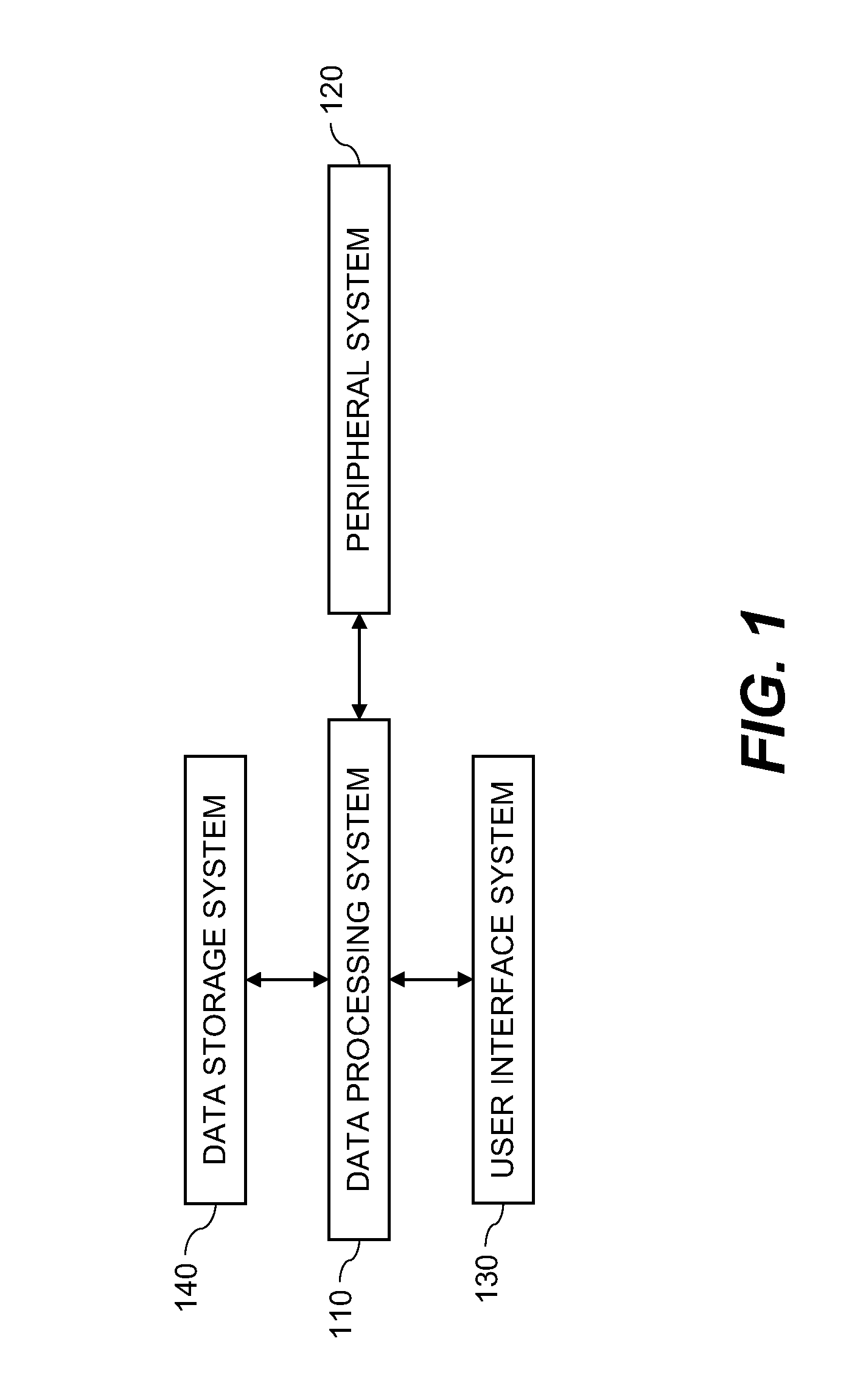
[0048]In the following description, some embodiments of the present invention will be described in terms that would ordinarily be implemented as software programs. Those skilled in the art will readily recognize that the equivalent of such software may also be constructed in hardware. Because image manipulation algorithms and systems are well known, the present description will be directed in particular to algorithms and systems forming part of, or cooperating more directly with, the method in accordance with the present invention. Other aspects of such algorithms and systems, together with hardware and software for producing and otherwise processing the image signals involved therewith, not specifically shown or described herein may be selected from such systems, algorithms, components, and elements known in the art. Given the system as described according to the invention in the following, software not specifically shown, suggested, or described herein that is useful for implement...

the structure of the environmentally friendly knitted fabric provided by the present invention; figure 2 Flow chart of the yarn wrapping machine for environmentally friendly knitted fabrics and storage devices; image 3 Is the parameter map of the yarn covering machine
Login to View More

PUM

No PUM Login to View More

Abstract

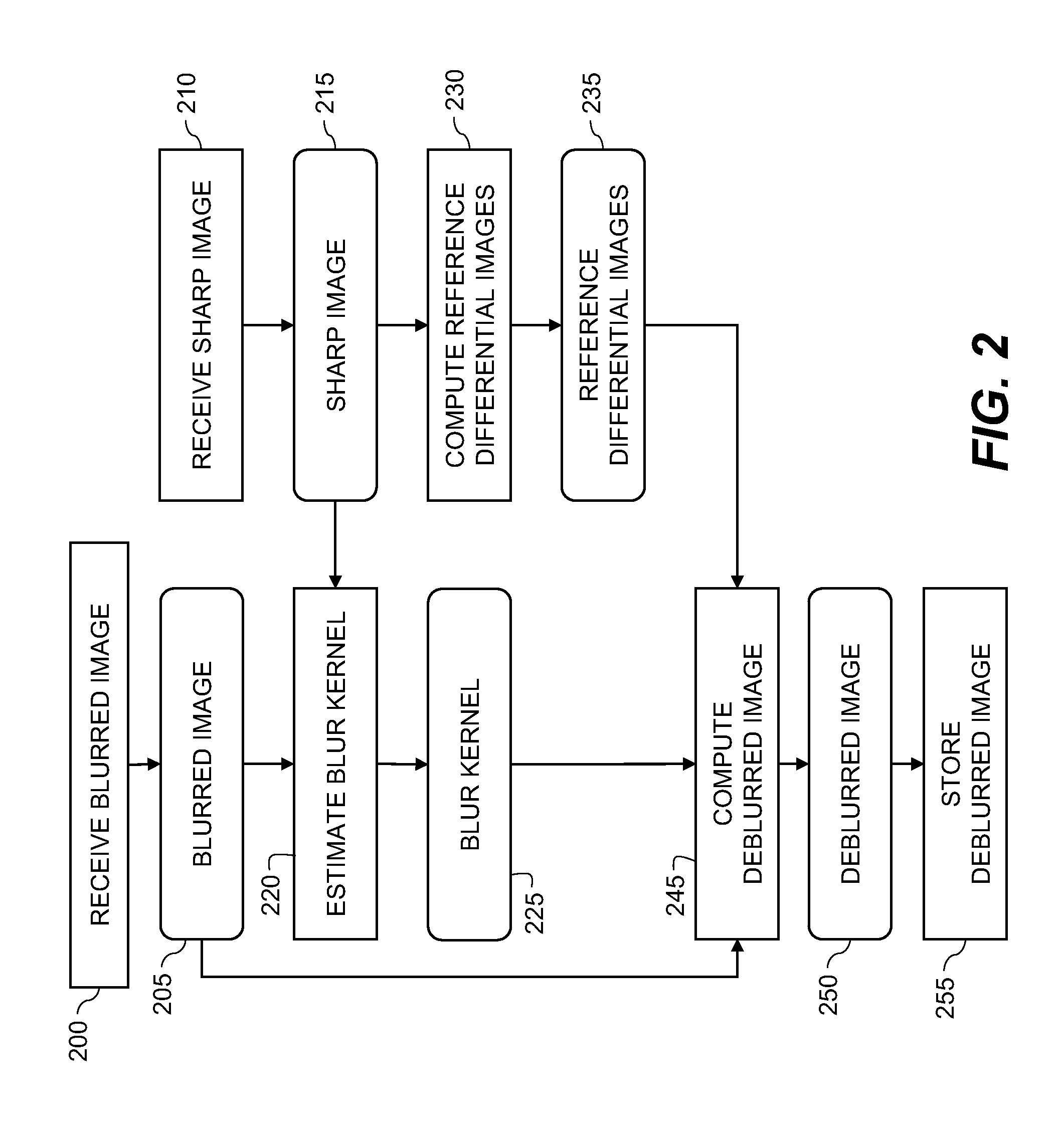
A method for determining a deblurred image from images captured using an image sensor comprising a two-dimensional array of light-sensitive pixels including panchromatic pixels and color pixels, the method comprising: receiving image sensor data from the image sensor for a sharp image of a scene captured with a short exposure time; receiving image sensor data from the image sensor for a blurred image of the scene captured with a longer exposure time than the sharp image; determining an interpolated sharp grayscale image from the sharp image; determining an interpolated blurred color image from the blurred image; determining an interpolated blurred grayscale image from the blurred image; determining a blur kernel responsive to the sharp grayscale image and the blurred grayscale image; determining a deblurred image responsive to the blurred color image and the blur kernel; and storing the deblurred image in a processor-accessible memory system.

Description

CROSS-REFERENCE TO RELATED APPLICATIONS[0001]Reference is made to, co-pending U.S. Patent Application Publication No. 2010 / 0232692, published Sep. 16, 2010, entitled: “CFA image with synthetic panchromatic image”, by Kumar, et al.; to U.S. Pat. No. 8,068,153, issued Nov. 29, 2011, entitled “Producing full-color image using CFA data” by Kumar et al.; to U.S. Pat. No. 8,045,024, issued Oct. 25, 2011, entitled “Producing full-color image with reduced motion blur” by Kumar et al.; to co-pending U.S. Patent Application Publication No. 2010 / 0302423, published Dec. 2, 2010, entitled “Four-channel color filter array pattern” by James E. Adams Jr., et al.; to co-pending U.S. Patent Application Publication No 2010 / 0302418, published Dec. 2, 2010, entitled “Four-channel color filter array interpolation” by James E. Adams Jr., et al. .; and to commonly assigned, co-pending U.S. Patent Application Publication 2011 / 0090352, published Apr. 21, 2011, entitled: “Image deblurring using a spatial imag...

Claims

the structure of the environmentally friendly knitted fabric provided by the present invention; figure 2 Flow chart of the yarn wrapping machine for environmentally friendly knitted fabrics and storage devices; image 3 Is the parameter map of the yarn covering machine
Login to View More

Application Information

Patent Timeline
no application Login to View More
Patent Type & Authority Patents(United States)
IPC IPC(8): G06K9/40H04N5/228
CPCG06T5/003G06T5/20G06T5/50H04N5/208H04N5/232H04N5/2355H04N9/045G06T2207/10024G06T2207/10144H04N23/741H04N23/843H04N25/133H04N25/135G06T5/73
Inventor WANG, SENTINGBO, HOUMILLER, RODNEY L.
Owner MONUMENT PEAK VENTURES LLC
Features
  • R&D
  • Intellectual Property
  • Life Sciences
  • Materials
  • Tech Scout
Why Patsnap Eureka
  • Unparalleled Data Quality
  • Higher Quality Content
  • 60% Fewer Hallucinations
Social media
Patsnap Eureka Blog
Learn More