Complex of ruthenium, method of production thereof and use thereof as (pre)catalysts of the metathesis reaction
a technology of ruthenium and complexes, which is applied in the direction of organic compounds/hydrides/coordination complexes, physical/chemical process catalysts, ruthenium organic compounds, etc., can solve the problems of difficult control of metal reaction, especially polymerization (romp, admet)
- Summary
- Abstract
- Description
- Claims
- Application Information
AI Technical Summary
Problems solved by technology
Method used
Image

Examples
example i
Production of a Compound with Formula 1a Generally (Scheme I) and Particularly of Compound 10a (Scheme II)
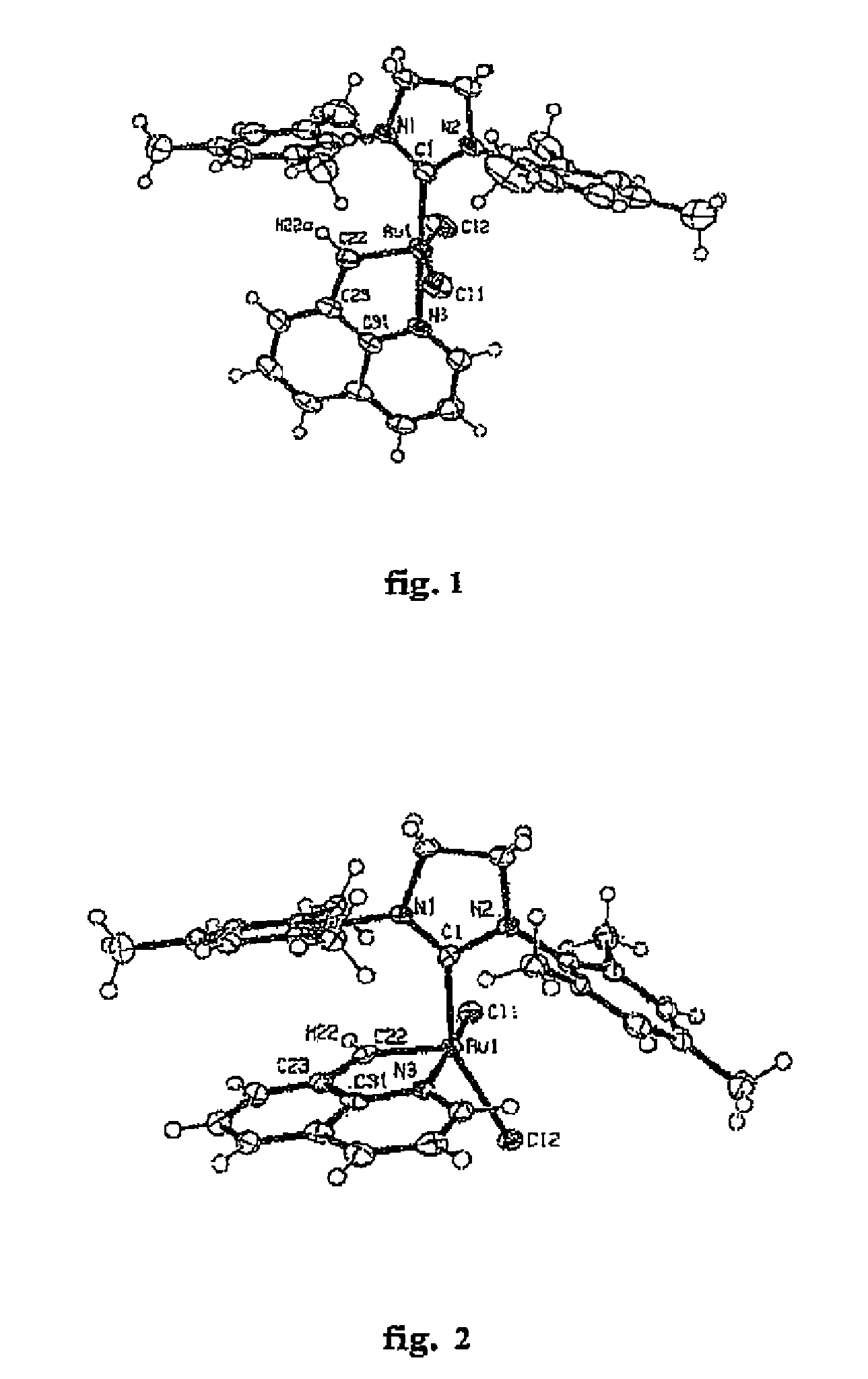
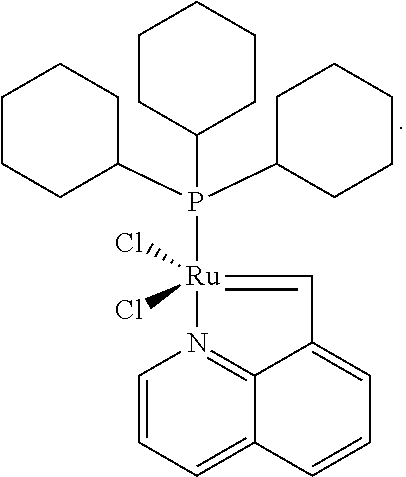
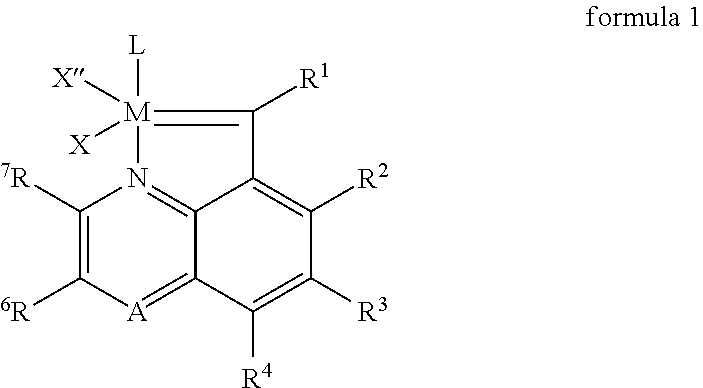
[0043]Using a protective atmosphere of argon, a Schlenk flask was charged with a solid carbene metal complex of formula 6, in which M denotes ruthenium, X and X′ denote chlorine, L denotes absence of a ligand, L1denotes tricyclohexylphosphine (PCy3), L2 is an NHC ligand with formula 9, in which B denotes an ethylene fragment (—CH2CH2—), R and R′ denote 2,4,6-trimethylphenyl, R8 hydrogen and R9 phenyl (so-called Grubbs second-generation catalyst, 102 mg, 0.12 mmol), anhydrous CuCI (13 mg, 0.12 mmol), and dry deoxidized CH2Cl2 (3 ml) was added. Then a solution of compound 5 was added, in which R1═R2═R3═R4═R5═R6═R7═H, and A denotes carbon, (20.5 mg, 0.132 mmol) in CH2Cl2 (3 ml). The suspension obtained was stirred at 40° C. for 20 min. From this moment all subsequent operations were performed in air, without the need to use the protective atmosphere of argon. The reaction mixture w...
example ii
Production of Compound 1b Generally (Scheme III) and Particularly of Compound 10b (Scheme IV)
[0044]Using a protective atmosphere of argon, a Schlenk flask was charged with a solid carbene complex of formula 6, in which M denotes ruthenium, X and X′ denote chlorine, L denotes absence of a ligand, L1 denotes tricyclohexylphosphine (PCy3), L2 is an NHC ligand with formula 9, in which B denotes a —CH2CH2—fragment, R and R′ denote 2,4,6-trimethylphenyl, R8 hydrogen and R9 phenyl (so-called Grubbs second-generation catalyst, 102 mg, 0.12 mmol), and dry deoxidized CH2Cl2 (3 ml) was added. Then a solution of compound 5 was added, in which R1═R2═R3═R4═R5═R6═R7═H, and A denotes nitrogen, (20.5 mg, 0.132 mmol) in CH2Cl2 (3 ml). The suspension obtained was stirred at 40° C. for 20 min and was then left unstirred at room temperature for 150 h. From this moment all subsequent operations were performed in air, without the need to use the protective atmosphere of argon. The reaction mixture was con...
example iii
Production of Compound 1b by Isomerization of 1a Generally (Scheme V) and Particularly of Compound 10b (Scheme VI)
[0046]Compound 10a (62 mg, 0.12 mmol) was dissolved in CH2Cl2 (1 ml). The solution was left in a dark place at room temperature for 3 days, in an argon atmosphere. After this time the solution was concentrated to dryness and washed with a mixture of solvents: ethyl acetate / n-pentane, and then methyl chloride / n-pentane. After drying, 10b was obtained as a dark green solid (48%, 30 mg). The product possesses analyses that tally with those obtained previously.
PUM
 Login to View More
 Abstract
Description
Claims
Application Information
 Login to View More