
4-(substituted anilino)-quinazoline derivatives useful as tyrosine kinase inhibitors
a technology of substituted anilino and quinazoline, which is applied in the field of medicinal chemistry, can solve the problems of interfering cell cycle, increasing the morbidity rate and mortality rate of tumors, and serious threatening the lives and quality of life of human beings
- Summary
- Abstract
- Description
- Claims
- Application Information
AI Technical Summary
Benefits of technology
Problems solved by technology
Method used
Image

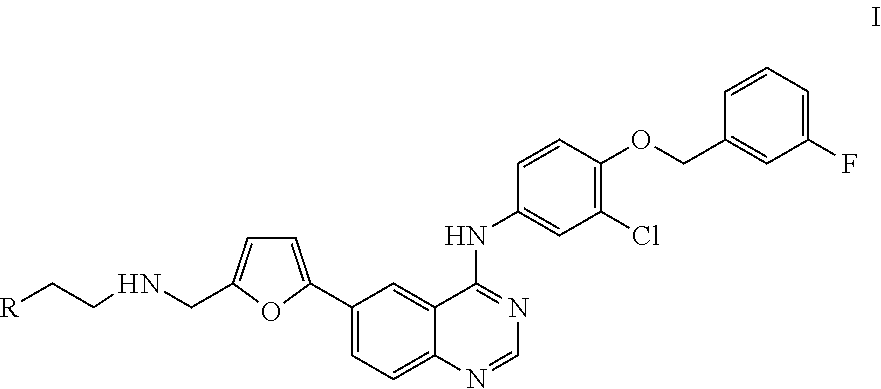
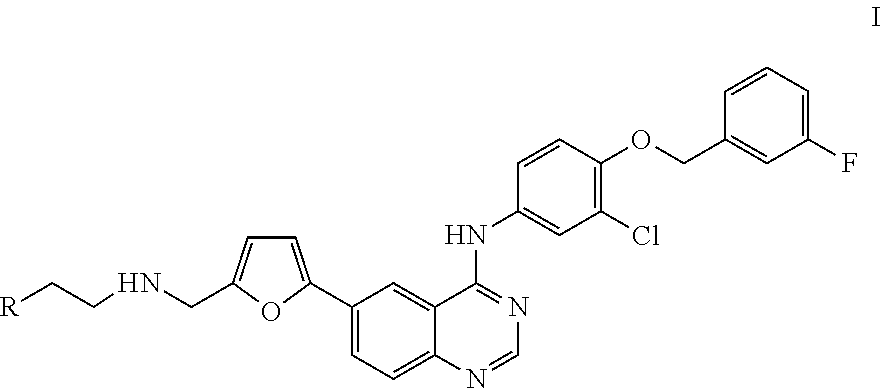
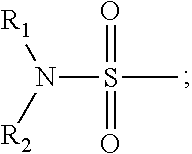
Examples
example 1
Synthesis of N-(4-(3-fluorobenzyloxy)-3-chlorophenyl)-6-(5-((2-(sulfamoyl)ethylamino)methyl)-2-furyl)-quinazolin-4-amine (Compound 1)
a. Synthesis of Amino-Cbz Protected Sodium Taurate
[0126]
[0127]25.0 g of taurine was dissolved in 200 ml of 1M NaOH solution, and a solution of carbobenzoxy chloride (CbzCl, 51 g) in dioxane and 300 ml of 1M sodium hydroxide solution were added dropwise simultaneously under vigorous agitation. Upon the end of the dropping, the mixture was stirred for 1 hour at room temperature, the water phase was extracted with ethyl acetate, and concentrated the reaction under a reduced pressure to obtain 46.1 g of white solid, yield 82%.
b. Synthesis of 2-benzyloxyformamidoethylsulfonyl chloride
[0128]
[0129]In a reaction flask, 20.0 g of amino-Cbz protected sodium taurate, SOCl2 (30 ml) and DMF 1 ml were added. The mixture was reacted under refluxing for 3 h, cooled to room temperature, filtrated, and distilled under a reduced pressure to remove the solvent to obtain 1...
example 2
Synthesis of N-(4-(3-fluorobenzyloxy)-3-chlorophenyl)-6-(5-((2-(methylsulfinyl)ethylamino)methyl)-2-furyl)-quinazolin-4-amine (Compound 2)
a. Synthesis of Boc Protected 2-mercaptoethylamine
[0141]
[0142]In a reaction flask, 35.3 g of ditertbutyl dicarbonate, 20.4 g of 2-mercaptoethylamine hydrochloride and 200 ml of dichloromethane were added. The mixture was added in batches with 25 ml of triethylamine under ice-bath condition, and was then stirred at room temperature overnight, added with an excessive amount of 0.5M hydrochloric acid solution for washing. The organic layer was washed with saturated sodium chloride solution, dried over anhydrous sodium sulfate, and distilled of the solvents to obtain 8 g of oily liquid, yield 87%.
b. Synthesis of Boc Protected 2-methylthioethylamine
[0143]
[0144]4.8 g of NaH was added in batches to the solution of 28 g Boc protected 2-mercaptoethylamine in anhydrous tetrahydrofuran (250 ml) under ice-bath and nitrogen-protection. The temperature was incr...
example 3
Synthesis of N-(4-(3-fluorobenzyloxy)-3-chlorophenyl)-6-(5-((2-(methylthio)ethylamino)methyl)-2-furyl)-quinazolin-4-amine (Compound 3)
[0153]
[0154]10.0 g of compound 5-(4-(4-(3-fluorobenzyloxy)-3-chloroanilino)-6-quinazolinyl)furan-2-formaldehyde was dissolved in the mixture of dichloromethane / methanol (3:1). The mixture was added with 4.3 g of triethylamine, stirred for 10 min, added with 6.9 g of 2-methylthioethylamine hydrochloride, and stirred at room temperature. Upon consumption of the starting materials detected by TLC, 2.4 g of sodium borohydride was added in batches under ice-bath. Upon the end of reaction detected by TLC, dichloromethane (q.s.) was added. The mixture was washed with saturated ammonium chloride and then with saturated sodium chloride, dried over anhydrous sodium sulfate, and subjected to a column chromatography to obtain 6.5 g of yellow solid, yield 56%.
[0155]1H-NM (600 MHz, DMSO-d6, δppm): 9.93 (s, 1H), 8.73 (s, 1H), 8.55 (s, 1H), 8.16 (d, 1H, J=2.4 Hz), 8....
PUM
| Property | Measurement | Unit |
|---|---|---|
| temperature | aaaaa | aaaaa |
| temperature | aaaaa | aaaaa |
| wavelength | aaaaa | aaaaa |
Abstract
Description
Claims
Application Information
 Login to View More