
Barium crown sealed glass and preparation and application thereof
A technology for sealing glass and glass, which is applied to lead-free sealing glass and its preparation and application fields, can solve the problems of poor chemical stability and electrical performance, cannot adapt to lead-free, and has no cost advantage, and achieves convenient operation. , the effect of low cost and excellent chemical stability
- Summary
- Abstract
- Description
- Claims
- Application Information
AI Technical Summary
Problems solved by technology
Method used
Image

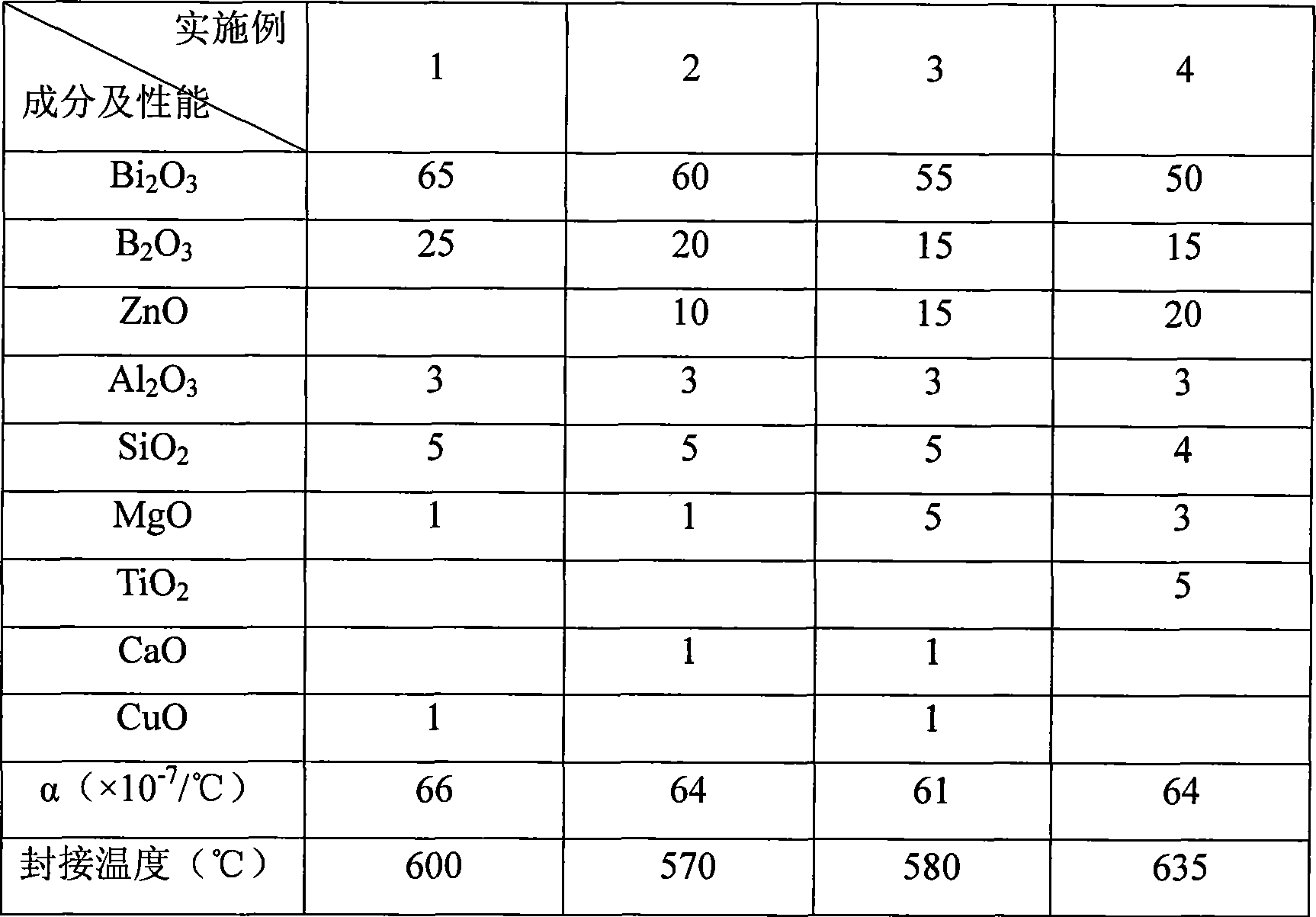
Examples
Embodiment 1
[0030] According to the weight percentage of the composition in Table 1, the ingredients are mixed evenly, the glass frit is put into a quartz crucible, and heated and melted in a silicon carbide rod electric furnace at a melting temperature of 1270°C and kept for 11 minutes.
[0031] The annealed sample is ground into a cylindrical sample of φ5×25mm for performance analysis: the coefficient of thermal expansion (α) is measured by a WRP-1 microcomputer thermal dilatometer, and the temperature rises from room temperature to 300°C with a heating rate of 5°C / min; The sealing temperature is obtained through a hemispherical experiment, and the test results are shown in Table 1.
[0032] The melted glass is poured into a tablet press to be pressed into tablets, and then it is ball-milled into powdered glass powder, and the sieved glass powder is packaged for use by users.
Embodiment 2
[0034] According to the weight percentage of the composition in Table 1 and mix evenly, put the glass frit into a quartz crucible, heat and melt in a silicon carbide rod electric furnace, the melting temperature is 1250°C, and keep warm...
[0035] The annealed sample was ground into a cylindrical sample with a size of φ5×25mm for performance analysis. The test results are shown in Table 1.
[0036] The melted glass is poured into a tablet press to be pressed into tablets, and then it is ball-milled into powdered glass powder, and the sieved glass powder is packaged for use by users.
Embodiment 3
[0038] According to the weight percentage of the composition in Table 1, the ingredients are mixed evenly, the glass frit is put into a quartz crucible, and heated and melted in a silicon carbide rod electric furnace at a melting temperature of 1230°C.
[0039] The annealed sample was ground into a cylindrical sample with a size of φ5×25mm for performance analysis. The test results are shown in Table 1.
[0040] The melted glass is poured into a tablet press to be pressed into tablets, and then it is ball-milled into powdered glass powder, and the sieved glass powder is packaged for use by users.
PUM
| Property | Measurement | Unit |
|---|---|---|
| transition temperature | aaaaa | aaaaa |
| sealing temperature | aaaaa | aaaaa |
| transition temperature | aaaaa | aaaaa |
Abstract
Description
Claims
Application Information
 Login to View More