This helps you quickly interpret patents by identifying the three key elements:
Problems solved by technology
Method used
Benefits of technology
Problems solved by technology
In this way, the bioavailability can be improved to a certain extent, but the Cmax value will also be high, resulting in side effects caused by high initial rapid release
That is, when the bioavailability becomes high, the initial rapid release becomes too high, and when the initial rapid release decreases, the bioavailability also becomes low
[0012] As mentioned above, the limitations of the existing technology for the preparation of controlled release microspheres are that the initial rapid release of the prepared microspheres is too high and the bioavailability is insufficient, which makes them unable to be applied to the preparation of exenatide-containing Controlled-release microspheres, because the controlled-release microspheres containing Exenatide are required to minimize side effects due to high initial rapid release, and also have improved bioavailability
Method used
the structure of the environmentally friendly knitted fabric provided by the present invention; figure 2 Flow chart of the yarn wrapping machine for environmentally friendly knitted fabrics and storage devices; image 3 Is the parameter map of the yarn covering machine
View more
Image
Smart Image Click on the blue labels to locate them in the text.
Viewing Examples
Smart Image
Click on the blue label to locate the original text in one second.
Reading with bidirectional positioning of images and text.
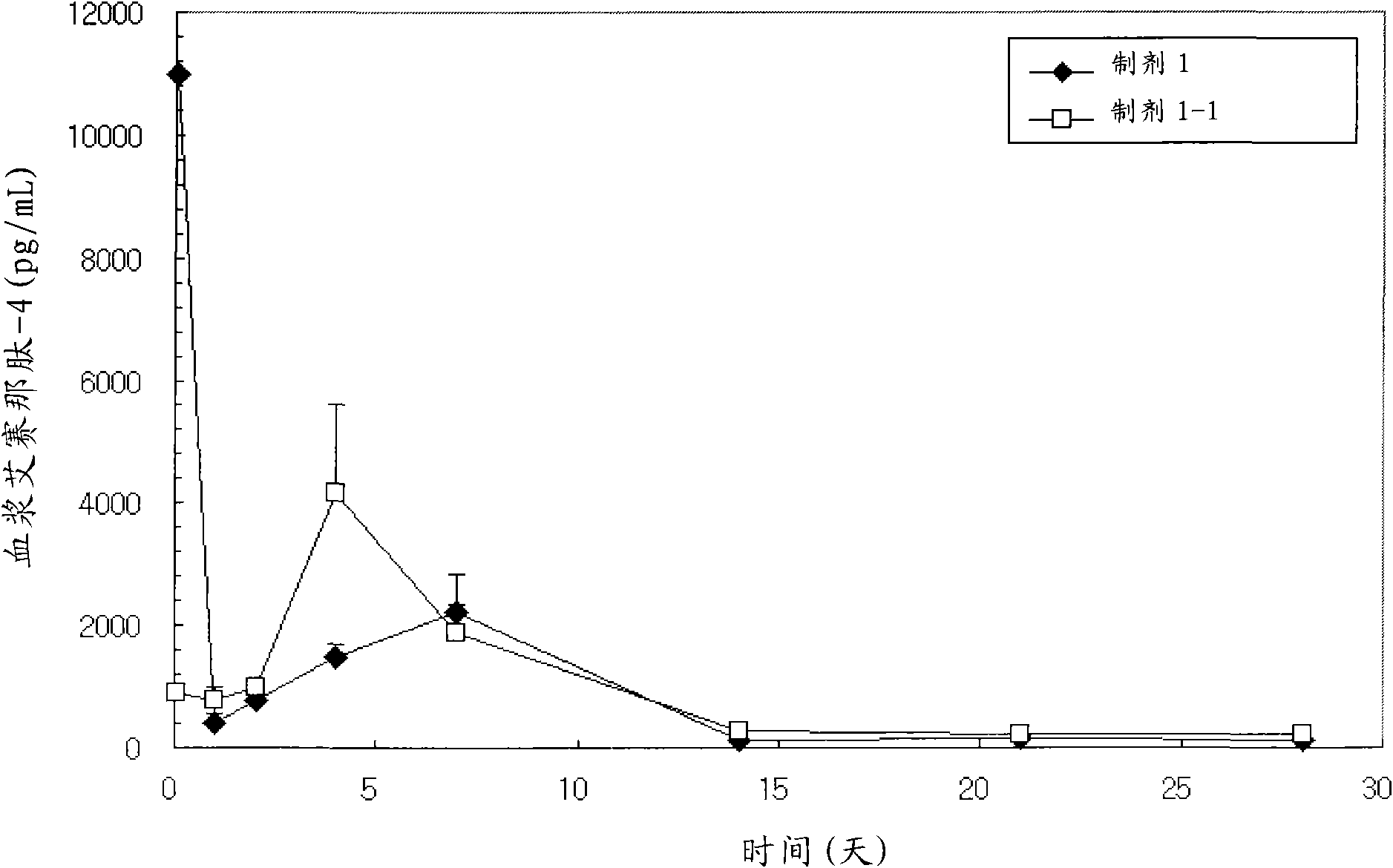
[0222] 4.850 g of biodegradable polymer RG502H (Lot No. 1009848, IV=0.19 dL / g) and 0.150 g of Exenatide-4 (Polypeptide Laboratories, USA) were uniformly dissolved in 97 mL of glacial acetic acid. The solution prepared using a piston pump at a flow rate of 1.5 mL / min was charged into a spray dryer (SODEVA, France) with an ultrasonic nozzle (Sono-tek, 120 kHz) while supplying dry air at 180 °C to prepare Microspheres. The prepared microspheres were suspended in 0.5M lysineaqueous solution (preparation 1-1), suspended in 0.01M lysineaqueous solution (preparation 1-2), suspended in 0.1M histidineaqueous solution (preparation 1-3) and suspended in 0.5M arginine aqueous solution (preparation 1-4), wherein the solution contains 1% (W / V) polyvinyl alcohol (polyvinyl alcohol , Gohsenol, EG-50) as a protective colloid, collected after stirring for 3 hours, washed with distilled water and then lyophilized. ...
Embodiment 2
[0223] depends on the effect of the composition of different polymers
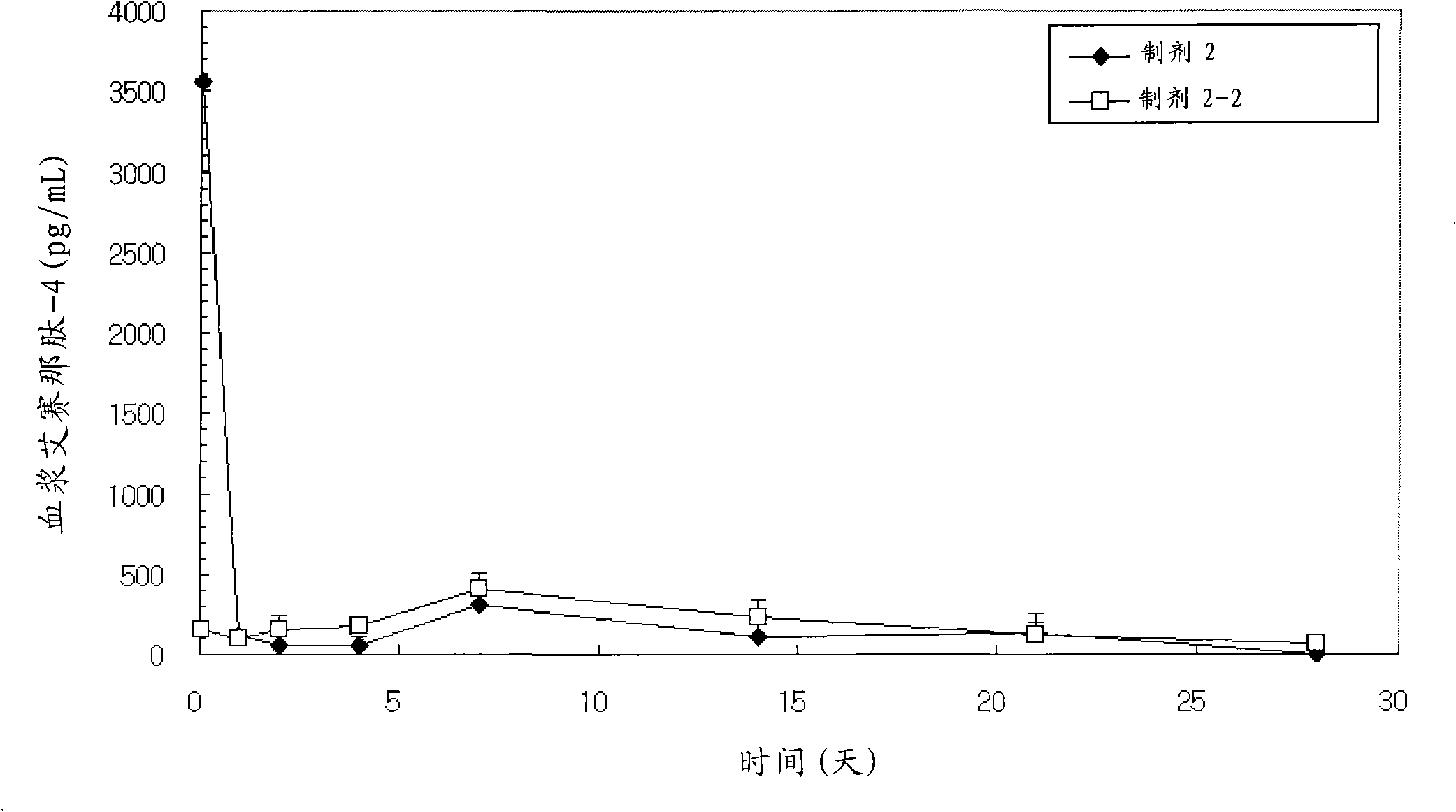
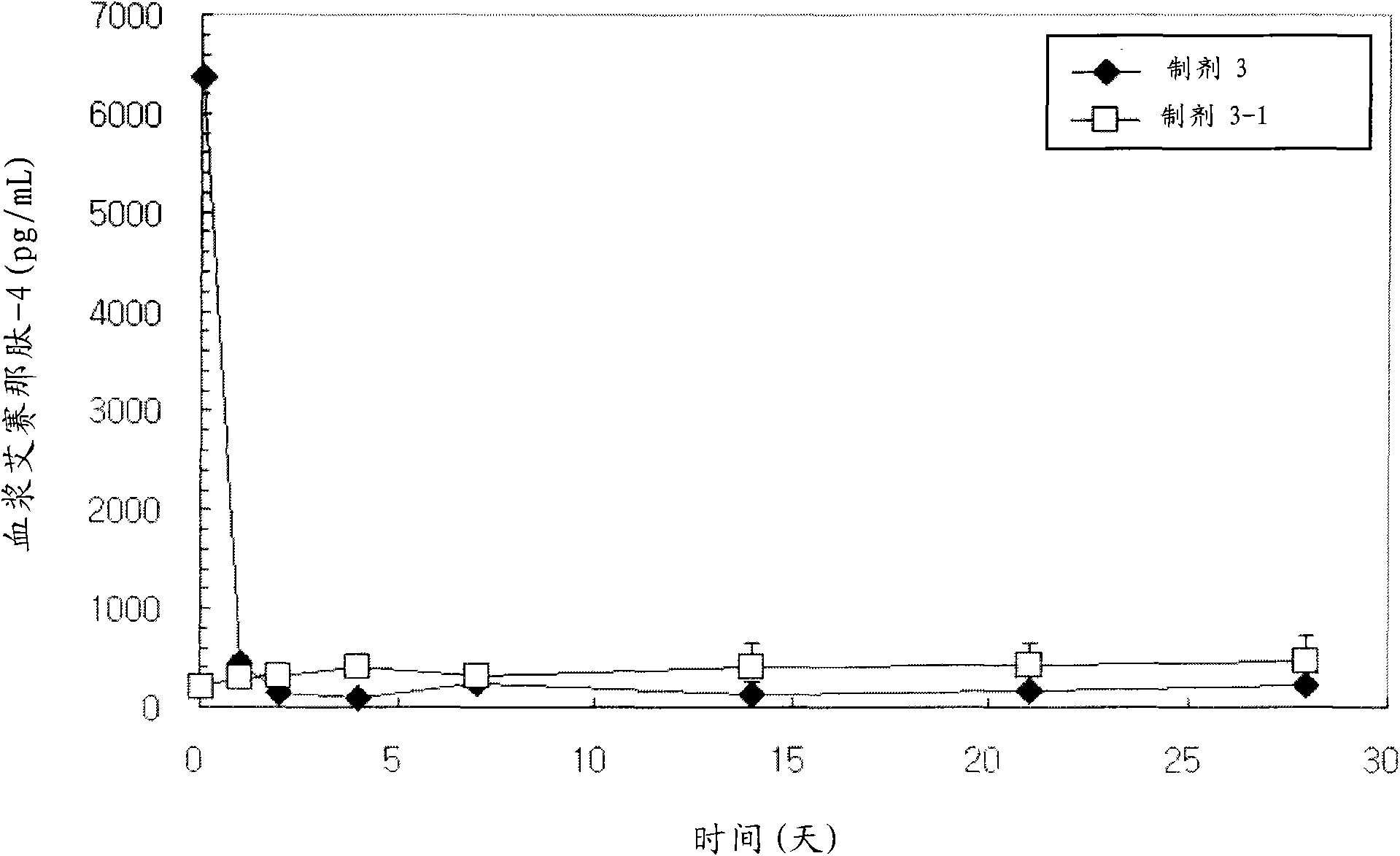
[0224] Exenatide-4-containing microspheres were prepared according to the same method as described in Example 1, the only difference being that the polymers used as biodegradable polymers were: RG503H (Lot No.1006370, IV=0.38 dL / g, formulations 2, 2-1 and 2-2), equal amounts of RG502H and RG503H (Lot No.1009848: Lot No.1006370=1:1, IV=0.29dL / g, formulations 3 and 3-1) Mixture, RG504H (Lot No. 1016605, IV = 0.51 dL / g, formulations 4 and 4-1), 5050DL2A (Lot No. LP-207, IV = 0.18 dL / g, formulations 5 and 5-1) and 5050DL 4A (Lot No. LP-206, IV=0.46 dL / g, formulations 6 and 6-1).
experiment Embodiment 1-1
[0225] Test the effect of microsphere coating layer
[0226] The content of Exenatide in the microspheres prepared in Examples 1 and 2 was quantitatively measured using the following method. Exenatide-4 (Polypeptide Laboratories, USA) was dissolved in DMSO (dimethyl sulfoxide), and diluted with DMSO to a concentration of 2, 5, and 10 μg / mL, respectively, the solution was used as a standard solution, and used A fluorescencephotometer (Cary Eclipse, Varian, USA) was used for fluorescence measurement at Ex 280nm and Em 350nm to obtain a measurement curve. The prepared microspheres were dissolved in DMSO to a concentration of 150 μg / mL, and then the fluorescence measurement was also performed, and the exenatide content in the microspheres was measured by extrapolation from the above measurement curve.
[0227] The content of the coating material used in the composition of the present invention, specifically, the content of lysine, arginine, histidine, etc. contained on the surf...
the structure of the environmentally friendly knitted fabric provided by the present invention; figure 2 Flow chart of the yarn wrapping machine for environmentally friendly knitted fabrics and storage devices; image 3 Is the parameter map of the yarn covering machine
Login to View More
PUM
Login to View More
Abstract
A controlled-release composition and controlled-release microspheres containing an exendin as an active ingredient, and a method of preparing the same are provided. More specifically, a controlled-release composition containing an exendin as an active ingredient, a biodegradable polymer with a specific viscosity, and coating materials, having high bioavailability and showing sustained release of the active ingredient in an effective concentration for a certain period without an excessive initial burst of the active ingredient; controlled-release microspheres containing a core including an exendin as an active ingredient and a biodegradable polymer, and a coating layer coating the core; and a method of preparing controlled-release microspheres including the steps of mixing an exendin, a biodegradable polymer, and a solvent, removing the solvent from the mixture to prepare hardened microspheres, and coating the hardened microspheres to form a coating layer on the surface of each microsphere, are provided.
Description
[0001] Cross-references to related applications [0002] This patent application claims priority based on Korean Patent Application No. 10-2007-0029586 filed on March 27, 2007, and the contents of this application are incorporated herein by reference in its entirety. technical field [0003] The invention relates to a controlled-release composition containing exenatide as an active ingredient, a controlled-release microsphere and a preparation method thereof. Background technique [0004] Exendin is a glucagon-like peptide 1 (GLP-1) agonist that acts as a GLP-1 hormonein vivo, and Exendin-4 interacts with GLP-1(7-36)NH 2 The amino acid sequence has 53% sequence homology (Goke, et al., J. Biol. Chem., 268: 19650-19655, 1993). [0005] GLP-1—a representative incretinhormone—is a peptide secreted by L cells in the intestine, which is secreted when food enters the digestive tract and lowers blood sugar levels by stimulating pancreatic beta cells to secrete insulin ( Orskov, ...
Claims
the structure of the environmentally friendly knitted fabric provided by the present invention; figure 2 Flow chart of the yarn wrapping machine for environmentally friendly knitted fabrics and storage devices; image 3 Is the parameter map of the yarn covering machine
Login to View More
Application Information
Patent Timeline
Application Date:The date an application was filed.
Publication Date:The date a patent or application was officially published.
First Publication Date:The earliest publication date of a patent with the same application number.
Issue Date:Publication date of the patent grant document.
PCT Entry Date:The Entry date of PCT National Phase.
Estimated Expiry Date:The statutory expiry date of a patent right according to the Patent Law, and it is the longest term of protection that the patent right can achieve without the termination of the patent right due to other reasons(Term extension factor has been taken into account ).
Invalid Date:Actual expiry date is based on effective date or publication date of legal transaction data of invalid patent.



 Login to View More
  Login to View More