
Preparation method of foam aluminium alloy wave-absorbing material
A foamed aluminum alloy and wave absorbing material technology, applied in the field of materials, can solve the problem that the wave absorbing performance needs to be further improved.
- Summary
- Abstract
- Description
- Claims
- Application Information
AI Technical Summary
Problems solved by technology
Method used
Image

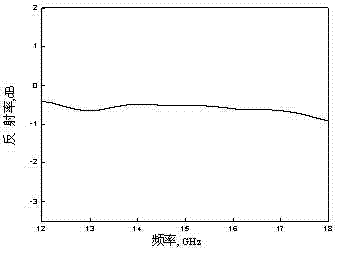
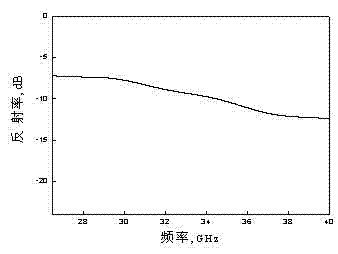
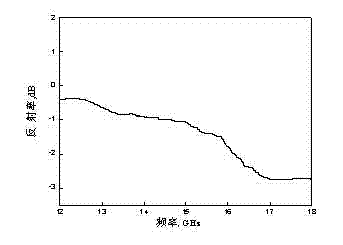
Examples
Embodiment 1
[0046] The coupling agent used is silane coupling agent KH-550;
[0047] The rare earth oxide used is cerium oxide;
[0048] The thinner that adopts is the mixed solution of n-butanol, xylene and propylene glycol methyl ether, and each material is n-butanol by volume ratio in the mixed solution: xylene: propylene glycol methyl ether=5: 3: 1;
[0049] The dispersant used is dispersant B401;
[0050] Add coupling agent to polyaniline, the amount of coupling agent is 2% of the total weight of polyaniline, with absolute ethanol as the medium, wet mix 20min with the speed of 200rpm in the ball mill; Then add rare earth oxide, rare earth oxide The addition amount is 1% of the total weight of polyaniline, and then the second wet mixing is carried out at a speed of 100 rpm in a ball mill for 8 hours; the material after the second wet mixing is dried to remove ethanol, and then dry mixed with a ball mill at a speed of 150 rpm for 4 hours to prepare into composite fillers;
[0051] A...
Embodiment 2
[0057] The coupling agent used is titanate coupling agent JN-115;
[0058] The rare earth oxide used is cerium oxide;
[0059] The thinner that adopts is the mixed solution of n-butanol, xylene and propylene glycol methyl ether, and each material is n-butanol by volume ratio in the mixed solution: xylene: propylene glycol methyl ether=6: 4: 1;
[0060] The dispersant used is dispersant B402;
[0061] Add coupling agent to polyaniline, the amount of coupling agent is 3% of the total weight of polyaniline, with absolute ethanol as medium, wet mixing 30min with the speed of 150rpm in ball mill; Then add rare earth oxide, rare earth oxide The amount of addition is 2% of the total weight of polyaniline, and then wet mixed for the second time in a ball mill at a speed of 200rpm for 4 hours; the material after the second wet mixed is dried to remove ethanol, and then dry mixed with a ball mill for 8 hours at a speed of 150rpm to prepare into composite fillers;
[0062] Add a coupl...
Embodiment 3
[0068] The coupling agent used is titanate coupling agent JN-108;
[0069] The rare earth oxide used is cerium oxide;
[0070] The diluent that adopts is the mixed solution of n-butanol, xylene and propylene glycol methyl ether, and each material is n-butanol by volume ratio in the mixed solution: xylene: propylene glycol methyl ether=5: 4: 1;
[0071] The dispersant used is dispersant CH-10S;
[0072] Add coupling agent in polyaniline, the amount of coupling agent is 4% of the total weight of polyaniline, take dehydrated alcohol as medium, wet mix 40min with the speed of 100rpm in ball mill; Then add rare earth oxide, rare earth oxide The addition amount is 5% of the total weight of polyaniline, and then wet mixed for the second time in a ball mill at a speed of 150rpm for 6 hours; the material after the second wet mixed is dried to remove ethanol, and then dry mixed with a ball mill for 6 hours at a speed of 150rpm to prepare into composite fillers;
[0073] Add a couplin...
PUM
| Property | Measurement | Unit |
|---|---|---|
| pore size | aaaaa | aaaaa |
Abstract
Description
Claims
Application Information
 Login to View More