Surface modification method for silicon quantum dots
A silicon quantum dot and surface modification technology, which is applied in the field of surface modification and modification of nanomaterials, can solve the problem of no carbon radical reaction modification of silicon quantum dots, etc., and achieve easy control of reaction conditions, short reaction time, and simple process Effect
- Summary
- Abstract
- Description
- Claims
- Application Information
AI Technical Summary
Problems solved by technology
Method used
Image

Examples
Embodiment 1
[0028] A method for modifying the surface of silicon quantum dots, comprising the steps of:
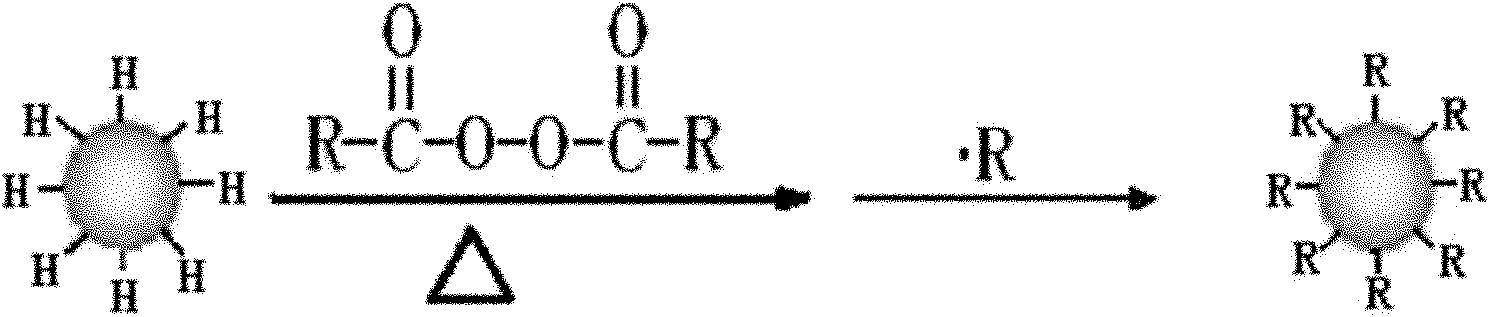
[0029] Weigh 3 mg of newly prepared silicon quantum dots and place them in a double-necked flask, add 150 mg of succinic acid peroxide and 3 ml of dichlorobenzene solution, stir and heat to 120 ° C under anhydrous and oxygen-free conditions, and after 10 minutes, put them in the flask A large number of bubbles overflowed, indicating that succinic anhydride peroxide decomposed to release carbon dioxide and CH 2 CH 2 COOH radical, .CH 2 CH 2 COOH radicals react rapidly with Si quantum dots to obtain water-soluble Si-(CH 2 CH 2 COOH)n, after continuing to react for 1 hour, the product after the reaction is transferred to a separatory funnel, pure water is added, extracted, and the functionalized water-soluble silicon quantum dots are transferred to the water phase; the silicon quantum dot aqueous solution is transferred to the dialysis bag, dialyzed in pure water for 24 hours to rem...
Embodiment 2
[0031] A method for modifying the surface of silicon quantum dots, comprising the steps of:
[0032] Weigh 3mg of silicon quantum dots newly prepared by electrochemical corrosion and place them in a two-necked flask, add 150mg of dibenzoyl peroxide and 3ml of dichlorobenzene solution, stir and heat to 120°C under anhydrous and oxygen-free conditions , after 10 minutes, a large number of bubbles overflowed from the flask, indicating that malonamide peroxide decomposed to release carbon dioxide and CH 2 CONH 2 free radical, CH 2 CONH 2 Rapid reaction between free radicals and silicon quantum dots to obtain water-soluble Si-(CH 2 CONH 2 ) n, after continuing to react for 1 hour, transfer the reacted product to a separatory funnel, add an appropriate amount of high-purity water for extraction, and transfer the functionalized water-soluble silicon quantum dots to the water phase. Transfer the aqueous solution of silicon quantum dots to a dialysis bag and dialyze in pure water ...
Embodiment 3
[0034] A method for modifying the surface of silicon quantum dots, comprising the steps of:
[0035] Weigh 3mg of newly prepared silicon quantum dots and place them in a double-necked flask, add 150mg of lauroyl peroxide and 3ml of toluene solution, stir and heat to 120°C under anhydrous and oxygen-free conditions, after 10 minutes, there are a lot of bubbles in the flask overflow, indicating that lauroyl peroxide decomposes to liberate carbon dioxide and .CH 3 (CH 2 ) 10 free radical, CH 3 (CH 2 ) 10 Free radicals react rapidly with Si quantum dots to obtain Si-(CH 3 (CH 2 ) 10 ) n, after continuing to react for 1 hour, wash with a high-speed centrifuge several times, and dry in vacuum to obtain hydrophobic silicon quantum dots.
PUM
 Login to View More
 Abstract
Description
Claims
Application Information
 Login to View More
 - R&D
- Intellectual Property
- Life Sciences
- Materials
- Tech Scout
- Unparalleled Data Quality
- Higher Quality Content
- 60% Fewer Hallucinations
Browse by: Latest US Patents, China's latest patents, Technical Efficacy Thesaurus, Application Domain, Technology Topic, Popular Technical Reports.
© 2025 PatSnap. All rights reserved.Legal|Privacy policy|Modern Slavery Act Transparency Statement|Sitemap|About US| Contact US: help@patsnap.com