
Low-roughness silicon wafer alkali corrosion process
A low-roughness, alkali-etching technology, applied in the field of low-roughness silicon wafer alkali-etching process, can solve problems such as the adverse effects of subsequent polishing and poor surface roughness of alkali-corrosion wafers, meet the requirements, speed up the corrosion rate, and improve the The effect of surface quality
- Summary
- Abstract
- Description
- Claims
- Application Information
AI Technical Summary
Problems solved by technology
Method used
Image

Examples
Embodiment 1
[0018] Embodiment 1: The following is a detailed description of the alkali corrosion process of a 5-inch 375 μm thick zone-melted silicon double-sided ground silicon wafer:
[0019] 1) Select a 5-inch P-doped zone-melted silicon abrasive sheet with a thickness of 375 μm as the object of implementation, with a resistivity of 10-30Ω·cm.
[0020] 2) Use solid KOH (analytical pure) and deionized water to prepare a 47.3% KOH aqueous solution in a high-pressure water bath.
[0021] 3) Set the preparation temperature to 120°C, turn on the heater switch, and raise the temperature to the preparation temperature.
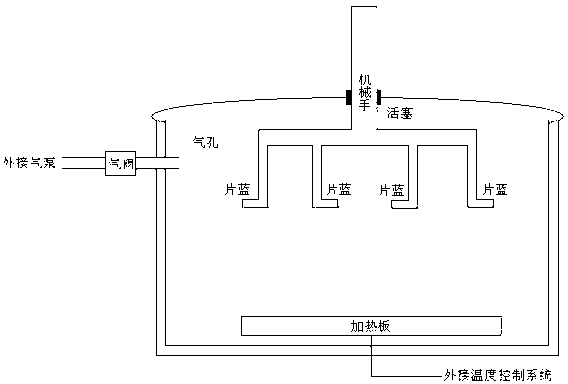
[0022] 4) Load the slices with abrasive slices into the manipulator of the high-pressure water bath, load 2 baskets of 50 slices at a time, and close the upper cover of the high-pressure water bath.
[0023] 5) Pressurize to 240Kpa; heat up to 153°C.
[0024] 6) The sinking manipulator dips the ingot into the corrosive solution, performs alkali corrosion for 3 minutes and 2...
Embodiment 2
[0039] Embodiment 2: The following is a detailed description of the alkali corrosion process of a 4-inch 410 μm thick zone-melted silicon double-sided ground silicon wafer:
[0040] 1) Select a 4-inch P-doped zone-fused silicon abrasive sheet with a thickness of 410 μm as the object of implementation, with a resistivity of 5-10Ω·cm.
[0041] 2) Use solid NaOH (analytical pure) and deionized water to prepare a 49.5% KOH aqueous solution in a high-pressure water bath.
[0042] 3) Set the preparation temperature to 120°C, turn on the heater switch, and raise the temperature to the preparation temperature.
[0043] 4) Load the flakes with abrasive flakes into the manipulator of the high-pressure water bath, load 2 baskets of 50 flakes at a time, and close the upper cover of the water bath.
[0044] 5) Pressurize to 250Kpa; heat up to 157°C.
[0045] 6) The sinking manipulator dips the ingot into the corrosive solution, carries out alkali corrosion for 2 minutes and 54 seconds, a...
PUM
 Login to View More
 Abstract
Description
Claims
Application Information
 Login to View More